Same pigment, same resin, same cure. Two panels leave the line indistinguishable, hang outdoors for two years, and come back different: one wipes clean, the other leaves a white smear on a thumb. The difference was decided before the powder met the gun — in where the platelets came to rest in the film. This page follows that decision from mix to panel, then asks what a weathering report can honestly settle.
Key takeaways
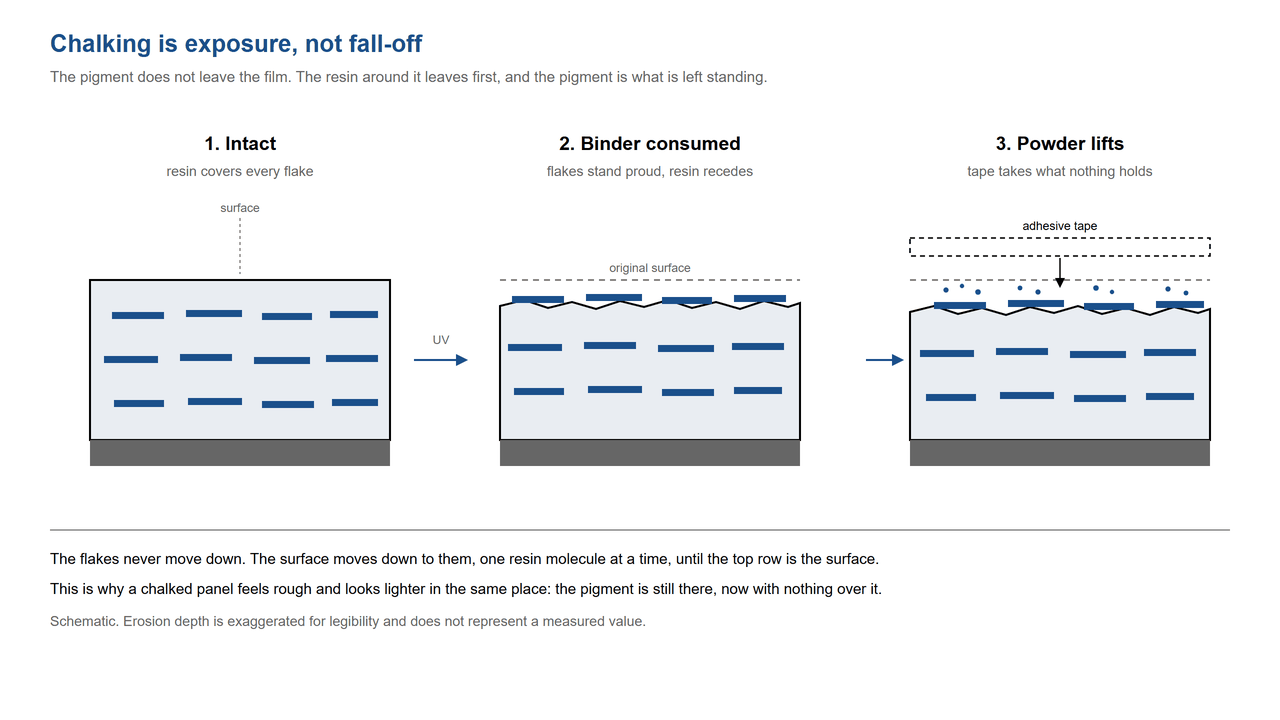
Chalking is a surface change — loose powder, still adherent, produced by the coating degrading. It is not pigment escaping the film.
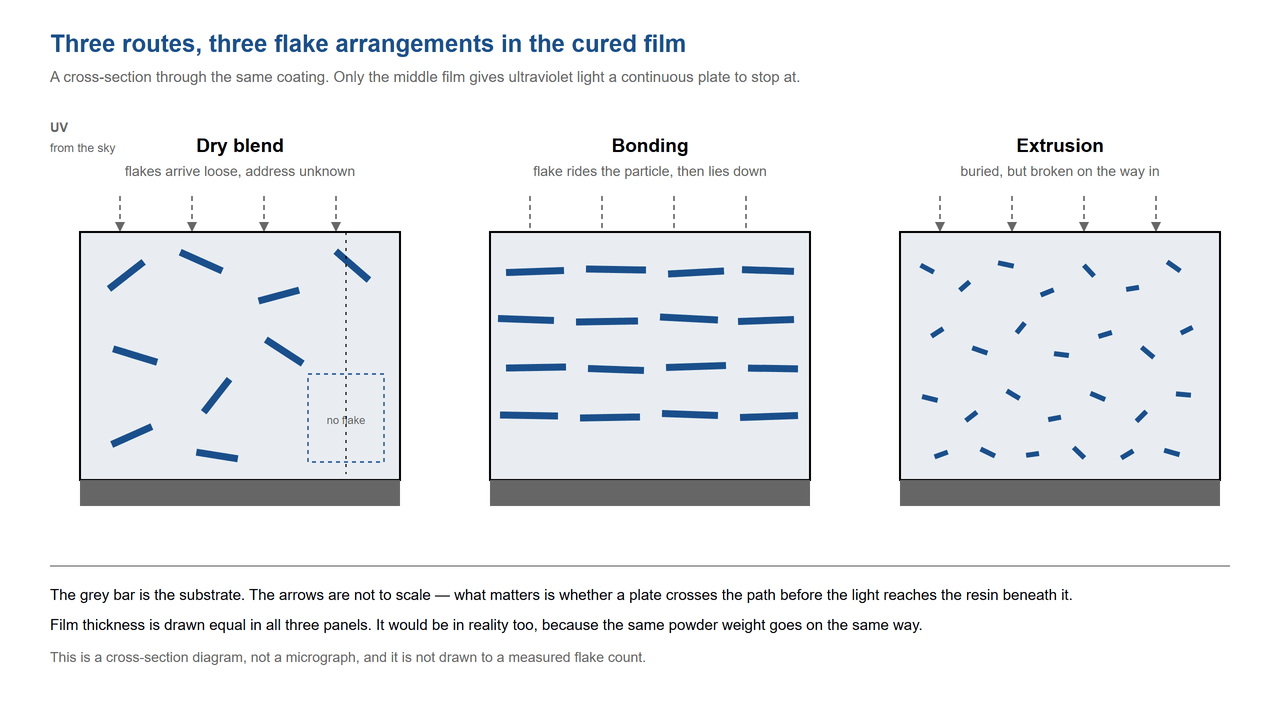
Dry blend, bonding and extrusion leave the same flake in three different positions inside a cured film.
Flake lying parallel to the surface makes ultraviolet light cross a barrier. Flake at random angles does not.
Tape lifts degraded binder off the panel. A visual rating cannot tell that powder apart from the dirt the atmosphere put there.
What moves between suppliers is the method behind a weathering number, not the number.
Why Do Two Panels of the Same Colour Chalk at Different Rates?
The standard that rates chalking defines the word before it grades anything: a surface change in the form of loose adherent powder produced by coating degradation [1]. Read that twice. The white on a thumb is not pigment that fell out of the film. It is pigment that stayed while the resin around it was consumed, so the particles now stand proud of the surface with nothing left to bind them.
The definition also settles the order of events. Chalking and colour fade are a binder problem before they are a pigment problem: the resin goes first and the pigment is merely uncovered. Two panels built to the same formulation should therefore fail at the same rate. They do not. Something in the film shields part of the resin and leaves the rest exposed, and in a coating loaded with flat platelets that something is not evenly spread.
When a customer brings this in, grade, resin and cure are already fixed. Set those equal and one variable remains: where the platelets ended up in the film. The pigment does not choose that position. The route the powder took to the gun does.
Where the Flake Ends Up Is Settled Before the Film Cures
A powder coating is a pile of dry resin particles, with pigment travelling alongside as a separate solid. The flake leaves the gun in one of three states — loose, attached or buried — and that state is the one it keeps, because once the film flows and gels, the flake stops moving.
Loose flake has no fixed address in the film
In a dry blend the pigment sits between the resin particles, held there by nothing but mixing. It is also the route where pigment and powder separate in the electrostatic field, because the two charge differently. The consequence is spatial. A film built from a blend has regions where flake is dense and regions where it is nearly absent, and the absent regions are bare resin with a clear path to the sky.
Bonded flake lies down as the film flows
Bonding warms the powder until the particle surface softens and the flake sticks to it. The flake then arrives attached to a particle instead of floating free. A 2005 study of aluminium flake in powder coatings found that the longer the bonding step runs, the more the platelets come to lie parallel to the coating surface [2]. Read that narrowly: it reports orientation, not durability, and no service life is borrowed from it here.
Extruded flake is already broken before it reaches the panel
Extrusion puts the pigment inside the particle. That ends the separation problem and starts a different one. The platelet is broken in the extruder and broken again in the mill, and the gloss loss that follows is why the industry moved away from extrusion for effect pigments [3]. A broken flake has no continuous plane left to offer. It colours the film and does nothing else.
If the open question is the substrate rather than the route, the trade-offs between borosilicate glass and mica as a substrate are set out separately, and the glass flake range is the same geometry taken to its limit.
Coatings have used flat fillers as barriers for a long time — glass flake and micaceous iron oxide are the familiar cases — on the reasoning that overlapping plates lengthen the path water and oxygen must travel to reach the substrate. Parallel flake interrupts the ultraviolet path as well, which is what decides how quickly the resin underneath is consumed. The same geometry runs the optics: platelets lying flat return light as one sheet of pearl, platelets at random scatter it and the depth leaves the colour.
None of that is a finding of ours. It is why those fillers are sold, and nobody has to take it from us.
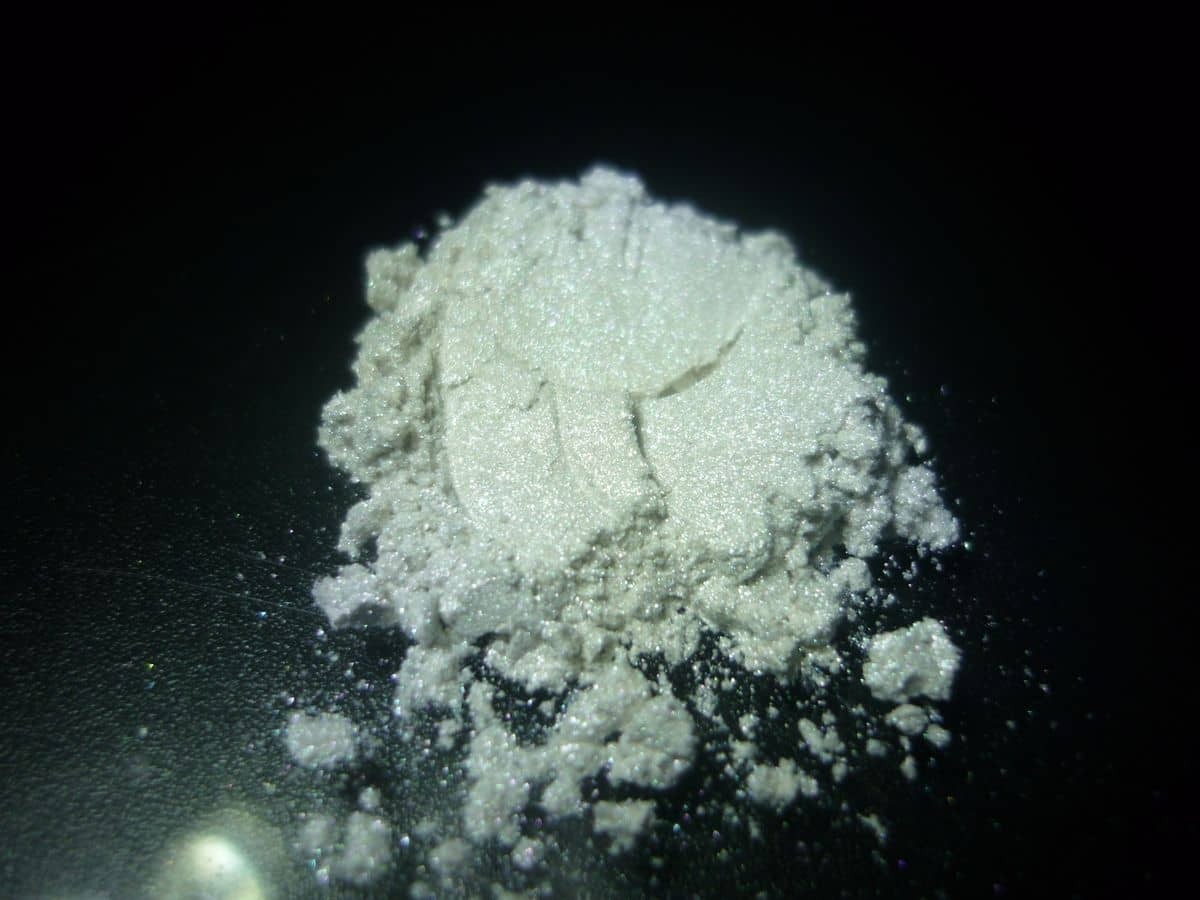
A pearl grade as supplied, before it goes into a powder line. What survives weathering is decided by where these platelets end up in the film.
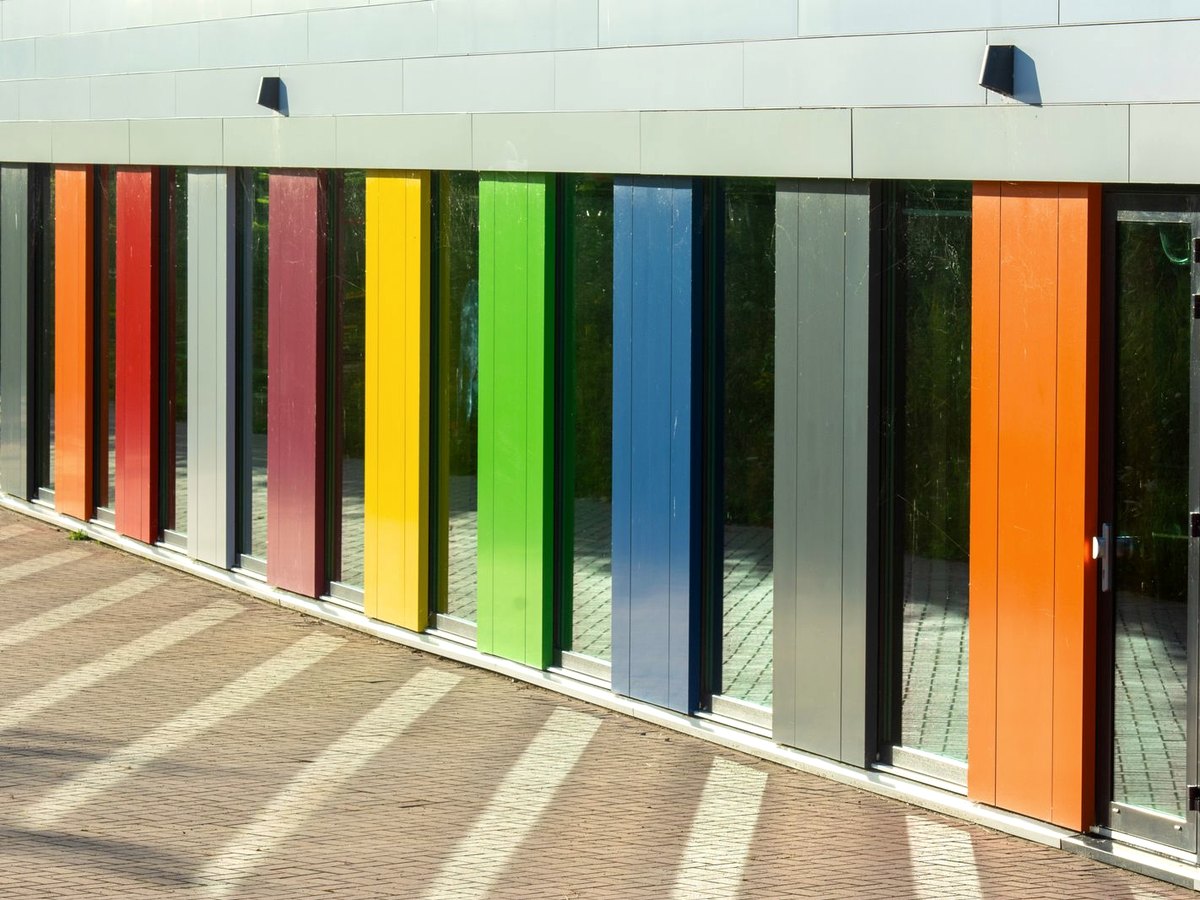
Powder coated aluminium panels on an outdoor facade. The faces that take the most sun are where gloss loss shows first.
The Pigment Is a Barrier and a Reactant at the Same Time
Everything above treats the flake as geometry, which is half the story. Pigment also takes part in the weathering chemistry, and that is not a new observation. In 1940 two separate teams published papers under the same title on the chalking of exterior finishes pigmented with titanium dioxide [4]. The mechanism is better characterised now; the problem was never one formulator's mistake.
So the flake works in two directions at once. Lying parallel to the surface it interrupts the ultraviolet path and slows the attack on the resin beneath it. As a particle with an active surface it joins that attack. Which of the two dominates is not a property of the pigment on its own. It depends on the grade, on the resin it sits in, and on how much of it stands exposed at the surface — which puts the argument back on placement.
| Route |
Flake arrives as |
Orientation control |
What the film loses first outdoors |
| Dry blend |
Free flake sitting between resin particles |
None. Flow and field decide |
Evenness. Chalking appears in patches long before it appears everywhere |
| Bonding |
Flake attached to the particle surface |
High. Platelets lie parallel as the film flows [2] |
Gloss, and it goes across the whole panel rather than in patches |
| Extrusion |
Broken flake inside the particle |
Not applicable. No intact platelet survives |
Depth of effect. The barrier was gone before the film had cured |
The right-hand column is our reading of the geometry, not a measured result, and it belongs beside a real exposure rather than in place of one. Its use is narrow: it tells you which question to ask first when a panel comes back from the field.
What Does a Weathering Report Actually Prove?
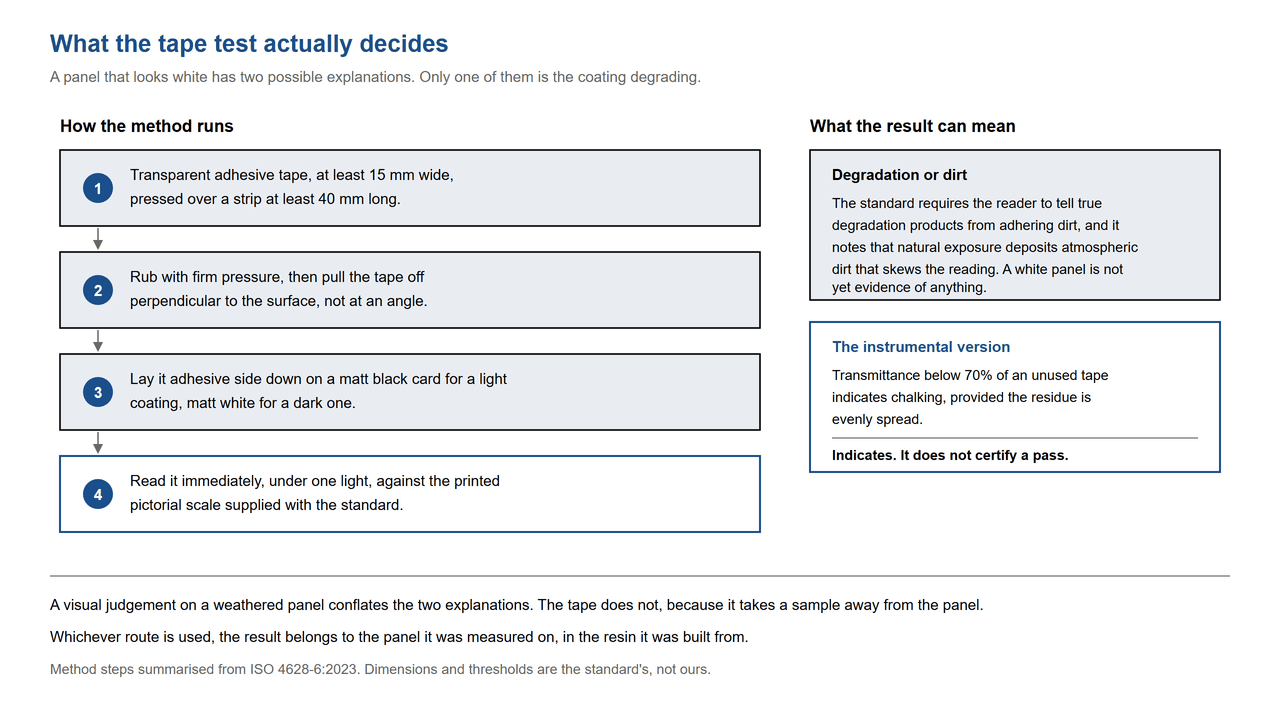
Less than it is usually asked to prove. A weathering report is a measurement taken under a stated method, and the method carries most of the information — which is why one panel can produce two numbers that look like a disagreement. For chalking the field check is a strip of transparent adhesive tape and a printed pictorial scale. It costs a roll of tape and it works on any panel that has already come back from a site.
The procedure: tape at least 15 mm wide, laid over a strip at least 40 mm long, pulled off perpendicular to the surface, and the residue compared against the scale on a matt background under uniform lighting [1]. The standard permits an instrumental version as well, which compares the transmittance of the used tape against an unused one.
Transmittance below 70% of the unused tape indicates chalking. That figure has one narrow meaning: it is the threshold at which the method says chalking is present. It is not a pass mark, and a report that presents it as one has quietly changed the question [1].
One line in the standard is worth carrying into a customer meeting. Where chalking is slight, the operator has to separate true degradation products from adhering dirt, and the standard notes that natural exposure deposits atmospheric dirt and skews the result [1]. A panel that looks white after two years may be dirty. Without the tape, nobody knows which of the two they are looking at.
Natural and artificial weathering have been compared directly, and the comparison was thought worth a dedicated study, which tells you the two are not interchangeable [5]. That work was done on wood coatings, so it is a parallel and not evidence about a powder film; it is cited for one purpose, that the question is real. We do not publish an exposure lifetime for these grades, because we have not run an outdoor exposure on your system.
So What Do You Actually Ask For?
Ask for the method before the number. Five questions cover most of it, and each one has an answer the report either contains or does not.
Was this natural exposure or artificial weathering? A duration on its own answers nothing; the report should name a site or an equipment model.
Was chalking rated with tape or by eye? Those are different measurements with different error, and a visual rating on a dirty panel is the weaker of the two by a wide margin.
How many locations were read on the panel, and does the report give a mean or a range? A single spot reading cannot show patchiness, and patchiness is the signature of poor flake distribution.
At which angle was gloss measured? A gloss figure without an angle compares to nothing, and gloss loss is the earliest visible signal on a bonded film.
Which resin system were the panels built on? Pigment itself affects the weathering of a polyester powder film [6], so a result belongs to the system it was measured in and does not transfer by quotation.
Particle sizes and grade data for the pigments discussed here are in the pearl pigment colour cards. Fix particle size before any weathering trial: it sets both the orientation behaviour and the surface roughness the tape will read.
For the application side rather than the pigment side, see effect pigments for paints and coatings, where the same platelet logic plays out in liquid systems.
A weathering report is a measurement, not a promise. What transfers between suppliers is the method, not the number.
Two reports that disagree need a comparison, not another quotation. Send us both: the method each one used, the angle gloss was read at, the resin system the panels were built on, and how many spots were rated. We will tell you whether the numbers are comparable at all, and what a trial on your own powder would have to look like to settle it. A sample pack can be built around the resin you actually run rather than the one on the paper — tell us which grade and particle size your line is set up for.
References
[1] ISO 4628-6:2023. Paints and varnishes — Evaluation of quantity and size of defects, and of intensity of uniform changes in appearance — Part 6: Assessment of degree of chalking by tape method. International Organization for Standardization. https://iso.org/standard/85312.html
[2] Gunde, M. K.; Kunaver, M.; Hrovat, A.; Cvelbar, U. "Bonding process efficiency and Al-flake orientation during the curing of powder coatings." Progress in Organic Coatings, 2005, 54(2), 113–119. DOI: 10.1016/j.porgcoat.2005.05.002
[3] "Improved powder coating composition and method." EP 1 339 806 B1, European Patent Office. https://data.epo.org/publication-server/rest/v1.2/publication-dates/20051019/patents/EP1339806NWB1/document.pdf
[4] Troutman, R. E.; Vannoy, W. G. "Chalking of Titanium Dioxide Pigmentated Exterior Finishes." Industrial & Engineering Chemistry, 1940, 32(2), 232–237. DOI: 10.1021/ie50362a017
[5] Grüll, G.; Tscherne, F.; Spitaler, I.; Forsthuber, B. "Comparison of wood coating durability in natural weathering and artificial weathering using fluorescent UV-lamps and water." European Journal of Wood and Wood Products, 2014, 72(3), 367–376. DOI: 10.1007/s00107-014-0791-y
[6] Kazat, K.; Yamashita, T.; Nakayama, Y.; Kazuma, Y.; Takizawn, K. "Effect of pigment on weathering resistance of polyester resin powder coating films." Metal Finishing, 2000, 98(9), 70–72. DOI: 10.1016/s0026-0576(00)83286-9

 English
 Français
 Deutsch
 Русский
 Español
 Português