Quick Answer
When sourcing a xirallic equivalent for automotive refinish work, the non-negotiable starting point is the substrate: you need an aluminum oxide (Al₂O₃) crystal-based pigment — not mica — to replicate the faceted, high-brilliance sparkle that defines the Xirallic visual signature. At Kolortek, our XiallicSparks series (KT-F60 and KT-T60 product codes) is built on exactly this technology, covering 11 shades in a 6–30 μm particle range engineered for basecoat/clearcoat spray systems. Following a structured refinish pigment selection process — matching substrate, particle size, color family, and compliance requirements — is what separates a convincing panel match from a costly respray.
Key Takeaways
- Xirallic pigments use aluminum oxide (Al₂O₃) crystal substrates — not mica — which is the source of their distinctive crystal sparkle. Any true equivalent must match this substrate, not substitute a mica-based pearl.
- Particle size governs sparkle character: the 6–30 μm range delivers fine crystal brilliance without the coarse, glittery texture associated with 40 μm+ particles — a critical spec for premium automotive finishes.
- Proper formulation technique matters as much as pigment selection: flash-off timing between basecoat and clearcoat, pigment loading of 1–10%, and avoiding high-shear mixing are all essential to developing the sparkle effect correctly.
- Dark basecoat colors substantially amplify sparkle intensity and color-travel — a controlling variable many refinish shops overlook when attempting color matching.
- For refinish programs requiring full compliance documentation, verify that your supplier provides TDS, MSDS/SDS, and relevant regulatory certificates before committing to a production batch.
Why Xirallic Is a Different Kind of Effect Pigment
A common misconception in the refinish industry is that all sparkle-effect pigments are essentially the same — just different colors of pearlescent mica. In practice, this misunderstanding leads to mismatched panels, frustrated customers, and wasted material.
Xirallic, Merck KGaA's branded line, belongs to a distinct category: aluminum oxide crystal effect pigments. Unlike standard pearlescent pigments built on natural or synthetic mica with TiO₂ coatings, Xirallic uses Al₂O₃ crystal platelets as the substrate. This structural difference is what produces the characteristic visual outcome — not soft pearl luster, but a high-sparkle, deep-brilliance effect with a crystal-like faceting that catches light dramatically at multiple angles.
When a vehicle rolls in for refinish work on a panel originally painted with a Xirallic-containing factory finish, matching it with a conventional mica pearl will always fall short. The angular sparkle simply isn't there. The right approach is a direct xirallic alternative built on the same Al₂O₃ substrate — which is precisely the design principle behind our XiallicSparks platform.
Understanding the XiallicSparks Product Platform
At Kolortek, our XiallicSparks series (KT-F60 and KT-T60 codes) was developed specifically as a drop-in equivalent to Merck Xirallic pigments for automotive coating applications. The platform covers 11 shades, from Galaxy Silver and Luxury Gold to Radiant Red, Rainbow Violet, Polar Green, and Flame Copper — addressing the most commonly specified Xirallic color families in OEM and refinish programs.
Every shade in the range shares a 6–30 μm particle size distribution. This is not arbitrary. It places the pigment squarely in the fine-to-standard sparkle window — delivering the crystal brilliance expected of Al₂O₃-based pigments while maintaining the smooth, premium surface texture that automotive clearcoat finishes demand. The "WR" designation in each product code signals weather-resistant grade suitability, meaning the pigments are formulated to withstand exterior automotive exposure conditions.
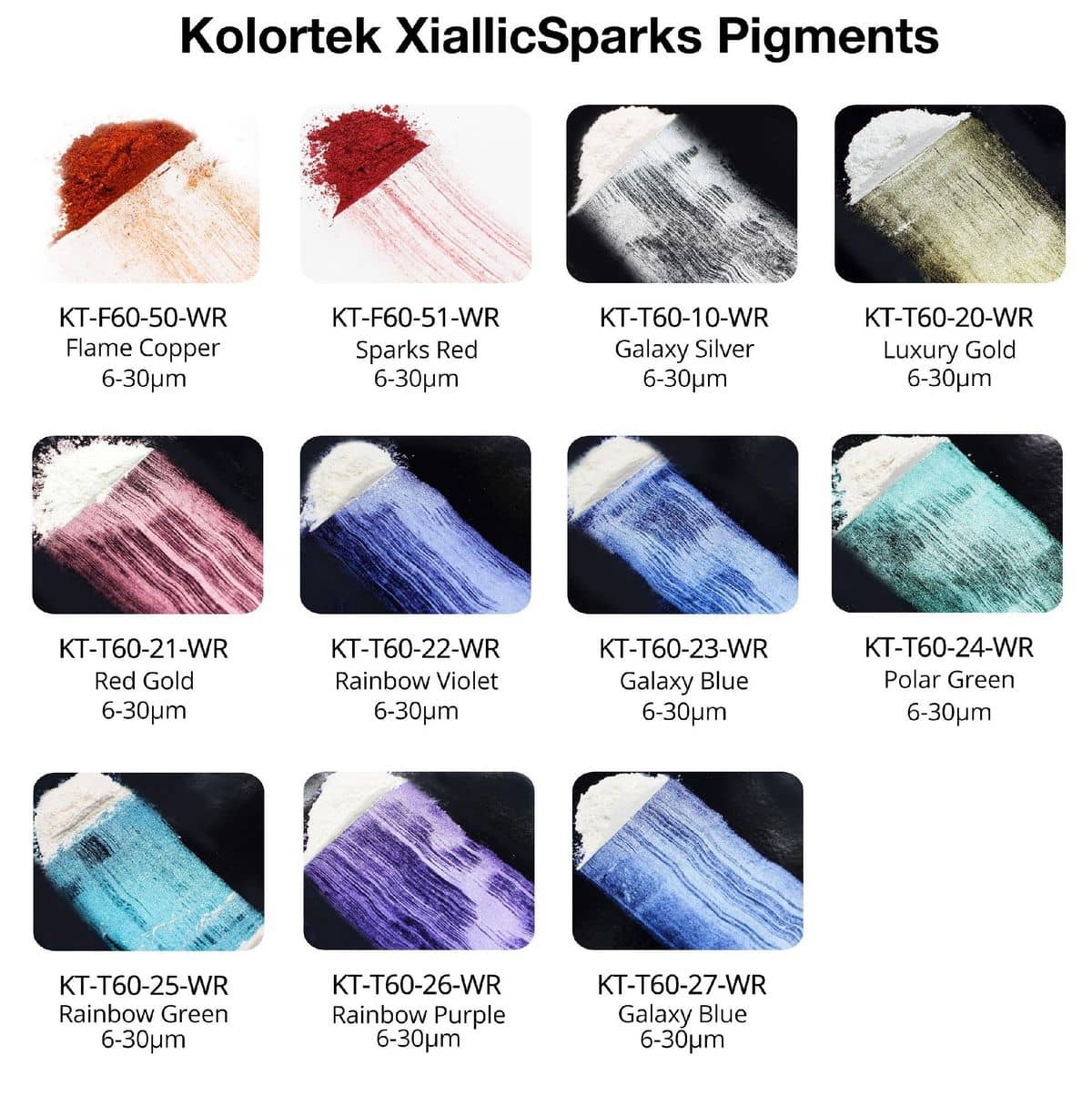
Full XiallicSparks Shade Range
| Kolortek Code |
Color Name |
Particle Size |
Best For |
| KT-T60-10-WR |
Galaxy Silver |
6–30 μm |
Neutral sparkle base, universal matching |
| KT-T60-20-WR |
Luxury Gold |
6–30 μm |
Warm-tone OEM finishes |
| KT-T60-21-WR |
Radiant Red |
6–30 μm |
Red basecoat matching |
| KT-T60-22-WR |
Rainbow Violet |
6–30 μm |
Color-shift violet/blue automotive finishes |
| KT-T60-23-WR |
Galaxy Blue |
6–30 μm |
Blue tone OEM/refinish programs |
| KT-T60-24-WR |
Polar Green |
6–30 μm |
Green sparkle finishes |
| KT-T60-25-WR |
Rainbow Green |
6–30 μm |
Interference green effects |
| KT-T60-26-WR |
Rainbow Purple |
6–30 μm |
Purple and multi-shift panels |
| KT-F60-50-WR |
Flame Copper |
6–30 μm |
Copper/bronze warm-tone refinish |
| KT-F60-51-WR |
Sparks Red |
6–30 μm |
High-chroma red sparkle |
| KT-T60-27-WR |
Galaxy Blue (variant) |
6–30 μm |
Deeper blue-tone OEM matching |
A Step-by-Step Xirallic Alternative Selection Framework
Selecting the right automotive crystal pigment for a refinish project isn't just picking a color from a chart. A structured four-step process reduces respray risk and cuts sampling cycles significantly.
Step 1 — Confirm Substrate Type in the Original Finish
Before selecting any xirallic alternative, confirm whether the panel's original sparkle effect comes from an Al₂O₃ crystal pigment or a conventional mica pearl. Al₂O₃-based effects show distinct high-angle sparkle with a faceted, almost glassy appearance. Mica-based pearls produce softer, more diffuse luster. If in doubt, consult the vehicle's OEM paint code reference — most major automotive paint databases now identify effect pigment type for premium finishes.
Step 2 — Match Color Family and Interference Character
Within the XiallicSparks range, match the primary color family of the original finish: silver/neutral (Galaxy Silver), warm metallic (Luxury Gold, Flame Copper), red-family (Radiant Red, Sparks Red), blue-family (Galaxy Blue variants), or multi-shift/violet (Rainbow Violet, Rainbow Purple). For finishes with visible color travel — where the hue shifts depending on viewing angle — prioritize the rainbow and interference-named variants, which are designed for that multi-angle shift character.
Step 3 — Verify Formulation Compatibility with Your Resin System
XiallicSparks pigments are compatible with the resin families most commonly used in refinish basecoats: acrylic, polyurethane, alkyd, polyester, epoxy, and nitrocellulose systems. That said, always verify against the specific clearcoat product in your shop's workflow. Request the TDS for the XiallicSparks shade you're evaluating — it contains recommended usage levels and compatibility notes that save troubleshooting time downstream.
Step 4 — Check Compliance Documentation Before Production Commitment
Automotive refinish programs — especially those feeding dealer-approved or insurance-approved repair networks — require documentation. At Kolortek, every XiallicSparks product ships with a full TDS and MSDS/SDS. Our facility operates under ISO 9001:2015 quality management certification, and we maintain REACH registration documentation for our synthetic substrate grades. For programs with ΔE <1.0 batch consistency requirements (standard for OEM color matching rigor), request batch certificates with each shipment.
Expert Insight: What Actually Goes Wrong in Refinish Applications
In our experience working with refinish shops and coating formulators across more than 100 countries, the technical failures we see most often aren't about the wrong pigment selection — they're about correct pigments applied incorrectly.
The most damaging mistake is high-shear mixing. Al₂O₃ crystal platelets are more mechanically delicate than many technicians assume. Running them through a high-speed disperser or recirculation pump at excessive pressure fractures the platelet structure. The result is a dull, flat finish with none of the characteristic crystal sparkle — and the pigment gets blamed when the application process was the real problem. For XiallicSparks and all crystal-effect pigments, use gentle low-shear incorporation: add the pigment to the pre-reduced basecoat with hand stirring or a low-speed paddle, and never grind it.
Flash-off timing is the second major variable. Between basecoat layers and before clearcoat application, the flash-off window controls how the platelets orient themselves in the film. Too fast, and the clearcoat traps platelets at random angles — you get a muddy, irregular sparkle. Too slow, and you get over-orientation and mottling. Target a 15–25 μm dry film build in the basecoat, and follow the flash-off guidance in your clearcoat manufacturer's technical data sheet precisely.
One formulation insight we share consistently: if the original panel finish appears to have especially intense sparkle, check whether the factory basecoat used a dark toner beneath the crystal layer. Dark underlying colors — near-black or deep charcoal — dramatically amplify the perceived brilliance and color contrast of Al₂O₃ crystal pigments. Attempting to match this effect over a light gray or white basecoat will always look washed out, regardless of the pigment quality.
Performance Benchmarks: What Automotive-Grade Pigments Must Deliver
| Performance Requirement |
Specification Benchmark |
Why It Matters in Refinish |
| Weatherability (QUV) |
1,000+ hours without significant color shift |
Repaired panels must age at the same rate as surrounding OEM finish |
| Chemical resistance |
Withstands acid rain, fuel, bird droppings, solvent exposure |
Daily road exposure; failure means visible panel discoloration |
| Heat resistance |
140–180°C baking cycle stability |
Forced-cure refinish booths operate in this range |
| Batch consistency |
ΔE <1.0 between production batches |
Multi-panel repairs must match across separate mixing sessions |
| Pigment loading range |
1–10% in basecoat system |
Excessive loading creates muddy effect; insufficient loading loses sparkle density |
| Dry film build (basecoat) |
15–25 μm target |
Controls platelet overlap density and sparkle intensity |
Particle Size and the Visual Outcome: Getting the Sparkle Character Right
One area where many buyers make an avoidable error is conflating sparkle with particle size in a crude way — assuming "bigger particles = more sparkle." The reality is more nuanced, and it matters directly for sparkle effect pigment choosing in refinish contexts.
| Particle Size Range |
Visual Effect |
Surface Texture |
Appropriate Application |
| 5–25 μm |
Fine luster |
Silky smooth |
Satin/matte pearl finishes, subtle OEM effects |
| 6–30 μm (XiallicSparks) |
Crystal sparkle |
Smooth, premium |
Automotive refinish — Xirallic-equivalent matching |
| 10–60 μm |
Standard pearl |
Slight grain |
Conventional pearl automotive and industrial coatings |
| 20–100 μm |
Flash/sparkle |
Noticeable sparkle, slight texture |
Custom/aftermarket sparkle finishes |
| 40–200 μm |
Coarse glitter |
Grainy, visible particles |
High-impact custom/show car applications |
The 6–30 μm range of XiallicSparks occupies the sweet spot for OEM-specification refinish: enough particle size for clear, distinct crystal sparkle under direct and angled light, but fine enough to produce the smooth, gloss-over-sparkle surface that premium automotive finishes require. Going larger than 30 μm for a factory-finish repair would produce a noticeably different texture from the surrounding panels — something an experienced detailer or insurance assessor would flag immediately.
Building a Complete Refinish Palette Around Xirallic Equivalents
Most refinish programs need more than a single effect pigment type. XiallicSparks handles the crystal sparkle segment, but a full-service refinish shop working across a broad vehicle range will also encounter standard pearlescent panels, color-shift finishes, and metallic effects. Here's how the Kolortek portfolio maps to those needs:
| Refinish Scenario |
Recommended Kolortek Product |
| Xirallic crystal sparkle replacement |
XiallicSparks (KT-F60 / KT-T60 series, 6–30 μm) |
| Standard white pearl OEM match |
KT-100 Silver White (natural mica, 10–60 μm) |
| Interference/tinted pearl match |
KT-200 Interference series (gold, red, violet, blue, green) |
| Premium sparkle — borosilicate glass flake |
KT-8000 DreamStar |
| Color-shift / chameleon finishes |
KT-9000 Magic Chameleon / Chromashift series |
| Mirror metallic panels |
Aluminum Silver Paste (solvent- and water-based) |
Frequently Asked Questions
What is the difference between a xirallic equivalent and a standard pearlescent pigment for automotive use?
Xirallic equivalents use aluminum oxide (Al₂O₃) crystal substrates, which produce a high-brilliance, faceted sparkle — a categorically different optical effect from standard pearlescent pigments built on mica with TiO₂ coatings. Mica pearls create soft, diffuse luster; Al₂O₃ crystals create sharp, directional sparkle with more depth and intensity. For matching an original Xirallic-containing OEM finish, only an Al₂O₃-based pigment will produce a convincing result.
How do I know if the original vehicle finish contains a Xirallic-type pigment that needs an equivalent?
The visual signature is a strong clue: Xirallic-based finishes show pronounced, distinct sparkle points that shift dramatically with viewing angle, rather than the even, flowing luster of conventional pearls. For confirmation, cross-reference the OEM paint code in a professional color database — most current automotive paint system databases identify effect pigment type for premium factory finishes from major manufacturers.
What pigment loading should I use when formulating XiallicSparks in a refinish basecoat?
Use 1–10% pigment loading in the basecoat system, targeting a dry film build of 15–25 μm. Loading below 1% will produce insufficient sparkle density; going above 10% creates excessive inter-platelet interference that results in a cloudy, muddy appearance and poor orientation. For most refinish color matching applications, 3–6% loading is a practical starting range for initial draw-downs.
Can I use XiallicSparks xirallic alternative pigments in water-based refinish basecoats, or only solvent-based systems?
XiallicSparks pigments are compatible with both solvent-based and water-based basecoat systems. The WR-grade product designation covers compatibility across the resin families used in modern refinish formulations, including waterborne acrylic and polyurethane systems. As water-based refinish formulations continue to gain regulatory traction globally under VOC reduction requirements, this compatibility is increasingly important for shops operating under low-VOC compliance programs.
Why does my sparkle effect look dull even after using the correct xirallic alternative pigment?
The most likely causes are either high-shear mixing during pigment incorporation (which fractures the Al₂O₃ platelet structure) or incorrect flash-off timing before clearcoat application (which traps platelets in misaligned orientations). Both issues destroy the effect regardless of pigment quality. Additionally, confirm the base color beneath the crystal layer — applying Al₂O₃ pigments over a light toner base significantly reduces perceived sparkle intensity compared to a dark near-black base.
What batch-to-batch color consistency can refinish programs expect from Kolortek's XiallicSparks series?
XiallicSparks production targets the ΔE <1.0 batch consistency benchmark expected in OEM approval programs and professional refinish color matching applications. Kolortek's ISO 9001:2015 certified quality management system governs production consistency across batches. For programs with documented color match requirements, batch certificates are available on request to support traceability in professional refinish workflows.
The key thing to remember: selecting a xirallic equivalent for automotive refinish comes down to three non-negotiable criteria — the right substrate (Al₂O₃ crystal, not mica), the right particle size (6–30 μm for premium automotive surface quality), and the right application technique (gentle incorporation, correct film build, proper flash-off). Get those three right, and the sparkle matching takes care of itself. Get any one wrong, and no amount of color adjustment will close the gap.
If you're working on a refinish program and want to evaluate XiallicSparks against your current supply, our technical team can provide drawdown samples across the full 11-shade range. Explore the XiallicSparks product page or visit our automotive coatings pigment guide for formulation documentation and shade selection resources.

 English
 Français
 Deutsch
 Русский
 Español
 Português