Ask three suppliers for a pearlescent pigment quote and you will get three different materials behind three similar prices. The difference is rarely the shine. It is whether the particle size band matches what your process can disperse, whether the treatment suits your base, and whether the paperwork clears your market. Here is how to check those three things in the order that saves the most time.
Key Takeaways
- "Pearl pigment" is not a specification. The particle size band is one, and the same shade exists across several of them.
- A product is usable only if its colorant is permitted in your destination market — that is a list question, not a quality question.
- A color card narrows the field. It cannot confirm fit, because the same powder reads differently in a different base.
- Documentation, not catalogue size, is what separates a supplier who can support a cosmetic launch from one who cannot.
What Changed in Pearlescent Pigment Supply
Two shifts matter more than any ranking of suppliers. The first is that substrate choice moved up the buying decision. Natural mica, synthetic mica and borosilicate glass are now compared side by side in the same conversation, because particle size distribution and heavy-metal control start at the flake rather than at the coating. A buyer who specifies "pearl pigment" without naming a substrate has left the most expensive variable open.
The second shift is documentary. A cosmetic pigment is usable only if its colorant is permitted where you sell it. In the EU, Article 14(1)(c)(i) of Regulation (EC) No 1223/2009 limits cosmetic products to colorants listed in Annex IV.[1] That turns a routine question — which list this material is on — into a gate that a supplier either clears quickly or does not clear at all.
Neither shift makes a supplier list more useful. A ranking tells you who is large. It does not tell you whether what is in the box fits the line you are running, which is the only question that affects your yield.
Four Things a Supplier Should Be Able to Prove
The list is short on purpose. Each item can be answered with a number or a document, which means each one can also be checked rather than believed.
1. The particle size band, per grade
The band decides coverage, sparkle and hand feel, and it is the first thing that goes wrong when a buyer works from a color chart. A fine band disappears into a thin film; a coarse band sits on top of it and reads as texture. Ask for the band in micrometres for the specific item, not for the range as a whole.
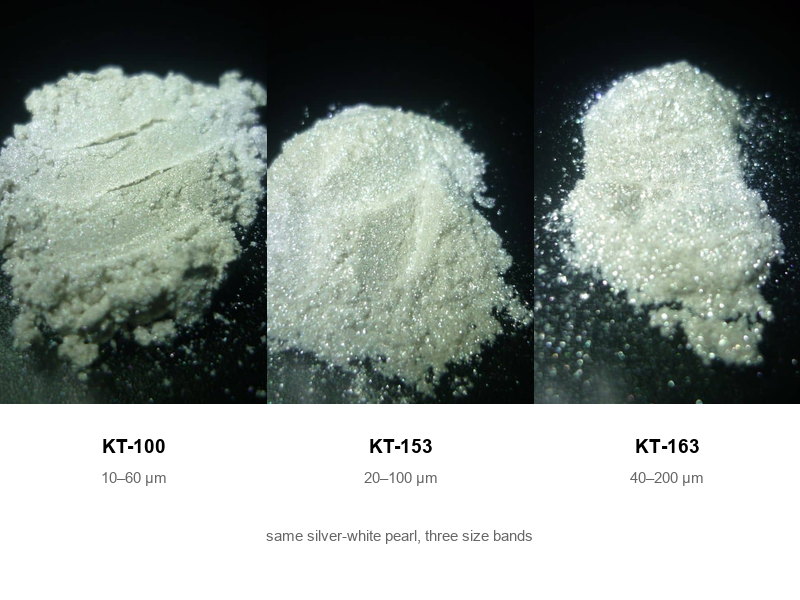
Figure 1. The same shade across three size bands. Whichever way the band is described on a data sheet, the difference is visible in the powder before anything is dispersed.
2. The surface treatment, and what it is for
Treatment changes how the flake behaves at the interface: dispersion, adhesion, and in a cosmetic base, skin feel and pressability. Treated materials are built for cosmetic and nail formulations. If your base is an industrial coating, the untreated product is the one to test — carrying a treated material across from a cosmetic line usually costs more in dispersion trouble than it saves.
3. Heavy-metal data that names its regulation
Under US FDA 21 CFR 73.1496, mica used as a color additive must not exceed 20 ppm lead, 3 ppm arsenic and 1 ppm mercury.[2] Those are legal limits for one substrate in one market. They are not a general purity standard, and quoting them as though they applied everywhere is how analytical data ends up unusable in an audit. For the EU, the useful answer is the analytical package a safety assessor needs for the material and the market, because Regulation (EC) No 1223/2009 does not set a statutory limit for these elements.
4. Batch records that tie a COA to a lot
A certificate of analysis is only evidence if it carries the lot it belongs to. Ask to see one for a recent shipment and compare the color values with the grade's own specification. A supplier who can produce that on request has a system; a supplier who sends a generic certificate has a template.
Why a Color Card Cannot Settle It
A card has one job: to remove the colors you do not want. It cannot tell you how a powder will look in your film, and there is a reason written into the measurement standards themselves.
ASTM E2539-25 covers multiangle color measurement of interference flake materials, and its scope states that the gonioapparent effect depends strongly on the physical and chemical properties of the medium, naming vehicle viscosity, thickness, transparency and volume solids.[3] Read that as a warning about trial design: the same powder in a thinner film, or in a base with different solids, is a different color. The standard for metal flake materials goes further, noting that two specimens can read the same at three angles and still fail to match visually once gloss, orange peel, texture or flake orientation differ.[4]
The practical consequence is narrow. Test in your own base, at your own film weight, and look at more than one angle — and treat a spectrophotometer reading as confirmation of a match you have already seen, not as the match itself.
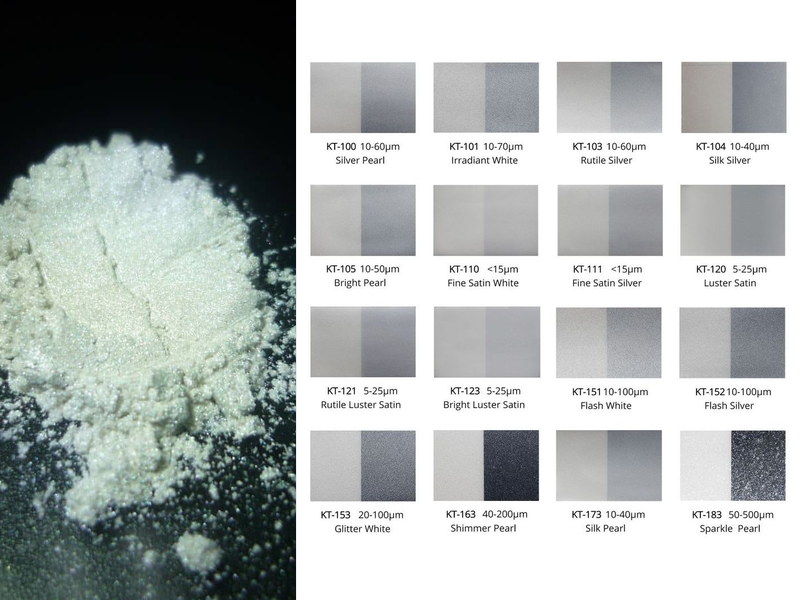
Figure 2. Dry powder and the film it produces, side by side. The color on the card is the powder; what your customer sees is the film.
Matching the Grade to the Application
Selection runs from the base backwards, not from the color forwards. A nail gel, an epoxy casting and an automotive topcoat each impose a different limit on how much pigment the system will carry and how the flakes will orient, and the band that works in one will look flat or coarse in another.
The four application groups with their own selection notes are cosmetic pigments, epoxy resin, automotive coatings and printing. The full range, by substrate and effect, sits under pearlescent pigments.
Five Mistakes That Cost More Than the Price Gap
Choosing from a card. Covered above, and still the most common. The color is the last variable to fix, not the first.
Working from another supplier's code. Codes do not travel between suppliers. Part of what a code encodes is the substrate, part is the treatment, and neither convention is shared. Ask for band and treatment in words, then map a code onto them — not the other way round.
Accepting a series-level TDS. One sheet covering a whole range tells you what the line can do. You need the sheet for the grade you will buy, because that is where the band, the treatment and the heavy-metal figures actually live.
Assuming every pearl pigment is mica-based. The carrier is a flake, and mica is only one of the options: natural mica, synthetic mica and borosilicate glass each bring a different particle size distribution and a different optical result. Assuming mica closes off two of the three before the comparison starts.
Treating a render as performance evidence. A picture can show a color shift. It cannot show weathering, alkali resistance or migration behaviour, and those are the properties that decide whether a finish survives its first year outdoors or in a hot melt.
Frequently Asked Questions
How can I tell whether a supplier really handles cosmetic work?
Ask for three things and read the answers, not the adjectives: the permitted-list position for your market, heavy-metal data with the regulation named, and a particle size distribution for the grade in question. A supplier who handles cosmetic work has all three ready. A supplier who does not will answer with the word "cosmetic".
Natural mica or synthetic mica?
Match it to the application rather than to a hierarchy. Natural mica covers most general work at lower cost and remains the substrate behind a large share of standard pearl effects. Synthetic mica brings a narrower particle size distribution and higher purity, which matters where the film is thin, the shade must repeat exactly, or the heavy-metal budget is tight. Borosilicate glass is the third option when brightness at a given loading is the constraint.
What belongs in a TDS for a pearl pigment?
Band and distribution, substrate, treatment, density, moisture, heavy-metal specification with its source, and the permitted-use position for the target market. If a sheet lists a shade range and nothing else, it is a catalogue page with a header.
Can I evaluate a material without ordering production volume?
Yes, and you should. Sample packs are assembled per item and per intended base, so what you test is what the specification covers. Describe the base, the film weight and the process temperature, and the pack can be narrowed to the few worth running.
Where Kolortek Fits
We manufacture effect pigments rather than trading them, which is why the powder can be matched to a substrate, a carrier and a process instead of the nearest catalogue entry. Production runs under an ISO 9001:2015 certified quality management system. Each material carries a TDS, MSDS and COA, and color matching and sample packs are handled in house. Every series is listed in the product catalogue. Tell us what you are making and which market it goes to, and we will come back with the grades worth testing.
References
[1] Regulation (EC) No 1223/2009 of the European Parliament and of the Council on cosmetic products, Article 14(1)(c)(i) and Annex IV. eur-lex.europa.eu/eli/reg/2009/1223/oj
[2] 21 CFR 73.1496 — Mica. US Food and Drug Administration. ecfr.gov/current/title-21/…/section-73.1496
[3] ASTM E2539-25, Standard Test Method for Multiangle Color Measurement of Interference Flake Pigmented Materials, Section 1.6. astm.org/Standards/E2539.htm
[4] ASTM E2194-14(2025), Standard Test Method for Multiangle Color Measurement of Metal Flake Pigmented Materials, Section 5.4. astm.org/e2194-14r25.html

 English
 Français
 Deutsch
 Русский
 Español
 Português