
Leave A Message
If you are interested in our products and want to know more details,please leave a message here,we will reply you as soon as we can.
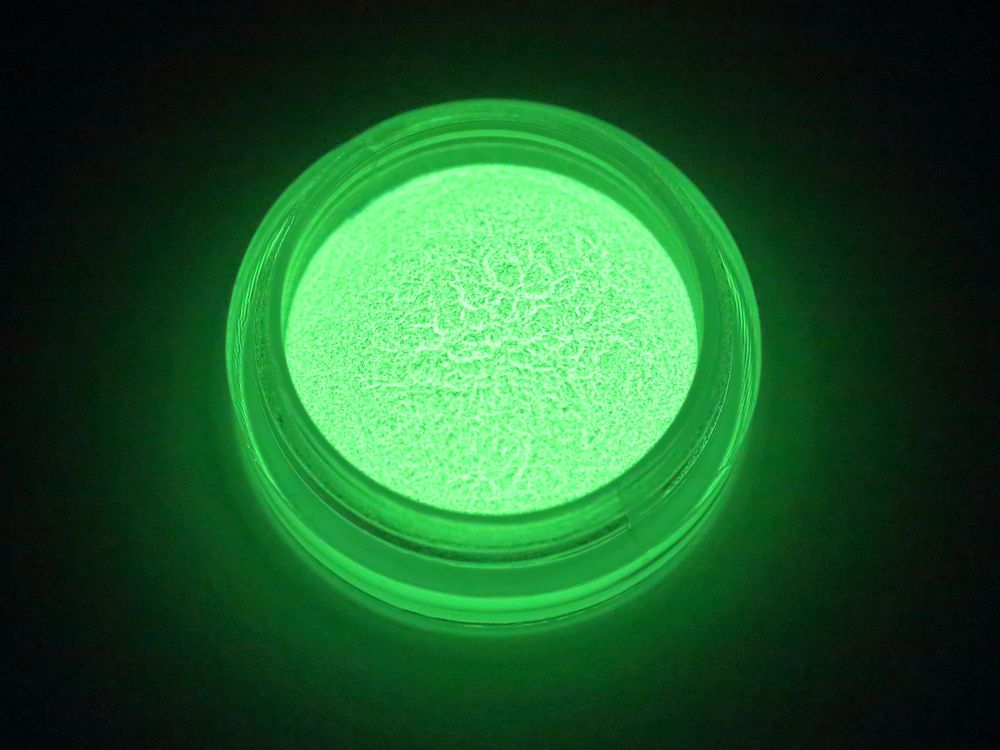
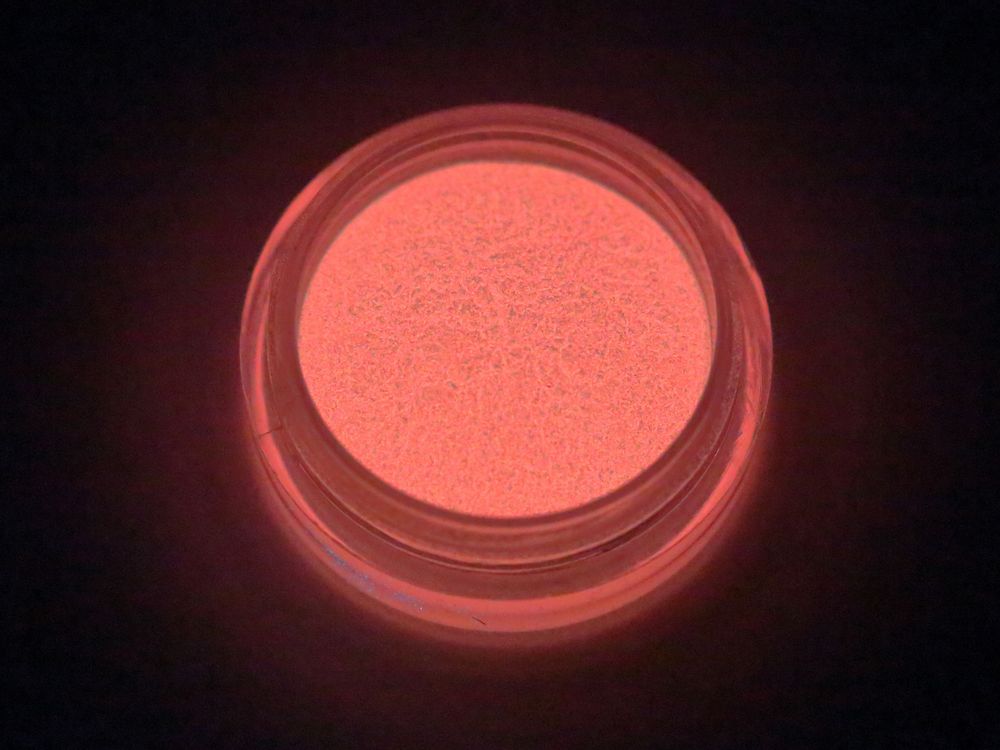
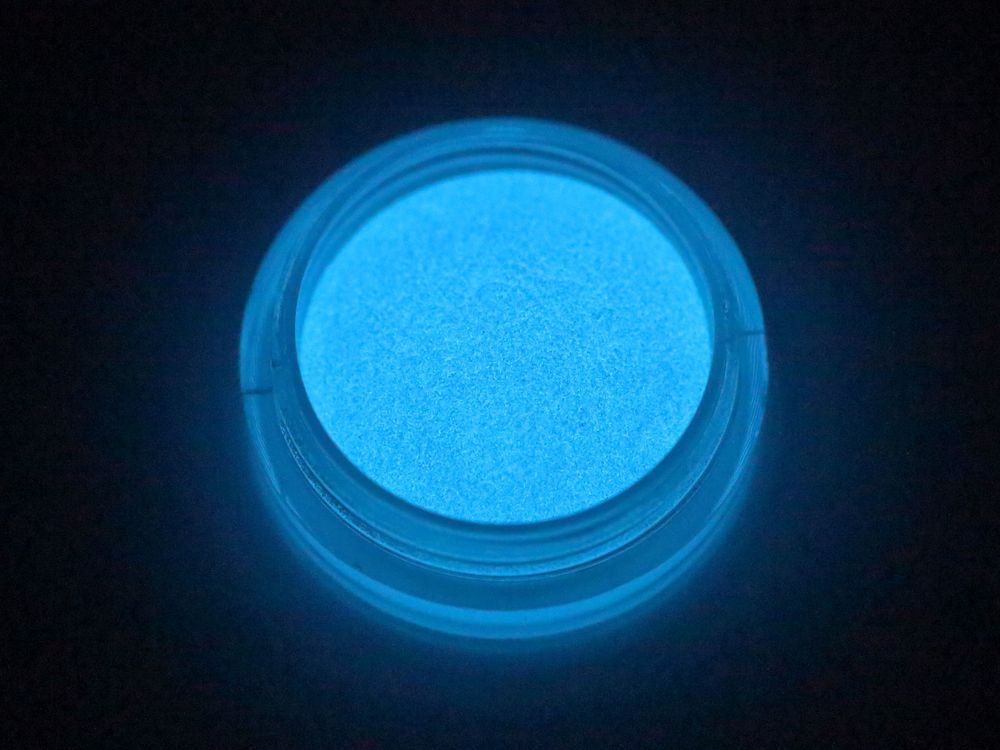
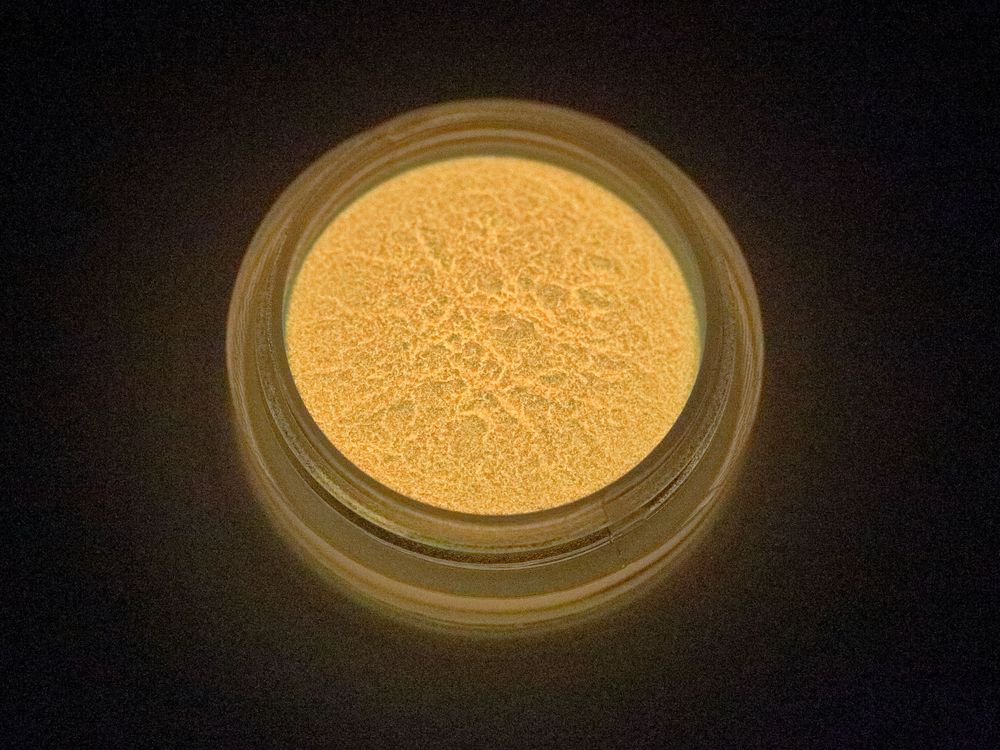
Kolortek's glow in the dark pigment series delivers reliable afterglow across a broad color range — from yellow-green and blue-green to orange-red and violet — making it a practical base material for coatings, printing inks, nail products, and safety-marking applications. Available in both strontium aluminate and zinc sulfide formulations, with water-based compatible grades included, these powders integrate cleanly into a wide range of carrier systems. Whether you're sourcing luminous pigment powder for decorative cosmetics or functional safety applications, the lineup covers the particle size and chemistry options most formulations actually need.
Item No. :
Glow in dark PigmentsColor Effect :
MluticolorsBrand :
Kolortek / OEMMOQ :
25KGGlow in the dark pigments absorb ambient light — sunlight or standard interior lighting — and re-emit it as visible luminescence after the light source is removed. The core mechanism is photoluminescence: the pigment crystal stores excitation energy and releases it gradually, producing that characteristic afterglow effect.
Two base chemistries are represented in this range. Strontium aluminate grades offer higher brightness and longer glow duration — the dominant choice for most commercial applications today. Zinc sulfide grades produce softer, lower-intensity emission and are typically used where cost or specific application constraints make them the practical option.
In practice, particle size is one of the more important specification decisions. Finer grades (5–25 μm range) disperse more easily in thin-film systems like nail gels and printing inks but sacrifice some glow intensity. Coarser grades (65–75 μm) deliver stronger afterglow but require more open substrate geometries. Most coating and plastic applications land somewhere in the 20–50 μm range.
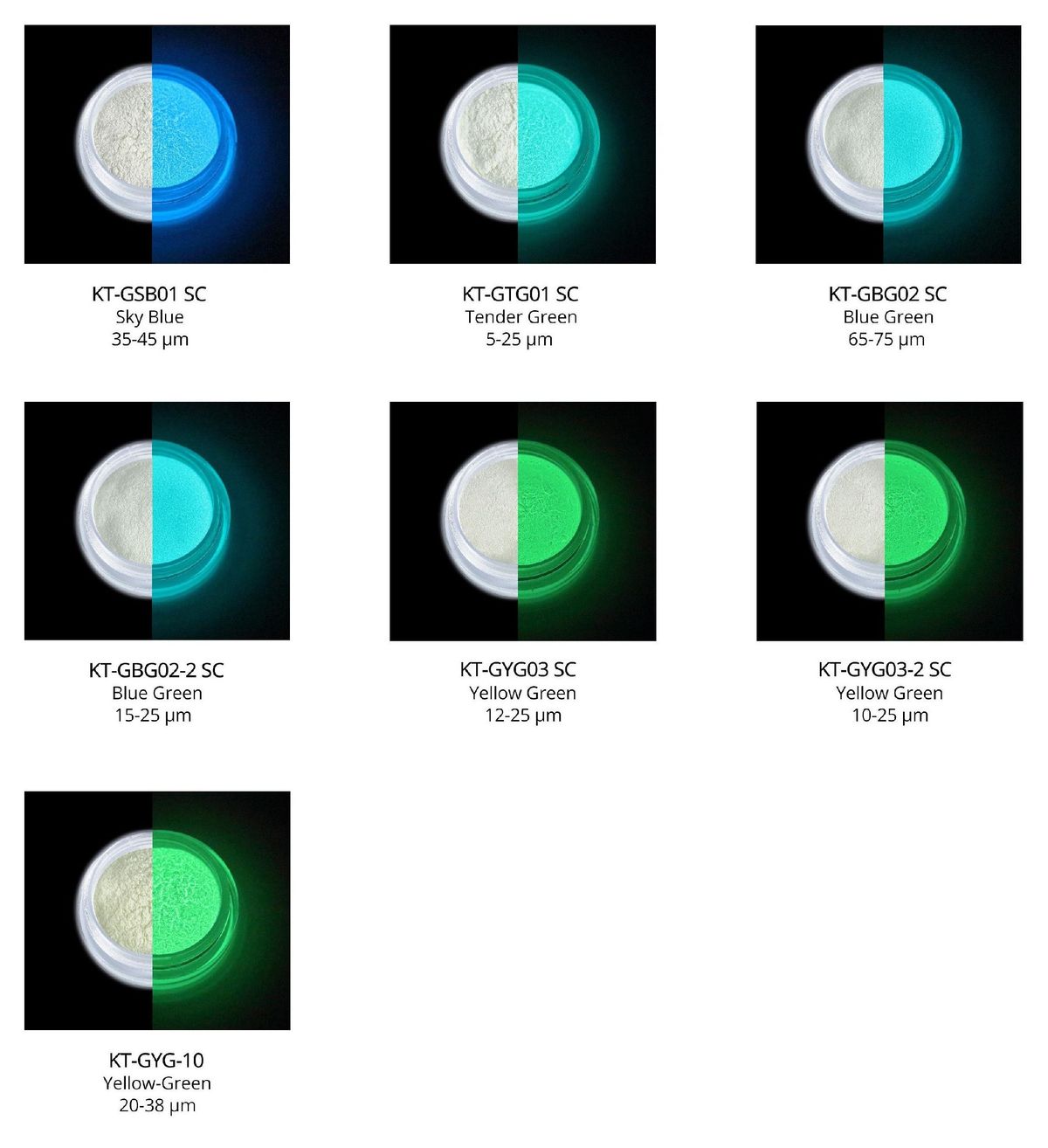
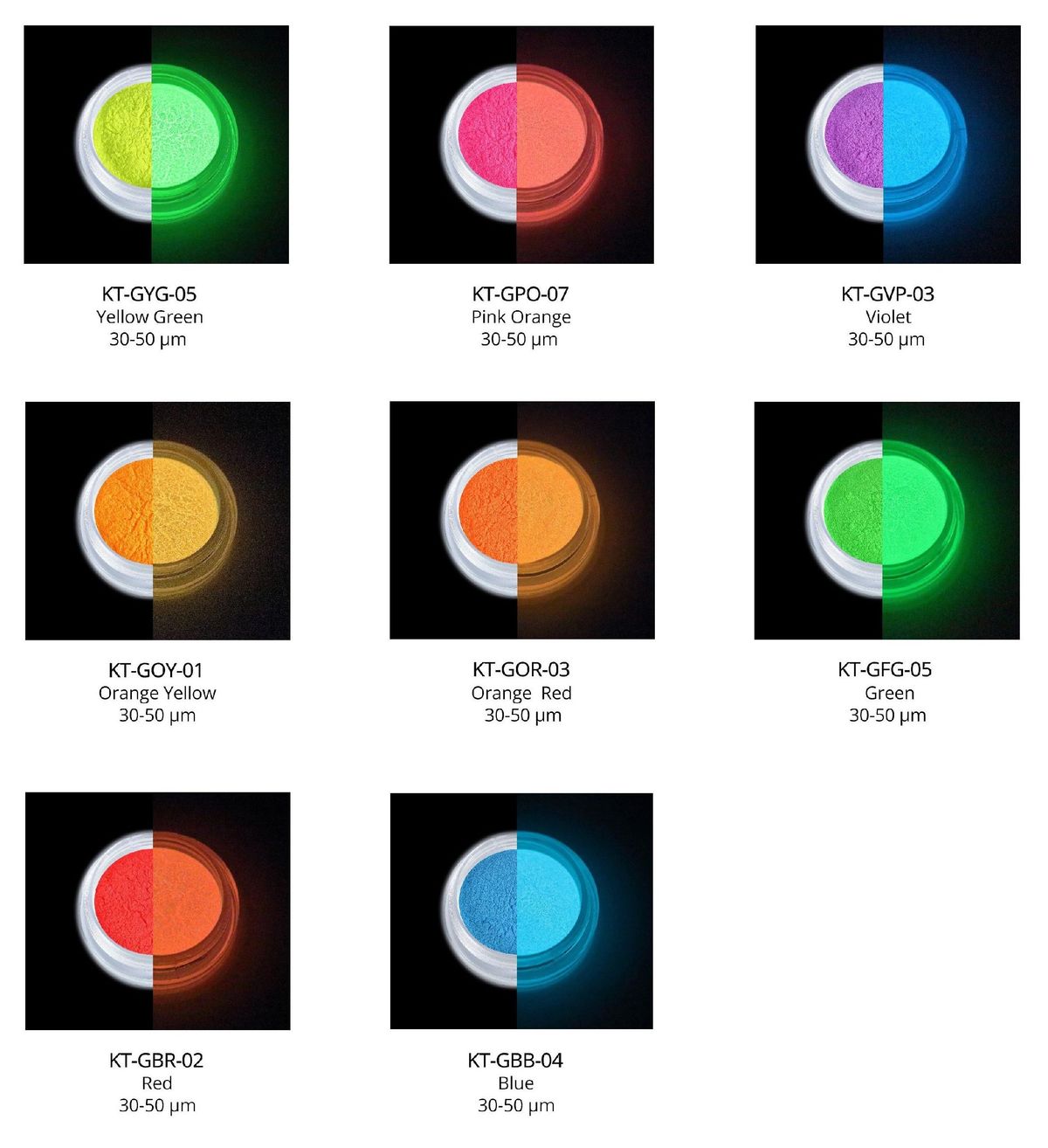
The table below covers the full model range with key specification points. Water-based designations indicate grades with either native water compatibility or waterproof surface treatment.
| Model | Color | Particle Size | Type / Notes |
|---|---|---|---|
| KT-GSB01 SC | Sky Blue | 35–45 μm | Strontium aluminate |
| KT-GTG01 SC | Tender Green | 5–25 μm | Fine particle; suitable for inks, nail |
| KT-GBG02 SC | Blue Green | 65–75 μm | Coarse grade; high glow output |
| KT-GBG02-2 SC | Blue Green | 15–25 μm | Water-based luminous |
| KT-GYG03 SC | Yellow Green | 12–25 μm | Strontium aluminate |
| KT-GYG03-2 SC | Yellow Green | 10–25 μm | Water-based luminous |
| KT-GP04 SC | Purple | 15–25 μm | Strontium aluminate |
| KT-GYG-10 | Yellow Green | 20–38 μm | Waterproof treated; water-based systems |
| KT-GYG-05 | Yellow Green | 30–50 μm | Water-based |
| KT-GPO-07 | Pink Orange | 30–50 μm | Water-based |
| KT-GVP-03 | Violet | 30–50 μm | Water-based |
| KT-GOY-01 | Orange Yellow | 30–50 μm | Water-based |
| KT-GOR-03 | Orange Red | 30–50 μm | Water-based |
| KT-GFG-05 | Green | 30–50 μm | Water-based |
| KT-GBR-02 | Red | 30–50 μm | Water-based |
| KT-GBB-04 | Blue | 30–50 μm | Water-based |
| KT-GYG03DSA | Yellow Green | 20–40 μm | Zinc sulfide |
| KT-SGWY-01A | Orange Yellow | 20–40 μm | Zinc sulfide |
| KT-SGWY-11 | Yellow | 20–40 μm | Zinc sulfide |
| KT-SGWR-02 | Red | 20–40 μm | Zinc sulfide |
| KT-SGOR-03 | Orange Red | 20–40 μm | Zinc sulfide |
These pigments cover a fairly wide application footprint. The most common end uses:
A few things worth understanding before selecting a grade:
Color range: The visible emission color under darkness is not the same as the daylight color of the powder. Yellow-green emission grades, for instance, may appear off-white or light green under daylight. The full range covers yellow-green, blue-green, sky blue, violet, purple, orange-yellow, pink-orange, orange-red, and red — giving formulators meaningful flexibility for branded or differentiated products.
Water-based compatibility: Standard strontium aluminate grades are moisture-sensitive and will degrade in aqueous systems over time. The water-based and waterproof-treated grades in this series address that directly. KT-GYG-10, for example, carries a surface treatment that makes it compatible with water-borne coatings and inks without the glow degradation issues that untreated grades exhibit.
Strontium aluminate vs. zinc sulfide: This is a meaningful decision. Strontium aluminate delivers substantially higher brightness and longer afterglow duration. Zinc sulfide grades are dimmer but remain relevant in price-sensitive applications or where regulatory or formulation constraints apply. Don't default to strontium aluminate without confirming it fits the budget and use case.
Glow duration and intensity: Both depend on excitation time, excitation source intensity, and pigment loading. There is no substitute for running your own charging tests in the intended substrate and film thickness.
Dispersion is straightforward by effect pigment standards — these are denser than typical pearlescent flakes and will settle in low-viscosity systems. Thixotropic additives or periodic agitation are standard practice for coating and ink formulations.
Loading rates vary by application. In coatings, 10–30% by weight is a common starting range; in nail gels, lower loadings are typical depending on the film build. Higher loading generally improves glow output up to a point — beyond that, particle crowding in the film limits further gains.
That said, milling or high-shear dispersion should be avoided. These pigments are crystalline and will fracture under aggressive mechanical energy — smaller particles mean reduced glow output. Low-shear mixing is the standard approach.
For printing applications, the practical lower limit for mesh screen printing is typically around 10–12 μm particle size. Grades in the 30–50 μm range are better suited to screen printing with open-mesh fabrics or for thick-film applications like pad printing and casting.
Worth noting: avoid strongly acidic systems with the standard strontium aluminate grades. Acid conditions will degrade the crystal structure. pH range of 7–9 is generally safe. The waterproof-treated grades offer somewhat broader pH tolerance, but it's still worth confirming with the specific formulation.
| Property | Strontium Aluminate | Zinc Sulfide |
|---|---|---|
| Afterglow brightness | High | Low–medium |
| Glow duration | Long (hours) | Short (minutes) |
| Moisture sensitivity | Higher (standard grades) | More tolerant |
| Cost | Higher | Lower |
| Typical use | Coatings, printing, safety, cosmetics | Craft, cost-sensitive applications |
Q: Can these pigments be used in water-based coating systems?
Standard strontium aluminate grades are not suitable for direct incorporation into water-borne systems — moisture degrades the luminescent crystal over time. The designated water-based grades (KT-GBG02-2, KT-GYG03-2, the KT-GYG-10 waterproof-treated grade, and the full KT-GYG-05 through KT-GBB-04 water-based series) are formulated for aqueous compatibility. Always confirm with the specific grade before scaling up.
Q: Which grade is appropriate for cosmetic or nail applications?
For decorative cosmetics and nail products, finer particle grades in the 5–25 μm range are generally more appropriate from a texture and application standpoint. Compliance documentation — MSDS, TDS, and relevant safety certifications — should be reviewed and verified against your market's regulatory requirements before use.
Q: What loading rate should I start with?
For most coating applications, a 10–20% loading by weight in the final formulation is a reasonable starting point for a glow powder like this. Glow output scales with loading and film thickness, but there are diminishing returns at higher concentrations. Practical testing in your specific system and substrate is the only reliable way to optimize this.
Q: Are these pigments suitable for use in automotive coatings?
No. These are not recommended for automotive topcoat applications. The durability, UV exposure, and processing conditions typical of automotive coatings are outside the suitable application range for this product series.
MSDS, TDS, and COA are available for all models. Formulation guideline support is available for qualified development inquiries. Custom packaging and private labeling are supported for volume orders.
To request samples, technical documentation, or pricing, contact the Kolortek technical sales team with your target application, system chemistry, and volume requirements — this allows for a more useful product recommendation rather than a generic response.
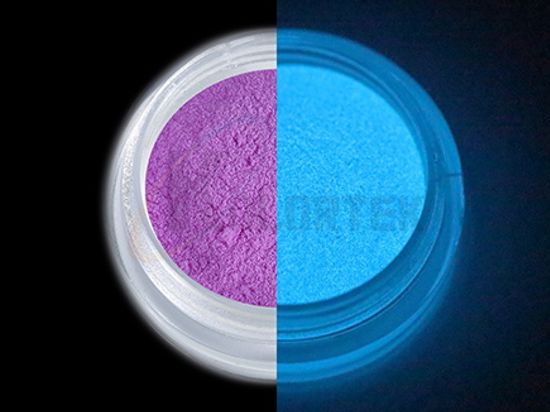
Glow in the Dark Pigments are phosphorescent powders that absorb light energy from natural or artificial sources and re-emit it as a visible glow in darkness. Unlike fluorescent pigments, which require a continuous light source to produce their effect, phosphorescent pigments store energy and release it gradually after the light source is removed. They are used across safety, decorative, cosmetic, and industrial applications where passive light emission in dark conditions is required.
Read More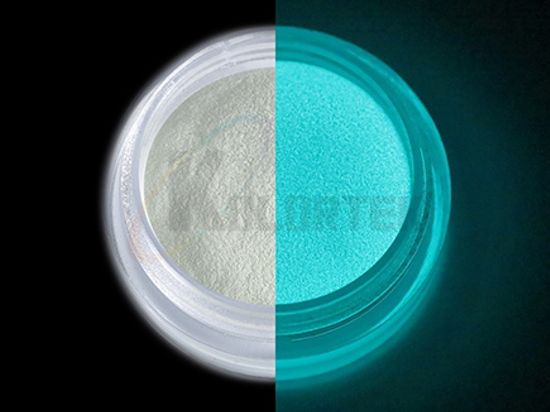
KT-GBG02 is a Blue Green strontium aluminate phosphorescent pigment in the coarse 65–75μm particle size range — a glow-in-the-dark pigment that absorbs ambient light (sunlight, fluorescent, LED) during exposure and releases it as a sustained blue-green glow after the light source is removed.
Read More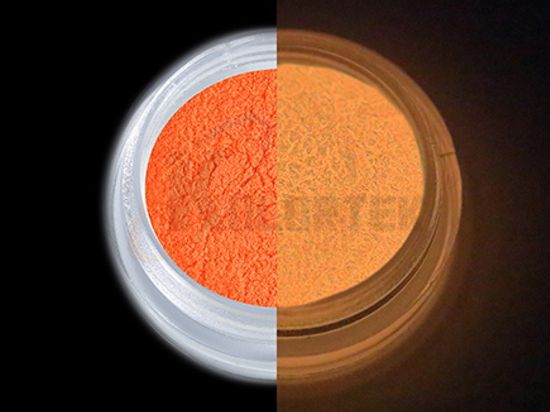
KT-GOR-03 is an Orange Red phosphorescent glow-in-the-dark pigment in the 30–50μm particle size range, formulated for direct use in water-based systems — a surface-treated strontium aluminate grade that resists the moisture-induced degradation that limits standard glow pigments in waterborne coatings, water-based adhesives, and aqueous craft formulations.
Read More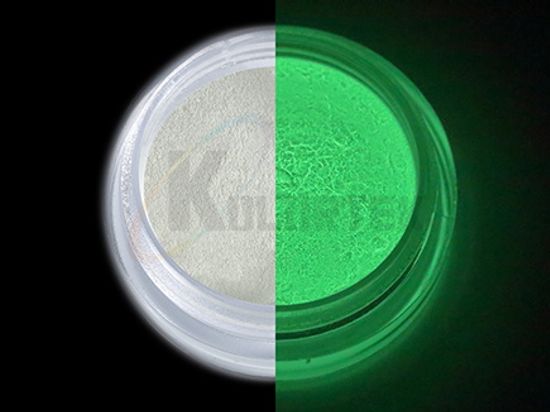
KT-GYG03 SC is a Yellow Green strontium aluminate phosphorescent pigment in the fine 12–25μm particle size range — the standard fine grade in Kolortek's glow-in-the-dark series, designed for coatings, printing inks, plastics compounding, and applications where particle size must remain within tight tolerances for smooth film formation.
Read More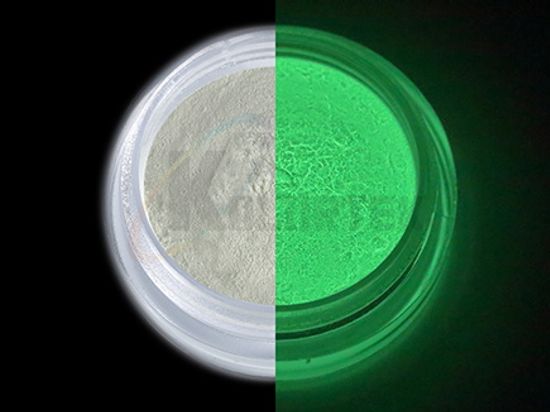
KT-GYG03DSA is a Yellow Green zinc sulfide (ZnS) phosphorescent pigment in the 20–40μm particle size range — the cost-effective glow-in-the-dark option in the Kolortek range for applications where a short-duration afterglow is functionally sufficient and the price premium of strontium aluminate is not warranted.
Read More
Kolortek's glow in the dark pigment series delivers reliable afterglow across a broad color range — from yellow-green and blue-green to orange-red and violet — making it a practical base material for coatings, printing inks, nail products, and safety-marking applications. Available in both strontium aluminate and zinc sulfide formulations, with water-based compatible grades included, these powders integrate cleanly into a wide range of carrier systems. Whether you're sourcing luminous pigment powder for decorative cosmetics or functional safety applications, the lineup covers the particle size and chemistry options most formulations actually need.
Read More
Kolortek's strontium aluminate-based glow in the dark powder delivers long-duration afterglow in a range of emission colors — from yellow-green and blue-green to violet, orange, and red — making it a reliable base material for paints, coatings, inks, and decorative applications. Available in both standard and water-based formulations, the photoluminescent powder charges rapidly under ambient or UV light and releases stored energy as a sustained, visible glow in darkness.
Read More
A long-afterglow phosphorescent pigment that charges under sunlight or interior light and releases a steady glow for hours in the dark. Available in sky blue, yellow-green, violet, orange, and red tones, this glow in dark powder works in both solvent and water-based systems, making it a practical luminescent pigment for paints, inks, craft art, nails, and safety-marking applications.
Read More
 English
 Français
 Deutsch
 Русский
 Español
 Português