
Leave A Message
If you are interested in our products and want to know more details,please leave a message here,we will reply you as soon as we can.
Glitter Pigment Grades: Cellulose, PLA and Solvent-Resistant Film
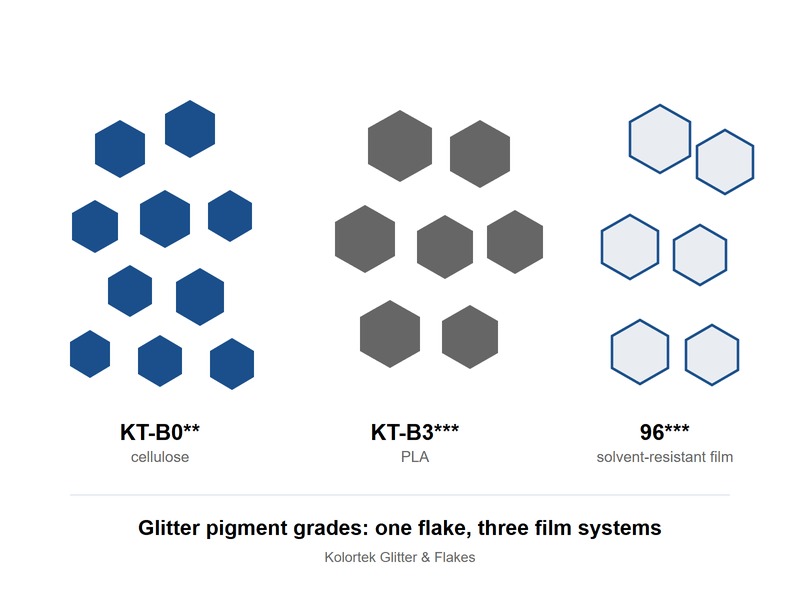
Cellulose, PLA and solvent-resistant film in one glitter range: code families, particle sizes and cosmetic grades of each, with the trade-offs stated plainly.
Item No. :
Glitter & Flakes family — cellulose KT-B0** / BC6*** / BC7*** / BC4*** / BC5***, PLA KT-B3*** / B7*** / B2***, regular film 92***–98***, fine laser KT-HL***, shape seriesColor Effect :
Cosmetic F-suffix grades for face and lip — 96***F-008 (18 solid colours), 97***F-008 (14 laser colours); biodegradable cosmetic blocks C93***F–C97***F; laser, rainbow, magic multicolour and fluorescent blocks on all three film systemsParticle Size :
1/128" ≈ 150 μm, 1/96" ≈ 180 μm, 1/64" ≈ 300 μm; cosmetic grades 100 and 200 μm; fine laser grades 100 μm and 35 μm; shapes from 0.1×1 mm strips to 3 mm pentagramsComposition :
Three film systems — compostable plant-derived cellulose; industrially compostable PLA (tougher film); solvent-resistant, heat-stable regular filmBrand :
KolortekMOQ :
Set per grade and per pack size; quoted against the selected codeApplication :
EU-led beauty and craft lines (cellulose/PLA); industrial coatings, nail systems and textile printing (regular film); cosmetic F-suffix grades at 3–5% use level; EU microplastics restriction (REACH Annex XVII Entry 78) positioning assessed per grade and aA buyer selling into the EU asks for glitter without the microplastic problem, and the honest answer starts with the film. This range runs three film systems — compostable cellulose, PLA, and solvent-resistant regular film — and the code prefix tells you which is which: the cellulose standard block alone covers 26 colours.
The EU microplastics restriction (REACH Annex XVII, Entry 78) restricts intentionally added microplastic particles, and glitter falls inside that scope for many uses. The restriction excludes unmodified naturally derived polymers and sets biodegradability test routes that some biodegradable glitter films are designed to meet. Phase-out schedules differ by application, so the film you select decides which markets stay open.
| Film system | Cellulose | PLA | Regular film |
|---|---|---|---|
| Source | Plant-derived cellulose | Polylactic acid | Metalised solvent-resistant film |
| End of life | Biodegradable in natural environments | Industrially compostable | Not biodegradable |
| Solvent and heat | Limited — verify in your system | Better durability than cellulose | Solvent resistant, heat stable |
| Standard code blocks | KT-B0**, KT-BC4***–BC7*** | KT-B2***, KT-B3***, KT-B7*** | 96***–98***, KT-HL***, shapes |
| Best fit | EU-led beauty and craft lines | Eco lines needing a tougher film | Industrial coatings, nail, textiles |
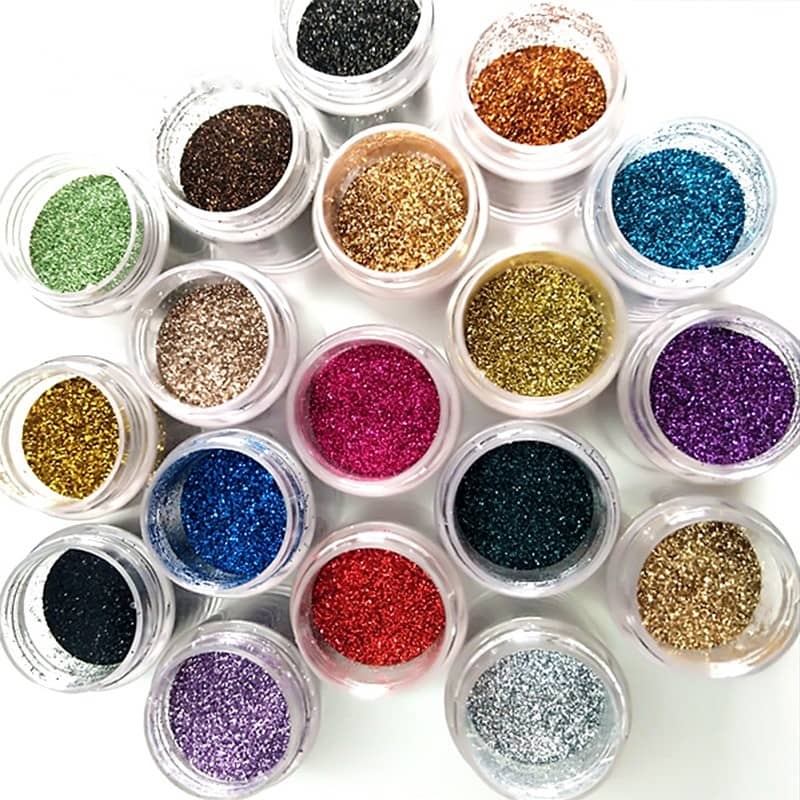
Fig. 1 — Part of the glitter colour range as supplied in jars. Colour is carried by the film coating; the material underneath is what the code prefix records.
Cellulose glitter replaces the plastic core with plant-derived film. The catalogue splits it into five blocks, and each block keeps its own size and colour logic:
The trade-off is real and we state it plainly: cellulose film has limited solvent and heat resistance compared with regular film. In a solvent-heavy system the flake surface can lose its brilliance. Test the grade in your actual base before committing a programme — the sample packs exist for this.
PLA glitter keeps the compostability story but starts from a polylactic acid film, which handles handling and formulation stress better than cellulose. Three blocks carry it:
"Industrially compostable" is a precise claim, not a loose one: it means the film breaks down under controlled composting conditions. If your customer's claim depends on a specific certification scheme, tell us which one — the documentation conversation is easier before the order.

Fig. 2 — Glitter flakes spread out for inspection. Flake geometry, not colour, is what the cutting step controls; the film system decides how that geometry survives in your base.
Regular film glitter is not the legacy option waiting to be replaced. It is solvent resistant and heat stable, which is why industrial coatings, nail systems and textile printing still run on it. We supply both lines, so this is a fit statement, not a sales pitch.
The regular line also goes finer and more shaped than the biodegradable blocks. The fine laser grades run at 100 μm (KT-HL001-360 and KT-HL105-360) and 35 μm super fine (KT-HL001-700 and KT-HL105-700), where a biodegradable film this thin is not on offer. Solid colours span the 96*** block, laser colours the 97*** block, with magic multicolours at 92***, rainbow at 95*** and fluorescent at 98***, plus aluminum silver and gold at KT-99001 and KT-99105.
Shapes live here too: the pentagram series cut at 3 mm, 16 strip variants from 0.1×1 mm up to 0.3×4.7 mm, circular shapes in single and mixed colours, and the Luxury Diamonds series. Where the brief calls for a shape rather than a hexagon, this is the family that carries it. For effect pairs outside the PET-style line, see the borosilicate Dreamstar glitter grades such as KT-8235, or mica-based carriers like KT-355 for epoxy and decorative work.
Cosmetic grade is a layer on top of the film choice, not a separate family. Grades carrying the F suffix at the 008 size — 18 solid colours in the 96***F block and 14 laser colours in the 97***F block — are made for face and lip products, cut at 100 and 200 μm in square and hexagonal shapes. Typical use level sits at 3–5%, and the particles are manufactured against FDA and EU cosmetics expectations.
The biodegradable side has its own cosmetic layer: the C93***F through C97***F blocks put candy, fresh, multicolour, laser and bright shades on cellulose film at 1/128", sized for pressed and gel formulas. Whichever side you pick, keep the size rule in mind — the bigger the particle, the more sparkling the effect, and the more the formula has to carry. For how we build cosmetic effect systems around pearlescent pigments, see the cosmetics industry page, and for a fine cosmetic sparkle outside the glitter family, KT-68860311 is the nearest match.
Glitter sizes are quoted in inch fractions, and three of them cover most of the range: 1/128" is about 150 μm, 1/96" about 180 μm, and 1/64" about 300 μm. The cosmetic grades quote directly in microns — 100 and 200 μm — because cosmetic formulation work happens in metric. When a customer brief says "fine", confirm the fraction: one supplier's fine is another's chunky, and the flake diameter decides both sparkle and carry.
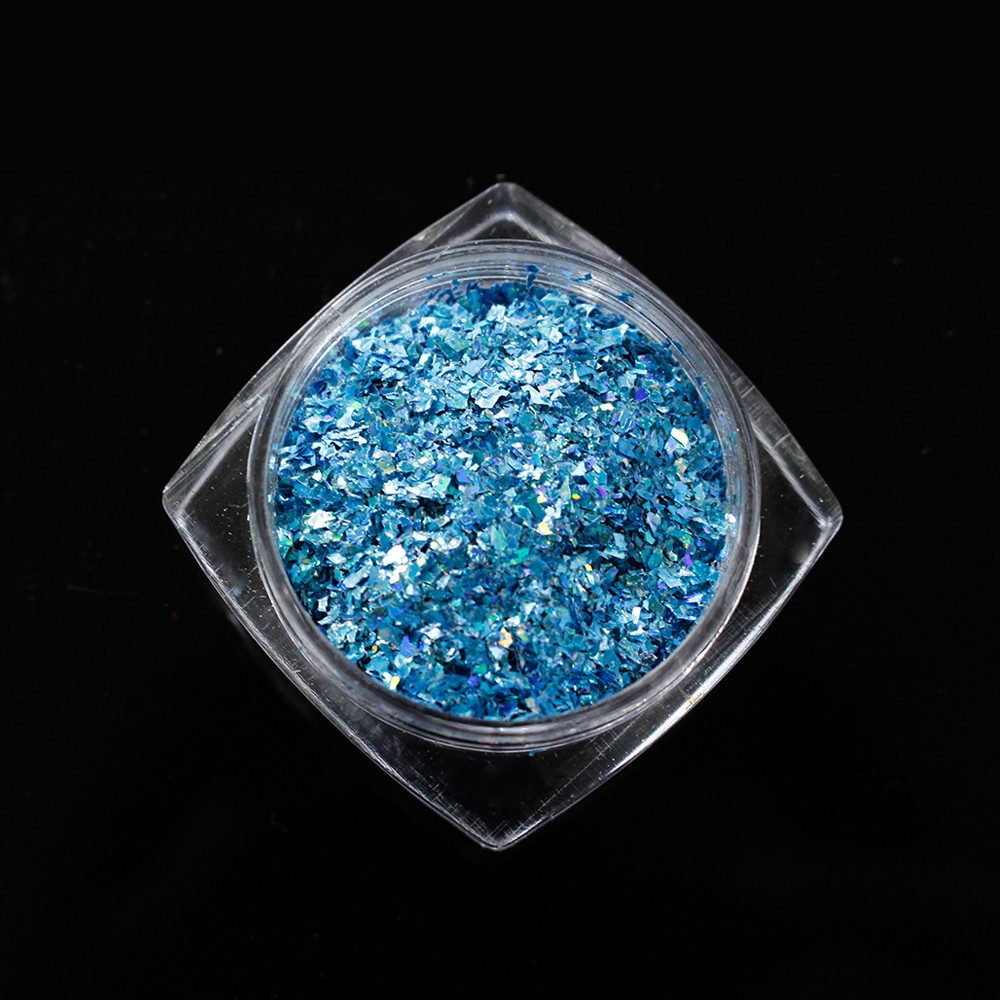
Fig. 3 — Supplied form: flakes packed in jars for sampling and production. Bulk packing is quoted against the selected grade and volume.
MOQ for the glitter range is set per grade and per pack size, and it differs between the sample-oriented cosmetic blocks and the industrial bulk blocks. Contact us with the code prefix, the size fraction and your target volume for a specific quote. The overview catalogue and current colour documentation are available from our download centre.
Production runs under an ISO 9001:2015 certified quality system. On the regulatory side, the EU microplastics restriction is the conversation that brings most buyers to this page: the restriction targets intentionally added microplastic particles, excludes unmodified naturally derived polymers, and defines biodegradability test routes that the cellulose and PLA films are positioned against. We do not hand out blanket compliance claims — scope and timing depend on your application and market, so the relevant declarations and supporting documents are provided on request for the required grade.
Will cellulose glitter survive a solvent-based system?
Not reliably. Cellulose film has limited solvent and heat resistance, so in solvent-heavy bases the surface can dull. If your system is solvent-based, start from the regular film line, or test a PLA grade — "better durability than cellulose" still has to be proven in your base.
Which grades can go into face and lip products?
The F-suffix blocks: 96***F-008 and 97***F-008 on regular film, and the C93***F–C97***F blocks on cellulose. Both are cut for cosmetic use and supported with the documentation your market asks for, provided on request.
Is biodegradable glitter weaker than regular glitter?
Cellulose, yes — that is the honest trade-off. PLA narrows the gap. Neither matches regular film in solvent and heat exposure, which is why the regular line remains our recommendation for industrial coatings and nail systems rather than a placeholder waiting to be swapped.
Which block should I sample first?
Let the market decide the film, the base decide the test. EU-led beauty line: start from the cellulose standard block, with PLA as the durability follow-up. Industrial or nail system: start from regular 96*** in your colour. Cosmetic launch: go straight to the F-suffix blocks at 100 or 200 μm.
The biodegradable family is covered by eight sample packs: the cellulose standard and finer-cut blocks, laser, fluorescent and rainbow cellulose, and the PLA standard, laser and rainbow blocks — each a 2 g bag set. Regular-line packs cover the 96***-008 and 96***-004 sizes, the holographic 360 and 700 laser grades, the pentagram shapes, the F-suffix cosmetic set and the Luxury Diamonds series. Tell us the market you are selling into and the system the flakes will end up in, and the sample set that arrives will match the decision you actually have to make.
Cellulose, PLA and solvent-resistant film in one glitter range: code families, particle sizes and cosmetic grades of each, with the trade-offs stated plainly.
Read More
 English
 Français
 Deutsch
 Русский
 Español
 Português