
Leave A Message
If you are interested in our products and want to know more details,please leave a message here,we will reply you as soon as we can.
Fluorescent Pigments for Plastics: Carrier Choice Sets the Heat Limit
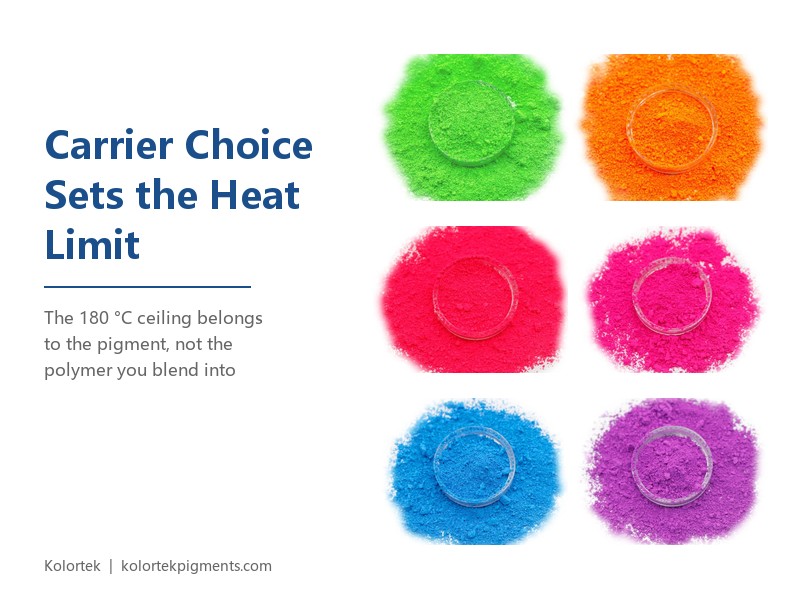
Fluorescent pigments for plastics carry a 180 °C ceiling set by the pigment carrier, not the machine. Host polymers rank differently for service life.
The temperature limit on a fluorescent moulded part does not sit in your injection moulding machine. It sits inside the pigment powder. Every fluorescent pigment is an organic dye dissolved in a transparent resin and ground fine, so each particle carries its own carrier. That carrier fails above 180 °C and the colour goes with it. Which polymer you put the powder into is a separate question, and it decides something different: how long the part keeps that colour.
Key takeaways
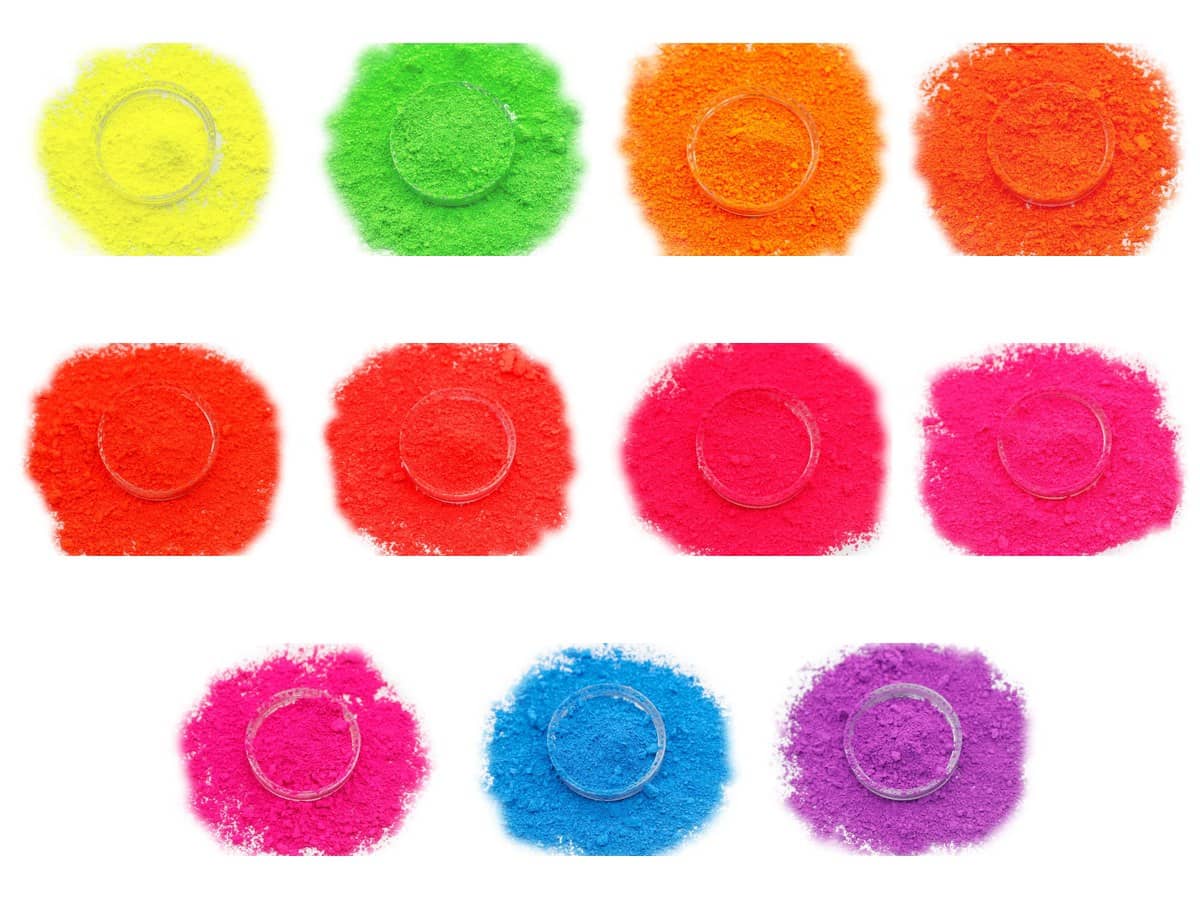
Loose FDS powder on a white card. Powder hue is not part hue: the moulded colour depends on the polymer, the loading and the base layer underneath.
Most buyers open with how much powder to add. The question that decides whether the project works is how hot the part runs. A fluorescent part that sees temperature above the ceiling is a colour failure no downstream adjustment repairs, and your machine is not where the limit comes from.
A fluorescent pigment particle is a composite. Organic dye is dissolved in a transparent resin carrier, cured, then ground to powder. The dye never sits loose in your compound — it sits inside that resin. So 180 °C is a property of the particle you bought, and it stays the same whether the surrounding plastic is PVC or polypropylene.
Above the ceiling the dye degrades thermally, and two things go at once: the hue fades and the fluorescence drops. It is not a slight yellow shift you can tint back. The dye itself degrades.
The second counterintuitive part: loading cannot rescue this. A degradation ceiling is a property of the material, not of concentration, so adding less buys no headroom. Nor is there a higher-temperature grade to switch to. If the process has to sit above the limit, change the process or the application — the recipe is the wrong place to look.
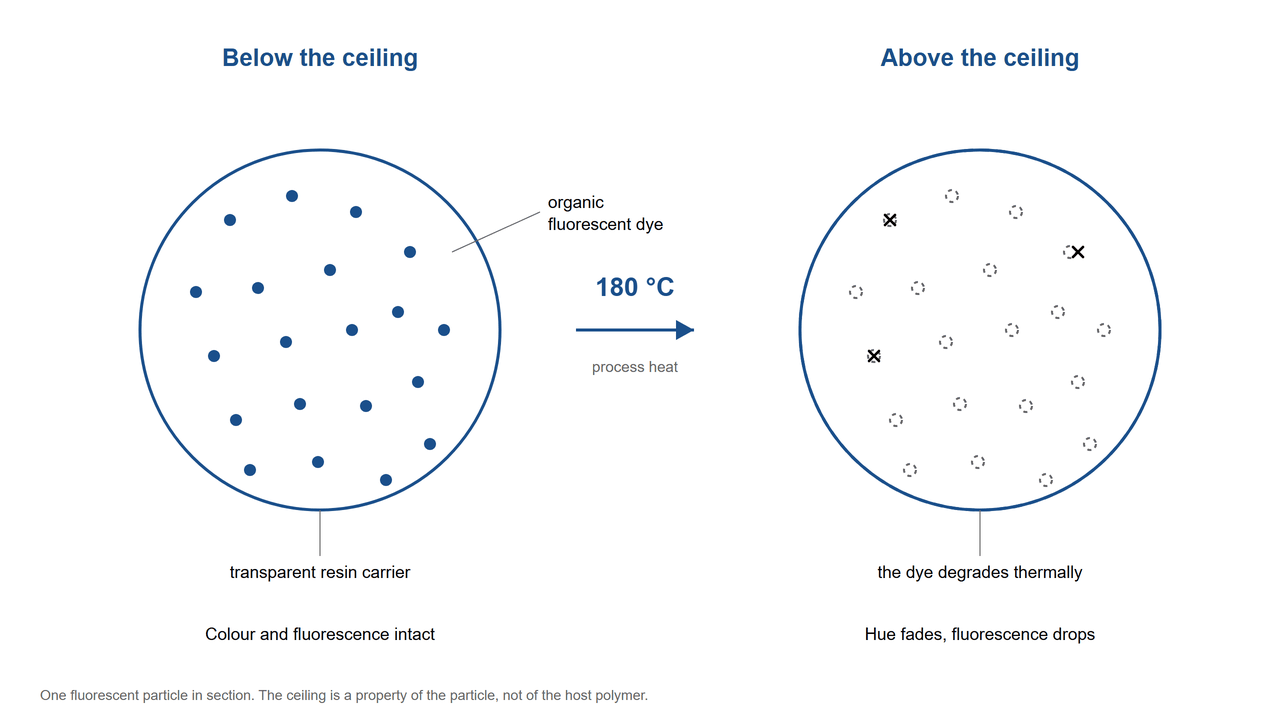
One fluorescent particle in section: dye molecules held inside a transparent resin carrier, with the failure path above 180 °C marked at the upper right.
Once the temperature gate is clear, a second gate decides everything else: the host polymer. The same powder blended into different systems gives noticeably different service life. That ordering is published industry data, not a result from our own testing.
The published sequence runs from PVC at one end to aromatic PUR at the other: PVC, transparent cPP, PC or ABS, aliphatic PUR, acrylic, polyolefin, alkyd, aromatic PUR. Read it as an order, not a scale. The positions tell you which system outlasts which; they carry no values you can convert between.
Standard polymer chemistry explains the order. Three forces pull on the dye: how much short-wave UV the polymer passes, how much oxygen it passes, and whether its own photo-oxidation generates radicals that attack the dye. PVC sits first because it is nearly opaque to short-wave UV and resists oxygen, not because it is a finer material. Polyolefin sits near the bottom because it passes UV and oxidises readily.
Keep the two carriers apart. The carrier inside the pigment sets the temperature ceiling. The polymer you blend into sets the service life. Teams that merge the two questions conclude that fluorescent pigment does not work in plastics, when what they actually measured is one dye in one system at one wall thickness.
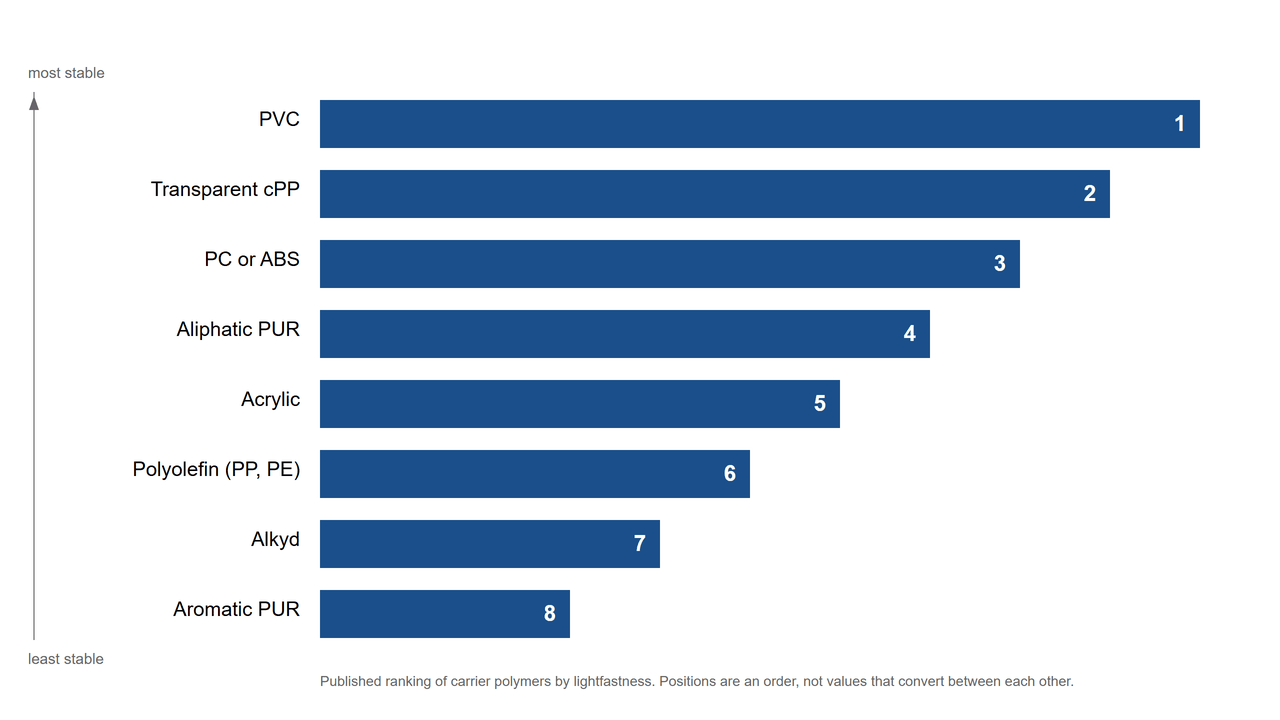
Published ranking of carrier polymers by lightfastness, eight positions, strongest at the top.
The table below spreads the eight systems out. It is not a verdict on whether you may use fluorescent pigment; it is a list of what you have to compensate for if you do.
| System | Position | What limits it | What to do |
|---|---|---|---|
| PVC, rigid or plasticised | 1 | Nearly opaque to short-wave UV, good oxygen barrier | First choice; confirm the plasticiser does not migrate |
| Transparent cPP | 2 | Process temperature stays under the ceiling, UV transmission moderate | Films and sheet first |
| PC or ABS | 3 | High process temperature; the polymer yellows on its own | Thin-wall signage parts; control residence time |
| Aliphatic PUR | 4 | Aliphatic structure photo-oxidises slowly | Workable for cast parts |
| Acrylic | 5 | Passes short-wave UV | Pair with a UV topcoat |
| Polyolefin, PP and PE | 6 | Passes UV and oxidises easily | Thin walls only, with stabilisers, designed for short life |
| Alkyd | 7 | Residual photosensitive groups | Not for long-life parts |
| Aromatic PUR | 8 | Aromatic structure absorbs UV and generates radicals | Avoid |
The further down the table you go, the more the compensation has to come from part design — thin walls, a UV topcoat, a white base layer — rather than from adding more powder.
Lightfastness also falls by hue, and the published order is blue, green, lemon yellow, UV blue, orange, magenta. Magenta fades first because of the dye's own conjugation length, not because the formulation was botched. If a part has to hold colour in daylight, that ordering is a design input rather than a footnote.
Range covers the choice. FDS runs 11 colours at 1–5 μm and FJS runs 11 colours at 1–2 μm; the finer grade disperses more evenly and gives a smoother surface, which matters for film and thin walls. The orange and red end is served by KT-FDS422 orange yellow and KT-FDS426 bright red.
Loading runs 5–15%, set by part thickness. Past a point the return falls away: particles shield one another and reabsorb emitted light, so a heavier loading is not a brighter part. Build a loading curve on your own substrate before you fix the number.
Fluorescence is semi-transparent. With no white base underneath, light passes through the part and the colour reads dull. The white base is a prerequisite, not a finishing trick.
There is no fluorescent black, grey or deep tone. When a part has to read dark, fluorescence is the wrong tool, and no loading changes that.
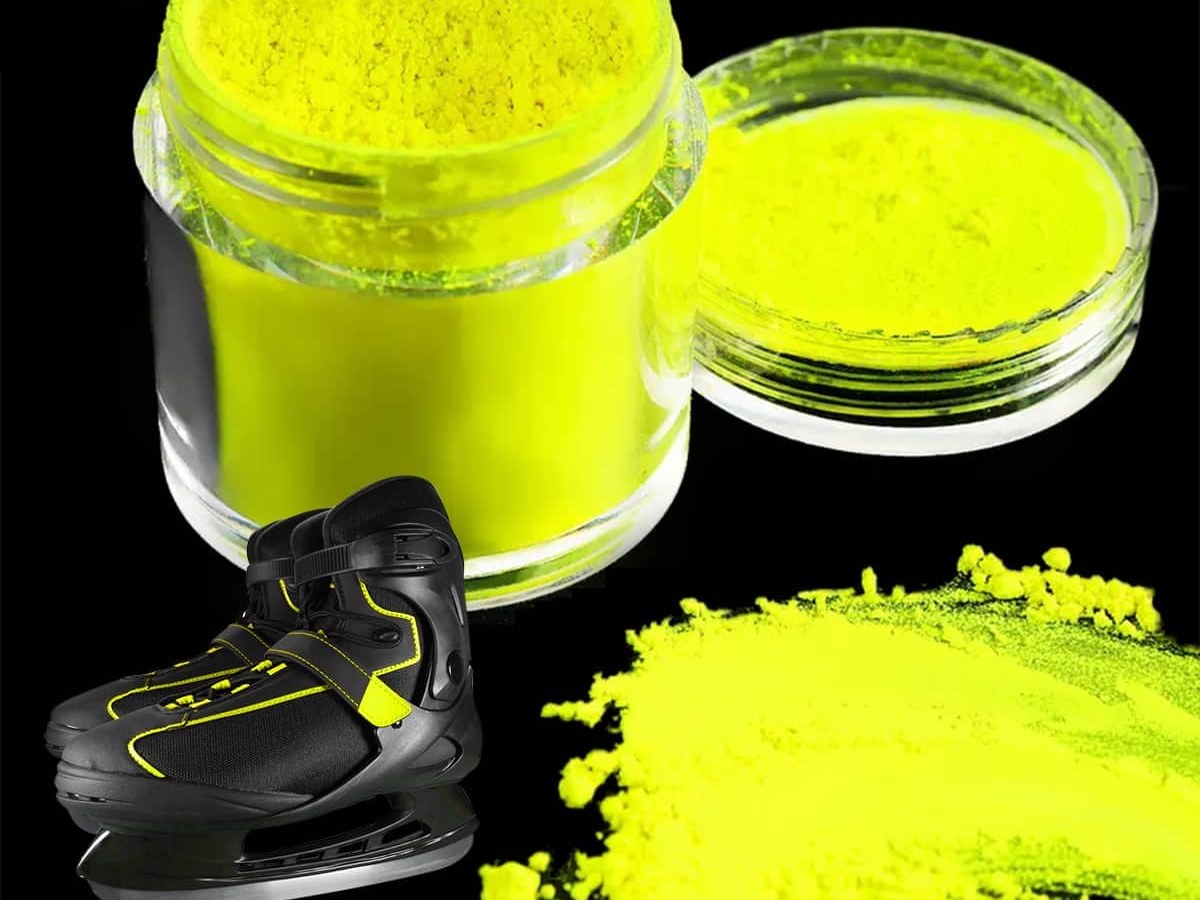
The same pigment as powder, and once inside a polymer. Base layer, wall thickness and loading all move the final colour.
Five things to settle before the mould is cut. Settling them afterwards costs more than settling them now.
Browse the fluorescent pigment range for the full colour set, or take the Fluorescent Pigments catalogue for particle size and series detail. We manufacture the FDS and FJS lines and supply detail on request. If you already know the polymer and the wall thickness, send both and we will point you at the grade that fits.
Yes, but this is the least rewarding group of systems. Polyolefins pass short-wave UV and oxidise easily, so fluorescence decays faster there than anywhere else on the list. If you use them, go thin-wall, add stabilisers, and design the part as a short-life item from the start.
The card is powder; the part is powder plus polymer. The polymer decides how deep UV and oxygen reach into the wall, and whether its own photo-oxidation produces radicals. That is why the same pigment in PVC and in a polyolefin are not the same material at all — the ranking in the table above is the working reference.
Only up to a point. The recommended band is 5–15%, and beyond it particles shield each other and reabsorb emitted light, so the return diminishes. Run a loading curve on your own substrate and choose from the data rather than from the top of the range.
The dye degrades thermally. Colour fading and loss of fluorescence happen together. The ceiling belongs to the resin carrier inside the pigment, so reducing the loading does not lift it — the process temperature has to come down, or the application has to change.
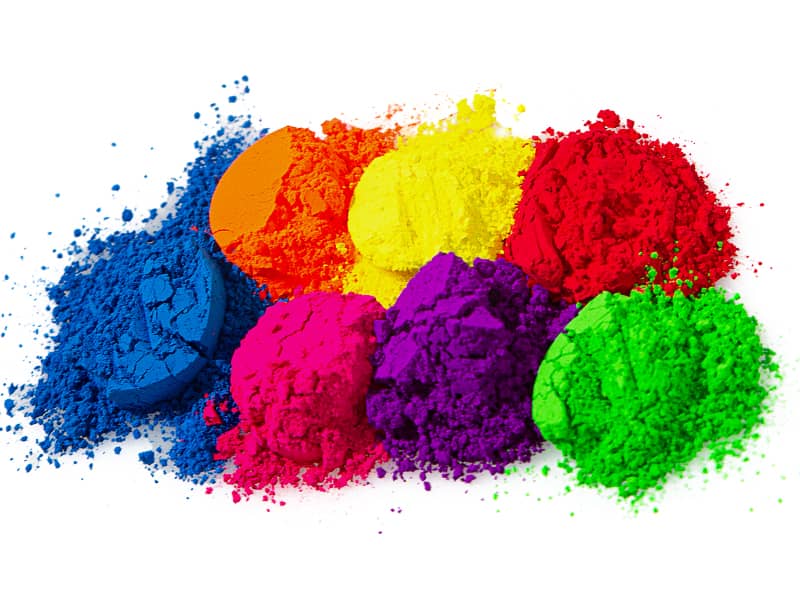
Fluorescent pigments — also referred to as neon pigments — produce colors that appear significantly brighter than conventional pigments under the same lighting conditions. This is because they absorb UV and short-wavelength visible light and re-emit it as visible fluorescence, adding emitted light to reflected light. The result is a color intensity that standard pigments cannot achieve through reflection alone. Kolortek's fluorescent pigment series covers a range of neon colors for use in printing inks, coatings, plastics, cosmetics, and specialty applications.
Read More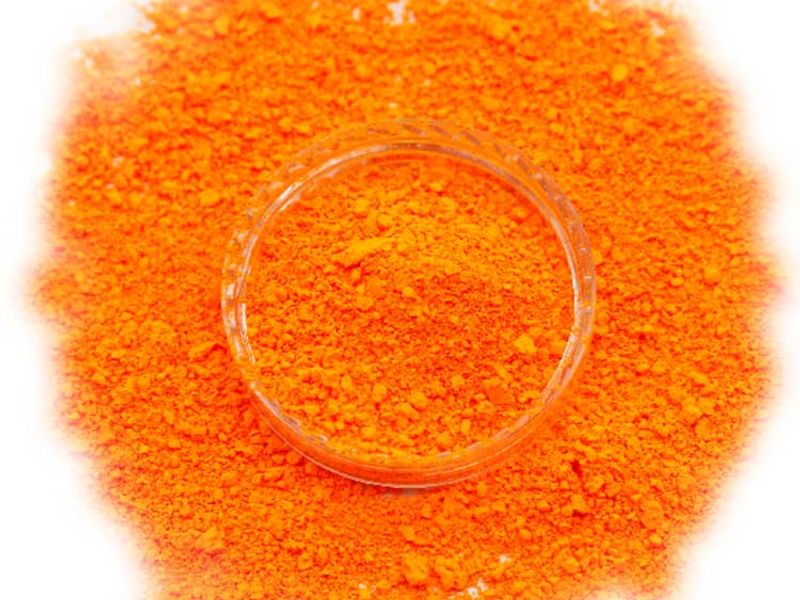
KT-FDS422 is an orange-yellow fluorescent powder in the fine 1–5μm particle size range — a neon-grade daylight fluorescent pigment that produces a high-chroma orange-yellow color significantly brighter than conventional pigments by converting absorbed light (including UV) into visible fluorescent emission.
Read More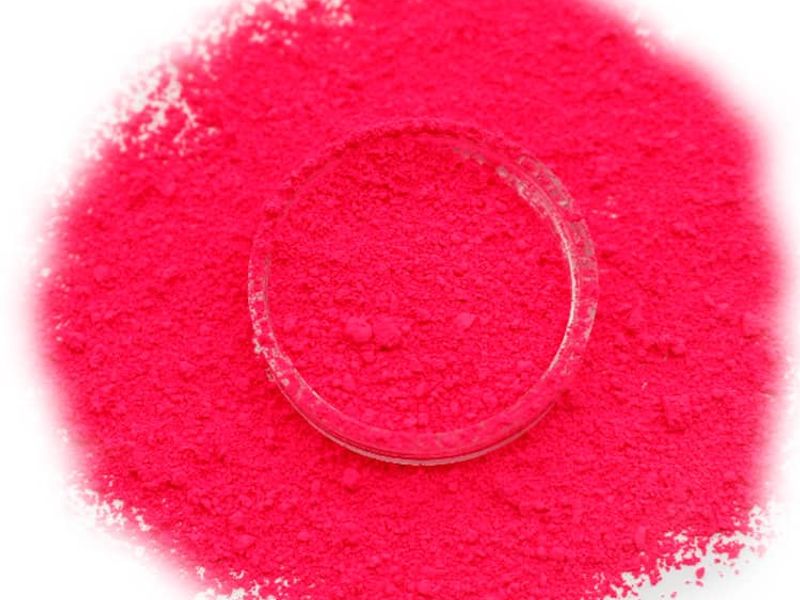
KT-FDS426 is a Bright Red daylight fluorescent pigment in the fine 1–5μm particle size range — a neon-grade organic pigment that converts absorbed light (including UV) into visible fluorescent emission, producing a red color with a luminance level that significantly exceeds conventional red pigments under daylight and UV-rich lighting conditions.
Read More
Fluorescent pigments for plastics carry a 180 °C ceiling set by the pigment carrier, not the machine. Host polymers rank differently for service life.
Read More
 English
 Français
 Deutsch
 Русский
 Español
 Português