Choosing the right particle size is one of the most important decisions when formulating with pearlescent pigments. A fine grade can create a smooth satin glow, while a larger particle size produces stronger sparkle, brighter reflections, and a more noticeable visual texture. However, the best particle size depends not only on the desired appearance but also on the application, coating thickness, processing method, and substrate.
For paint manufacturers, cosmetic formulators, plastic processors, printing ink producers, and resin manufacturers, understanding the relationship between particle size and optical performance helps reduce formulation trials and achieve more consistent results. Kolortek supplies pearlescent pigments in a wide range of particle sizes, allowing manufacturers to select grades for different surface finishes and application requirements.
This guide explains how pearlescent pigment particle size affects luster, coverage, sparkle, and processing performance, with practical selection recommendations for industrial and decorative applications.
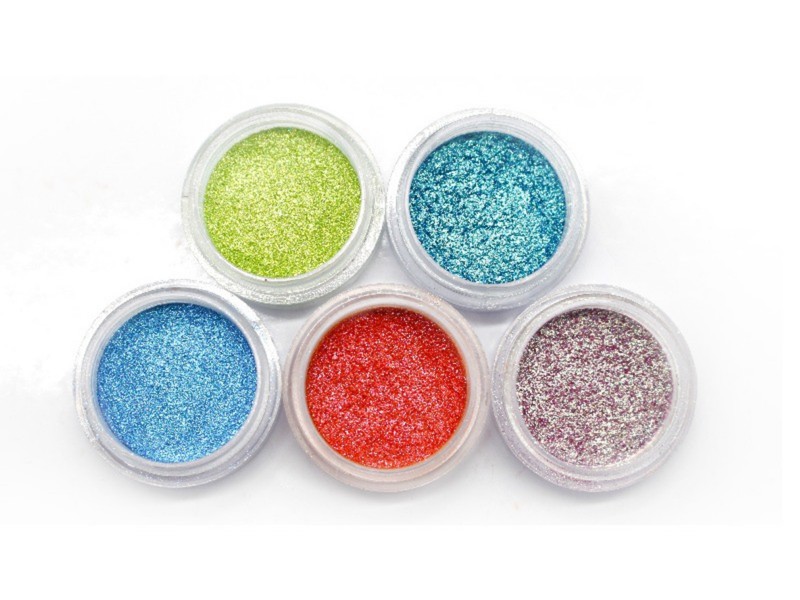
Pearlescent pigments create different visual effects depending on particle size, coating structure, and light reflection.
How Particle Size Affects Pearlescent Pigment Performance
Pearlescent pigments are generally composed of plate-like substrates coated with metal oxides. When light reaches these particles, reflection and interference create the characteristic pearl-like luster. Particle size determines how the reflected light is distributed across the surface and how the pigment appears to the observer.
Smaller particles generally produce a more uniform, softer reflection. Larger platelets reflect light more directionally, making individual flashes of light easier to see. As particle size increases, the appearance often changes from smooth pearl to visible shimmer and eventually to a sparkling or glitter-like effect.
| Particle Size |
Visual Effect |
Typical Characteristics |
| Fine: 5–25 μm |
Soft satin, silky pearl |
Smooth appearance, subtle shimmer, relatively uniform coverage |
| Medium: 10–60 μm |
Classic pearl luster |
Balanced brightness, coverage, and shimmer |
| Large: 20–100 μm |
Strong shimmer |
More visible reflective points and brighter appearance |
| Coarse: 40–200 μm |
Sparkle, flash effect |
Distinct reflections, decorative texture, lower hiding power |
| Extra coarse: 100–500 μm or wider |
Intense sparkle, glitter-like appearance |
Strong individual particle visibility, specialized decorative applications |
These ranges are general guidelines rather than fixed industry boundaries. Different pigment substrates, particle size distributions, surface coatings, and formulation conditions can produce different effects even at the same nominal particle size.
Fine Particle Pearlescent Pigments for Smooth Finishes
Fine pearlescent pigments, commonly ranging from approximately 5 to 25 μm, are suitable for applications where a smooth surface, subtle luster, and relatively uniform appearance are important. Smaller platelets tend to create a more continuous optical effect without producing prominent individual sparkle.
Fine particle grades are particularly useful in thin coatings, delicate cosmetic textures, and printing applications where surface smoothness and controlled reflection matter more than dramatic glitter.
Typical applications include:
- Automotive coatings requiring a smooth pearl finish
- Fine cosmetic powders and eyeshadow formulations
- Printing inks and decorative packaging
- Thin-film coatings and specialty surface finishes
- Plastic components requiring subtle shimmer
For formulators looking for a refined silver-white effect, Kolortek's Silver White Pearlescent Pigment Series includes fine grades designed for smooth luster and more controlled surface appearance.
Fine particles are not necessarily the brightest option under every lighting condition. They typically create a more diffuse and uniform sheen, while larger particles may produce stronger flashes of reflected light.
Medium Particle Sizes for Balanced Pearl Effects
Particle sizes around 10–60 μm are widely used because they offer a practical balance between coverage, brightness, and visible shimmer. This range is often a good starting point when a formulation needs a recognizable pearlescent effect without excessive sparkle or surface roughness.
Medium particle grades can be evaluated in many coating systems, plastic formulations, decorative products, and cosmetic applications. Their versatility makes them a common choice for manufacturers developing new pearl-effect products.
In coatings, medium-sized particles can provide noticeable pearl reflection while maintaining a relatively uniform finish. In cosmetics, they can produce visible shimmer without the highly textured appearance associated with some coarse grades. In plastics, they can add a decorative effect while remaining suitable for many molding and extrusion applications, subject to process testing.
Kolortek's Pearlescent Pigment Product Range includes silver white, interference, gold, metal luster, multicolor, and other effect pigment series with different particle size options.
Large Particle Pigments for Stronger Sparkle
Large particle pearlescent pigments, typically around 20–100 μm or above, create more visible flashes of light. Their platelets reflect light in a more directional way, making the finished surface appear brighter and more dynamic as the viewing angle changes.
These grades are often selected for decorative applications where visual impact is a priority, including automotive special-effect finishes, resin crafts, decorative floor coatings, nail products, and selected plastic components.
Compared with fine grades, larger particles generally provide less uniform coverage and may require a thicker coating or a more carefully controlled application process. They can also be more sensitive to spray nozzle size, film thickness, mixing conditions, and particle orientation.
For projects requiring stronger reflection or metallic-looking decorative effects, Kolortek's Metal Luster Pearlescent Pigment Series offers different particle size grades and warm metallic color effects.
How to Select Particle Size for Different Applications
The ideal particle size changes according to the application process. A pigment that performs well in a thick resin casting may not be suitable for a thin printing ink layer or a fine spray coating. Manufacturers should consider the film thickness, equipment limitations, desired appearance, and formulation compatibility before selecting a grade.
| Application |
Suggested Particle Size |
Selection Considerations |
| Automotive coatings |
5–25 μm or 10–60 μm |
Smooth finish, orientation, brightness, sprayability |
| Decorative paints |
10–60 μm |
Balanced pearl effect and surface uniformity |
| Epoxy resin and flooring |
20–100 μm or 40–200 μm |
Visible sparkle, film thickness, leveling |
| Cosmetics |
5–25 μm, 10–60 μm, 20–100 μm |
Skin feel, shimmer intensity, formulation requirements |
| Printing inks |
5–25 μm |
Ink film thickness, mesh or cell size, printability |
| Plastic masterbatch |
5–60 μm |
Shear conditions, particle integrity, molding geometry |
| Decorative nail products |
10–60 μm or 20–100 μm |
Shimmer, smoothness, suspension, application thickness |
For printing, particle size is especially important because the ink layer is relatively thin. Coarse particles may cause uneven printing, poor transfer, or compatibility issues with printing equipment. Fine grades are generally more suitable for gravure and flexographic systems, while screen printing can accommodate a wider range depending on mesh specifications.
For plastic processing, particle integrity also matters. Excessive mechanical shear during compounding may damage delicate platelets and affect the final optical effect. Testing the pigment with the actual resin, processing temperature, and equipment is recommended.
Manufacturers working with coating formulations can also refer to Kolortek's Pearlescent Pigments for Paints and Coatings application guidance when comparing grades for spray coatings, decorative paints, and other coating systems.
Particle Size, Coverage, and Brightness
Particle size influences both the visual intensity and coverage of a pearlescent pigment. Fine particles can distribute more evenly across a surface, creating a continuous satin or pearl appearance. Larger particles tend to produce stronger localized reflections, but the surface may look less uniform when the pigment concentration or film thickness is insufficient.
Brightness is not determined by particle size alone. Substrate transparency, metal oxide coating thickness, refractive index, platelet smoothness, pigment orientation, and the surrounding binder all contribute to the final optical result.
For example, a fine silver-white pigment may provide a clean, soft pearl effect, while a larger borosilicate-based pigment can create more intense sparkle. Two pigments with the same nominal particle size can therefore produce different visual effects depending on their substrate and coating structures.
When evaluating pigment grades, manufacturers should compare the following factors together:
- Particle size distribution rather than only the average particle size
- Platelet shape, thickness, and surface smoothness
- Substrate type, such as natural mica, synthetic mica, or borosilicate
- Metal oxide coating composition and thickness
- Pigment concentration and binder transparency
- Film thickness and application method
- Mixing and dispersion conditions
Why Particle Size Distribution Matters
Particle size distribution describes the range of particle sizes present in a pigment grade. It is an important specification because two products with the same nominal size may behave differently if one contains a broader distribution of particles.
A narrow distribution can help produce a more predictable optical effect, especially when uniform surface appearance or consistent batch performance is required. A broader distribution may combine smaller particles that contribute background coverage with larger particles that create visible sparkle.
When purchasing pearlescent pigments, manufacturers should request the particle size specification for the exact grade being evaluated. Depending on the supplier, the specification may include a particle size range, D50 value, or other distribution measurements. These values should be interpreted together rather than treated as interchangeable.
For high-volume production, batch consistency is also important. Differences in particle size distribution can affect appearance, application behavior, and color matching between production batches. Establishing an approved pigment grade and testing it under standardized conditions can help reduce variation during manufacturing.
How to Test and Confirm the Right Particle Size
Particle size specifications provide a useful starting point, but laboratory testing remains the most reliable way to confirm whether a pigment meets the requirements of a specific formulation.
A practical evaluation process should include:
- Prepare samples using the same binder, resin, or base formulation.
- Use consistent pigment loading and mixing conditions.
- Apply samples at comparable film thicknesses.
- Compare appearance under direct light, diffuse light, and different viewing angles.
- Check surface smoothness, coverage, sparkle, and color uniformity.
- Evaluate processing compatibility, stability, and final product performance.
- Confirm the selected grade through a production-scale trial when necessary.
For applications where particle size selection is difficult, working directly with a pigment manufacturer can help narrow the options. Kolortek provides multiple pearlescent pigment series and particle size grades for different applications, allowing customers to compare samples and identify a suitable specification for their formulation.
Frequently Asked Questions About Pearlescent Pigment Particle Size
What particle size is best for pearlescent pigments?
There is no single best particle size for every application. Fine grades around 5–25 μm are commonly used for smooth satin finishes, medium grades around 10–60 μm provide balanced pearl luster, and larger grades around 20–100 μm or above create stronger sparkle. The final choice depends on the desired appearance and formulation process.
Does a larger particle size always produce a brighter pearlescent effect?
Larger particles generally produce stronger visible flashes and sparkle, but brightness also depends on substrate transparency, coating structure, particle orientation, pigment concentration, and lighting conditions. A larger particle size does not automatically mean a better overall finish.
Which particle size is suitable for automotive paint?
Fine grades around 5–25 μm are often evaluated for smooth, subtle pearl finishes, while 10–60 μm grades are commonly used for balanced shimmer. Larger particles may be suitable for special-effect finishes, but spray equipment and film thickness should be checked before use.
Which pearlescent pigment particle size is suitable for epoxy resin?
Particle sizes around 20–100 μm are a common starting point for decorative resin applications. Coarser grades around 40–200 μm may be selected when a more visible sparkle effect is required and the resin layer is thick enough to accommodate the particles.
Why are fine pearlescent pigments preferred for printing inks?
Printing ink layers are usually thin, and the printing equipment has specific limitations related to ink transfer, mesh openings, and cell dimensions. Fine particles are generally easier to incorporate into thin ink films and help reduce printing defects associated with oversized particles.
Can different particle sizes of pearlescent pigments be mixed?
Yes. Mixing fine and coarse grades can create a combination of uniform background luster and visible sparkle. However, the blend ratio, dispersion conditions, film thickness, and compatibility should be tested to ensure the desired appearance and processing performance.
What is the difference between particle size and D50?
Particle size range describes the specified size interval of a pigment grade, while D50 is the median particle size under the measurement method used, meaning approximately half of the measured particle population is smaller and half is larger. D50 does not describe the full distribution by itself.
How can manufacturers choose the right pearlescent pigment grade?
Manufacturers should define the target appearance, application method, film thickness, substrate, formulation compatibility, and processing conditions. They can then compare particle size specifications, request samples, and conduct application testing before confirming the final grade.
Kolortek supplies pearlescent pigments in multiple particle size ranges for coatings, cosmetics, plastics, printing inks, resin, and decorative applications. If you are developing a new product or adjusting an existing formulation, contact Kolortek to discuss particle size, pigment series, sample availability, and technical specifications.
Looking for a suitable pearlescent pigment grade? Share your target effect, application, and processing requirements with Kolortek to help identify an appropriate pigment for evaluation.

 English
 Français
 Deutsch
 Русский
 Español
 Português