Leave A Message
If you are interested in our products and want to know more details,please leave a message here,we will reply you as soon as we can.
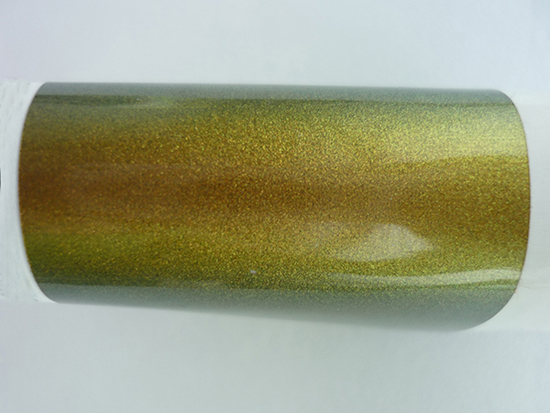
KT-90507 is an Orange/Cyan chameleon pigment in the 20–80μm particle size range — a color-shift pigment built on highly transparent flake crystals coated with titanium dioxide that produces a clear, angle-dependent shift between orange at the direct viewing angle and cyan at the oblique angle.
Item No. :
KT-90507Color Effect :
Orange/CyanParticle Size :
20-80μmBrand :
Kolortek / OEMMOQ :
1KGApplication :
Automotive Coatings, Cosmetics, Nail Products, Security Printing, Plastics, Synthetic Leather, Specialty Decorative
Orange/Cyan Chameleon Pigment Powder, 20–80μm – KT-90507
Pearlescent Pigments › Chameleon Series › Color Shift Pigments
KT-90507 is an Orange/Cyan chameleon pigment in the 20–80μm particle size range — a color-shift pigment built on highly transparent flake crystals coated with titanium dioxide that produces a clear, angle-dependent shift between orange at the direct viewing angle and cyan at the oblique angle. The color travel between these two complementary hues creates a strong visual contrast that reads distinctly different as the viewing angle or light direction changes. At 20–80μm, KT-90507 delivers the balanced combination of color travel intensity and surface coverage that makes it suitable for automotive refinish, decorative coatings, nail lacquer, plastics, and specialty printing applications.
Chameleon pigments differ fundamentally from standard pearlescent and interference pigments. Where standard interference pigments show a single color dependent on coating thickness, chameleon pigments use a multi-layer thin-film coating on a highly transparent flake substrate — the coating architecture is designed to produce strong constructive interference at two or more wavelengths depending on the angle of light incidence and observation. As the viewing angle changes, different wavelengths are selectively reinforced and suppressed, producing a continuous color flow rather than a static color shift.
In KT-90507, the shift progresses from orange at face angle to cyan (blue-green) at oblique angles. Orange and cyan are approximate complementary colors — the degree of contrast between them makes KT-90507 one of the visually higher-contrast shift pairs in the Kolortek chameleon range. The flake substrate's high transparency is essential to this effect: it allows light to pass through multiple coating interfaces cleanly, producing the strong color flow characteristic rather than a muted transition.
| Item No. | Color Shift | Shift Character |
|---|---|---|
| KT-90507 | Orange / Cyan | High contrast — warm to cool complementary shift |
| KT-90520 | Red / Orange | Adjacent warm hue shift |
| KT-90572 | Cyan / Red | Cool-to-warm complementary shift |
| KT-90552 | Green / Red | High contrast complementary shift |
| KT-90593 | Olivine / Violet | Yellow-green to violet shift |
| KT-90518 | Yellow / Blue | Warm-to-cool complementary shift |
The above represents the 20–80μm grade range. Multi-angle color-travel variants (4-color shift, e.g., KT-95107 Blue-green/Blue/Violet/Red) are also available in the Chameleon Series at various particle sizes from <15μm to 250μm. Contact Kolortek for the complete chameleon color card.
| Parameter | Value / Notes |
|---|---|
| Item No. | KT-90507 |
| Color Shift | Orange → Cyan (face angle → oblique angle) |
| Effect Type | Chameleon / color-shift — angle-dependent continuous color travel |
| Substrate | Highly transparent flake crystal — multi-layer TiO₂ coating for color shift generation |
| Particle Size | 20–80μm |
| Other Available Sizes | <15μm to 250μm range — contact us to confirm availability for this color combination |
| Base Color Dependency | Requires dark or black base — color travel effect is substrate-dependent; white or light bases suppress the shift |
| Binder Compatibility | Solvent-based, water-based, UV-curable, automotive basecoat systems |
| Primary Applications | Automotive refinish, decorative coatings, nail lacquer, plastics, printing, specialty security print |
| Documentation | TDS, SDS on request |
| Brand | Kolortek |
Chameleon color-shift pigments require a dark or black background to function. The color travel effect depends on the transparent flake substrate allowing light to pass through the multi-layer TiO₂ coating and reflect from an absorbing base beneath — without this absorption layer, the complementary wavelengths that should be suppressed at each angle are instead reflected by the light background, washing out the shift. Over a white or light substrate, KT-90507 will not show orange/cyan color travel.
In practice, this means: automotive and decorative coating applications require a black basecoat before applying the chameleon layer; nail lacquer must use a black or very dark base coat; resin and epoxy systems need a dark pigment incorporated into the base resin before chameleon addition; and plastic compounding requires either a dark-toned base resin or a black masterbatch carrier. The depth and clarity of the orange/cyan shift is directly proportional to how dark and light-absorbing the base layer is.
| Application | How KT-90507 Contributes | Base Requirement |
|---|---|---|
| Automotive refinish | Orange/cyan color travel in chameleon basecoat systems | Black basecoat required — apply chameleon layer over fully cured dark base |
| Decorative coatings | Color-shift effect in wall paint, furniture, architectural accent coatings | Dark base coat required |
| Nail lacquer | Orange/cyan color shift in standard and gel nail formulations | Black or very dark base coat required before chameleon top coat |
| Plastics | Color-travel effect in injection-molded and extruded plastic parts | Dark-toned base resin or black masterbatch carrier required for shift visibility |
| Specialty printing | Color-shift security feature in banknotes, negotiable securities, anti-counterfeit labels | Fine-grade (<15μm) preferred for printing — confirm nozzle spec; dark substrate required |
| Cosmetics | Color-travel effect in eye shadow, nail products | Dark base required; for cosmetic-grade documentation needs, contact Kolortek for dedicated cosmetic chameleon range |
Platelet orientation is critical: The color travel effect depends on chameleon flakes lying parallel to the substrate surface. Spray application produces better platelet orientation than brush application in coatings. In automotive basecoat systems, standard application parameters for metallic/pearl paints apply — wet-on-wet spray with controlled film thickness. Poor orientation reduces color travel clarity and can cause the shift to appear muted or incomplete.
Loading levels: Typical use levels in coatings range from 5–20% depending on the transparency of the system and the desired shift intensity. Higher loading increases color saturation but can reduce transparency and flatten platelet orientation. For automotive applications, 8–15% in a transparent medium coat over black is a practical starting range. Bench trials on your specific black base are essential before finalizing.
Mixing protocol: Add KT-90507 at the letdown stage using low-shear mixing. High-shear dispersion equipment fragments the transparent flake substrate and reduces the effectiveness of the multi-layer TiO₂ coating — both the color travel range and the shift intensity are reduced when flake integrity is compromised.
Kolortek has supplied chameleon color-shift pigments for over 20 years across automotive, decorative, and specialty printing markets, with consistent multi-layer coating uniformity across production batches — the manufacturing variable that most directly determines color travel range and shift clarity. TDS and SDS are available on request for KT-90507.
Q: Why does the orange/cyan shift disappear over a white base?
A: Chameleon color travel depends on a dark absorbing background. The transparent flake substrate allows light to pass through the multi-layer TiO₂ coating to the base and back — at each angle, certain wavelengths are selectively reflected while others pass through and are absorbed by the dark base. Over a white or reflective base, the wavelengths that should be absorbed at each angle are instead reflected back, mixing with the selectively reflected wavelengths and washing out the shift. A black base with low reflectivity provides the cleanest absorption of non-selected wavelengths and produces the most distinct orange/cyan color travel.
Q: What is the difference between the 20–80μm grade and the multi-angle 4-color shift chameleon grades (e.g., KT-95107)?
A: KT-90507 is a two-color shift pigment — it transitions between orange and cyan as the viewing angle changes. The KT-95107 series (e.g., Blue-green/Blue/Violet/Red) and similar multi-angle variants produce 4 distinct color phases across a wider angle sweep, using a more complex multi-layer coating architecture. Two-color shift grades like KT-90507 typically produce a higher contrast between the two specific hues; multi-color variants provide a richer color travel experience across a broader range of viewing conditions. Both require a dark base to function.
Q: Can KT-90507 be used in water-based coating systems?
A: Yes — chameleon pigments are chemically compatible with most water-based coating binders. The key formulation consideration is platelet orientation during film formation, which affects color travel clarity. Water-based systems with lower viscosity may allow more platelet settling before the film forms — incorporating a rheology modifier to maintain platelet suspension during application and early film formation helps preserve color travel intensity in waterborne systems.
Chameleon color travel is best evaluated in person — the orange/cyan shift in KT-90507 cannot be fully conveyed in product photography and must be seen under controlled directional light over a black substrate. Contact Kolortek to request a sample of KT-90507 for application trials, download the TDS, or discuss the full chameleon color-shift range including multi-angle variants.
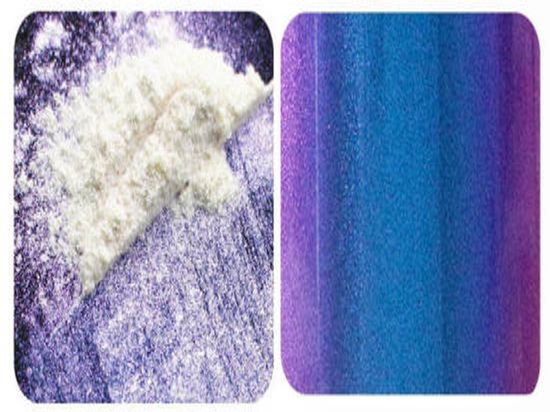
KT-92230 is a multichrome pigment that shifts through a full blue-purple-red-orange sequence as the viewing angle changes — one of the broadest color-travel arcs we produce in the KT-9000 series. Built on a natural mica substrate with a multi-layer TiO₂/Fe₂O₃/silica/tin oxide coating, it comes in a 25–130 μm particle size that delivers strong angular contrast and high visual impact across automotive finishes, decorative coatings, and specialty printing.
Read More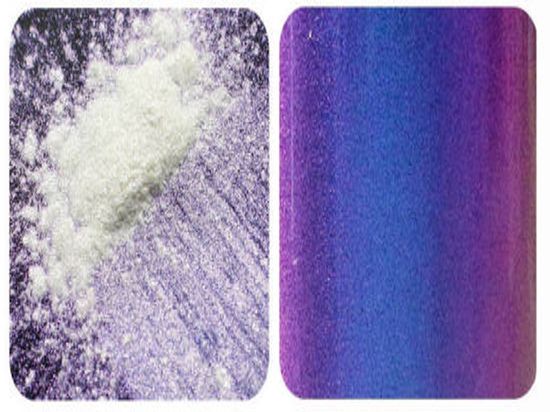
KT-92330 is a multi-layer interference pigment from Kolortek's KT-9000 Magic Chameleon Series, producing a continuous color shift sequence — indigo through purple, red, orange, and yellow — as the viewing angle changes. Built on natural mica coated with TiO₂, silica, and tin oxide, it delivers a high-mirror goniochromatic effect with a 25–130 μm particle size distribution engineered for maximum visual impact. This color shifting pigment powder performs best over dark or black substrates, where the full angular color travel is most legible.
Read More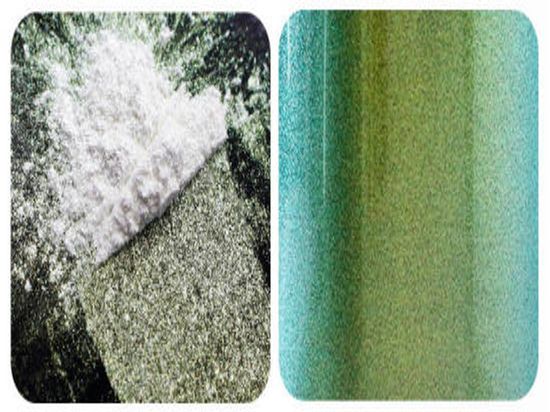
KT-92630 is a large-particle chameleon paint pearl from our KT-9000 Magic Chameleon Series, producing a sequential golden-to-kelly-green-to-blue color travel as the viewing angle shifts. With a 25–130 μm particle range, it delivers high visual impact in automotive custom finishes, decorative coatings, and specialty applications where a pronounced, multi-stop color flip is the goal. The substrate is natural mica with a multi-layer TiO₂/SiO₂/metal-oxide coating that generates the goniochromatic interference effect.
Read More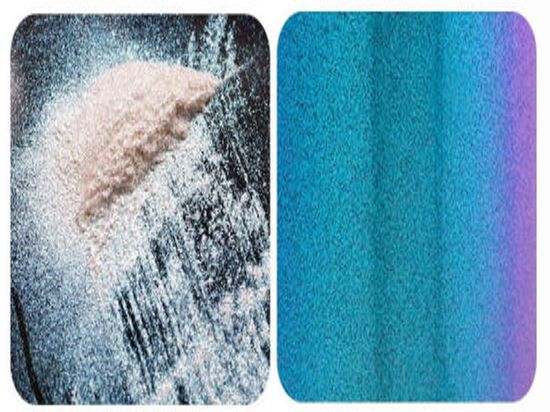
KT-92175 is the large-particle grade of our chameleon pigment for resin, built on a natural mica substrate with a multi-layer TiO₂, silica, and tin oxide coating that produces a continuous cyan-to-blue-to-purple-to-red angle-dependent color shift. At 75–175μm, it is the highest-sparkle option in the KT-9000 Magic Chameleon Series' KT-921** Cyan-Blue-Purple-Red range. Compatible with epoxy and UV resin at loadings of 1–10% by weight, the effect reads strongest on dark or black substrates where the goniochromatic shift has maximum contrast.
Read More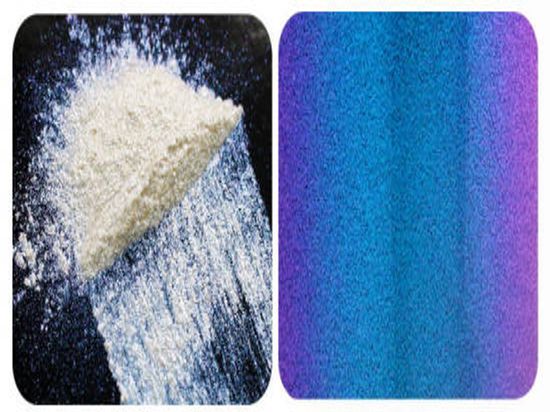
KT-92275 is a large-particle duochrome loose pigment from our KT-9000 Magic Chameleon Series, delivering a full blue-purple-red-orange color travel sequence that shifts continuously across the visible spectrum as the viewing angle changes. With a particle size range of 75–175 μm, this grade is engineered specifically for applications where maximum sparkle is the priority — loose eyeshadow, nail art toppers, and high-impact decorative cosmetics where the angular shift needs to read clearly against the skin or a dark base.
Read More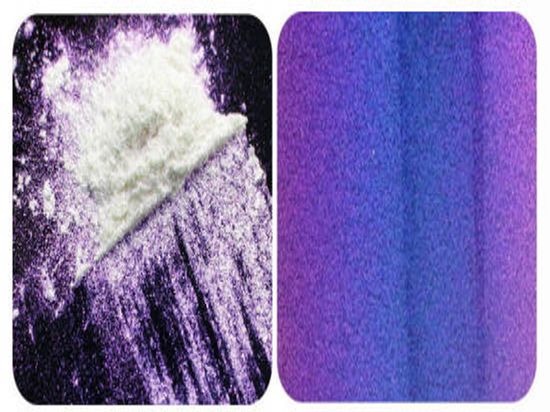
KT-92375 is a large-particle ghost chameleon pigment from Kolortek's KT-9000 Magic Chameleon Series, delivering a continuous five-stage color shift — indigo → purple → red → orange → yellow — as the viewing angle changes. Built on natural mica coated with titanium dioxide, silica, and tin oxide, it carries a particle size of 75–175 μm for maximum sparkle. We developed this grade specifically for high-impact automotive finishes, custom coatings, and luxury decorative applications where a dramatic, angle-dependent color shift is the primary design goal.
Read More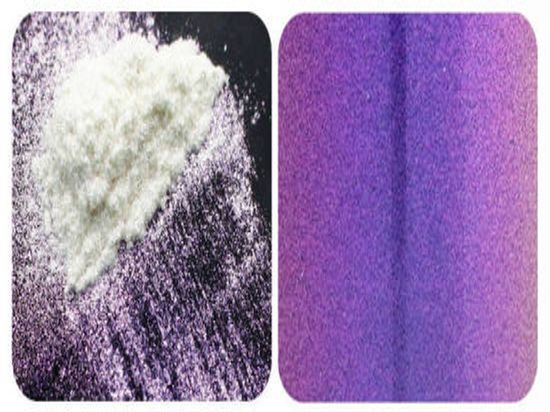
KT-92475 is a large-particle chameleon pigment from the KT-9000 Magic Chameleon Series, producing a continuous mauve → red → orange → yellow color shift that sweeps across the visible spectrum as the viewing angle changes. With a particle size of 75–175 μm and a natural mica substrate coated with titanium dioxide, silica, and tin oxide, it delivers the coarse, high-sparkle texture that nail art formulators need for maximum visual drama — particularly over a dark or black base coat.
Read More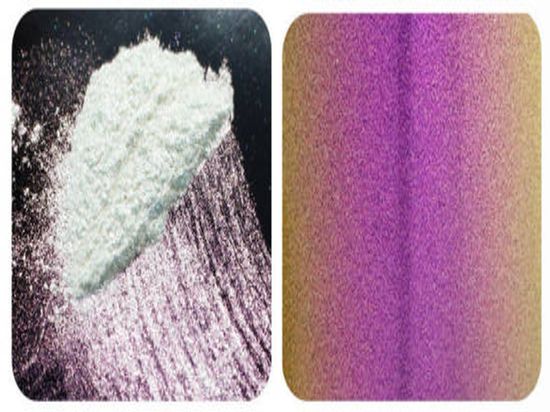
KT-92575 is a large-flake chameleon pearl powder from our KT-9000 Magic Chameleon Series, producing a dramatic angle-dependent color shift spanning red, orange, yellow, and kelly green on dark substrates. Built on a natural mica substrate with a multi-layer coating of titanium dioxide, silica, and tin oxide, it delivers an INCI composition suited to high-end cosmetic and nail art formulations. The 75–175 μm particle range gives it the high-sparkle, deep color-travel behavior that distinguishes it from finer cosmetic pearl grades.
Read More
 English
 Français
 Deutsch
 Русский
 Español
 Português