
Leave A Message
If you are interested in our products and want to know more details,please leave a message here,we will reply you as soon as we can.
Chromashift Color Travel Pigment for Auto Paint Applications
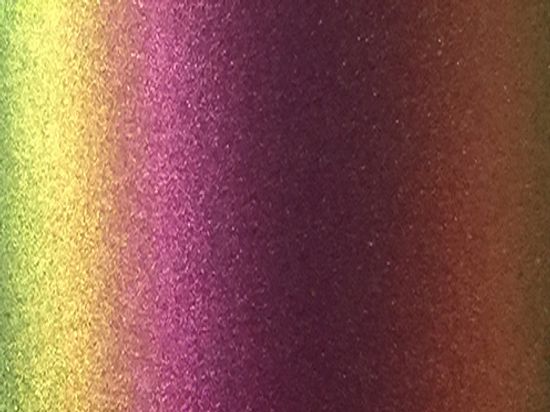
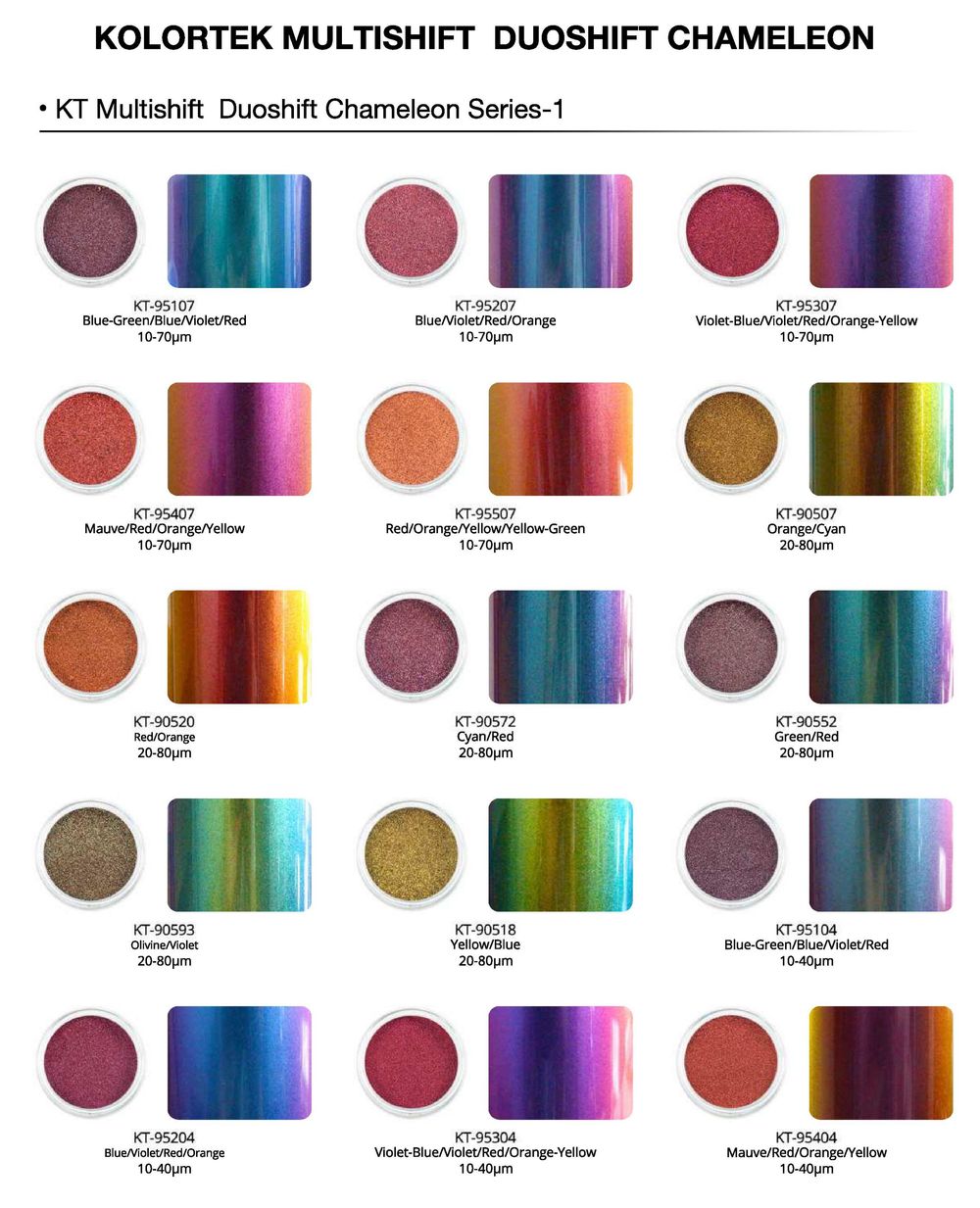
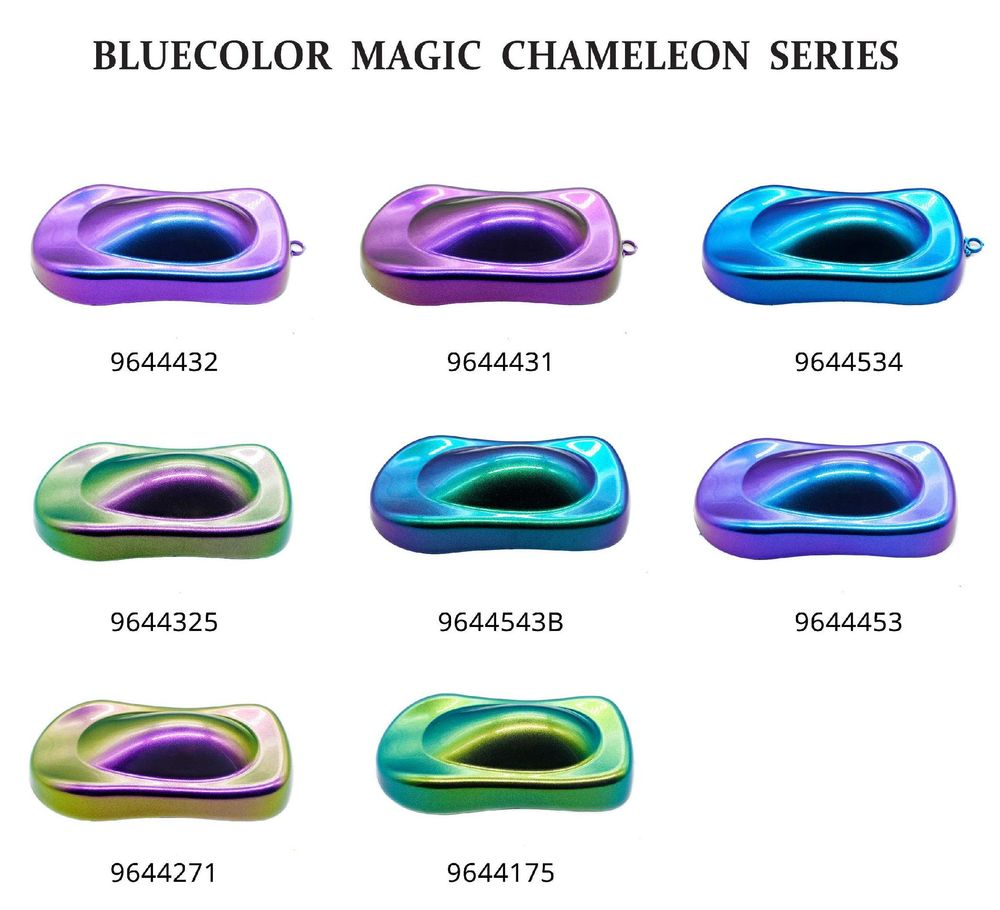
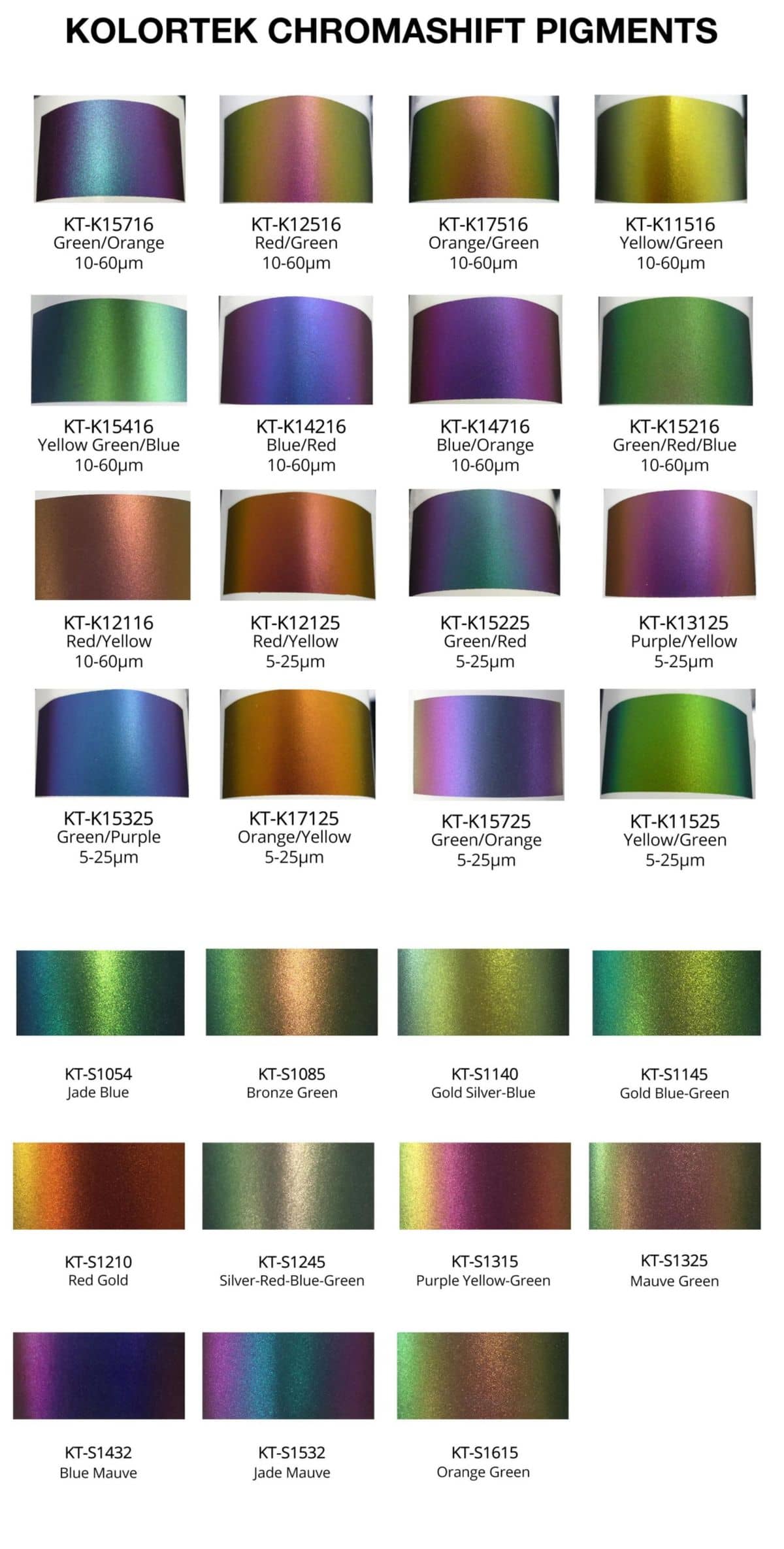
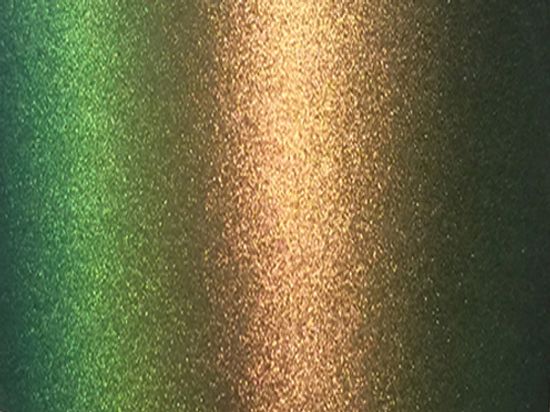
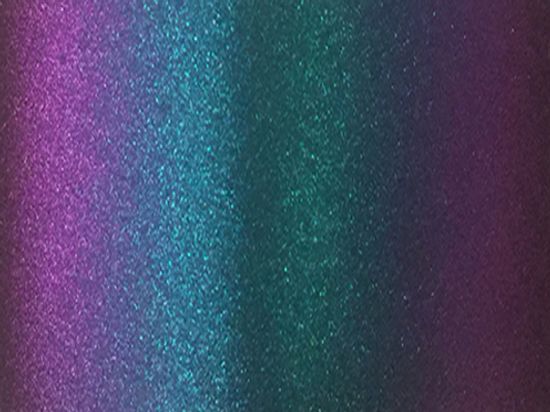
Kolortek's Chromashift series is an optically variable pigment engineered for dramatic, high-contrast color shift auto paint effects — shifting between two or more vivid colors as the viewing angle changes. Built on all-inorganic multi-layer interference technology, these pigments deliver the strongest color travel pigment auto paint performance in our portfolio, combining exceptional weatherability with compatibility across solvent-based, water-based, and UV-curable clearcoat systems.
Color-travel finishes have moved from concept-car curiosity to a mainstream specification in both OEM and aftermarket automotive segments. Consumers and custom builders now routinely request paint that shifts — green to orange under direct light, blue to red at oblique angles — and the underlying pigment technology has matured to meet those demands at production scale.
At Kolortek, we classify these pigments as optically variable pigments (OVP), a category defined by goniochromatic behavior: the perceived color changes continuously and predictably with viewing angle and illumination angle. This is distinct from simple metallic or standard pearlescent effects. The mechanism relies on thin-film interference within a precisely engineered multi-layer platelet — the same physics used in security ink on banknotes, adapted for coatings chemistry.
In automotive applications, the primary use case is the basecoat/clearcoat system, where the OVP platelet must orient parallel to the substrate surface during flash-off to develop its full angular color range. Secondary applications include color-shift wraps and aerosol custom finishes, where our KT-9000 Magic Chameleon series — based on natural mica coated with multi-layer TiO₂, Fe₂O₃, silica, and metal oxides — is a popular alternative for the custom and modified car market.
Choosing the right Chromashift grade starts with two variables: the desired visual character of the finish and the application method being used.
10–60 μm grades (K1 Series) produce high-sparkle, high-contrast color travel with a pronounced texture at close viewing distances. These are the preferred choice for custom show finishes, motorcycle tanks, and specialty automotive trim where visual drama is the primary objective. For example, KT-K15716 (Green/Orange) and KT-K14216 (Blue/Red) in this size range create a bold, wide-angle shift that reads clearly even under indirect lighting.
5–25 μm grades from both the K1 and S1 series produce a smoother, more continuous color transition — closer to the liquid-metal appearance seen on high-end production vehicles. KT-K12125 (Red/Yellow) and KT-S1245 (Silver-red/Blue-green) in this range are well-suited to OEM basecoat systems where surface smoothness and DOI (distinctness of image) must be preserved alongside the color-travel effect.
ChromaFlakes, the large-flake format of Chromashift technology, are specifically designed for situations where maximum visual impact is needed at unusually low pigment loadings — useful when formulators need to control viscosity in spray-applied clearcoats or achieve a bold "floating flake" aesthetic in custom finishes.
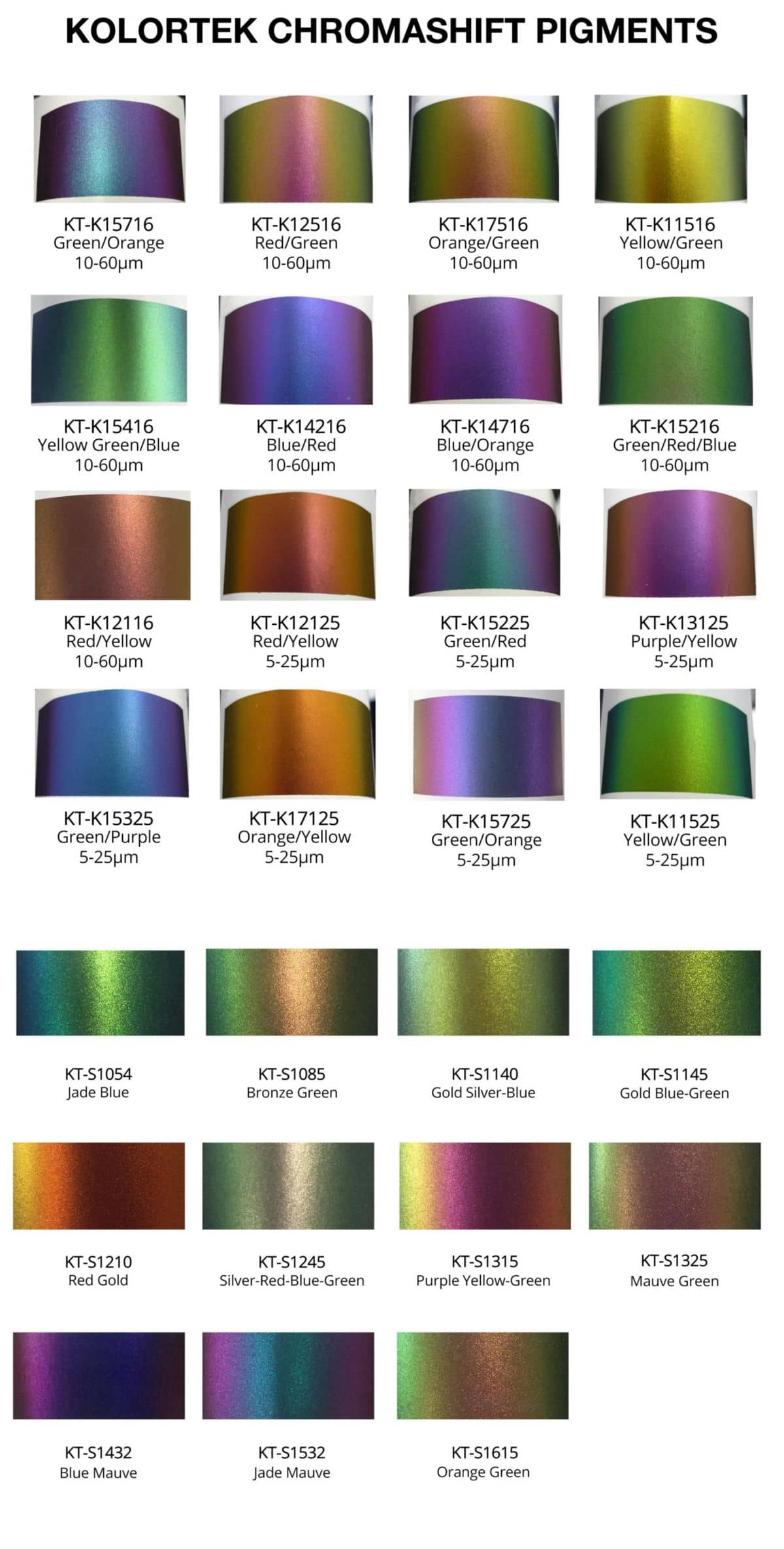
The K1 series covers primary-to-primary and complementary-color shift pairs: Red/Green, Blue/Red, Blue/Orange, Green/Orange, and multi-color options like Green/Red/Blue. The S1 series adds more complex transitions — Mauve/Green, Purple/Yellow-green, Gold/Silver-blue — which tend to appeal to luxury and bespoke automotive markets where subtlety and rarity are valued as much as drama. Our team recommends reviewing physical samples or application drawdowns before finalizing a specification, since digital representations of OVP color travel are inherently limited.
In production-line basecoat/clearcoat systems, Chromashift pigments are incorporated into the basecoat at loadings of 1–10% by weight, depending on the specific grade and the target visual intensity. The basecoat dry film thickness should target 15–25 μm to achieve proper platelet overlap — too thin and the coverage is insufficient for full effect development; too thick and solvent trap risk increases during flash-off.
Application is typically by pneumatic or electrostatic spray. Flash-off time between basecoat and clearcoat application is critical: insufficient flash-off disturbs platelet orientation, producing a mottled or inconsistent color-travel pattern. The clearcoat should be a high-gloss, optically transparent system — any haze or UV absorber loading that reduces visible-light transmission will diminish the perceived shift.
In the custom and modified car segment — where our KT-9000 Magic Chameleon series is particularly active — color-shift pigments are blended into single-stage urethanes, candy-coat systems, or pre-reduced aerosol paints. Here, particle sizes up to 100–250 μm are sometimes used specifically to create a visible "flake" aesthetic that reads as angular color shift at show distances. The formulator should always follow with a clear protective topcoat; unprotected OVP platelets are susceptible to mechanical abrasion that degrades the interference layer over time.
In both segments, applying over a black primer or black basecoat is not optional — it is the single most impactful formulation decision available. On white or light substrates, the background reflectance competes with the interference reflection, washing out the shift. On black, non-reflected wavelengths are absorbed, and the interference color reads with full saturation.
| Pigment Type | Visual Effect | Best For | Key Advantage | Considerations |
|---|---|---|---|---|
| Chromashift K1 Series (10–60 μm) | High-sparkle, high-contrast color travel between primary/complementary pairs (e.g., Blue/Red, Green/Orange) | Custom show cars, motorcycle tanks, specialty trim | Maximum drama and angular contrast; wide shift angle | Larger particle size may affect surface smoothness; requires careful spray technique |
| Chromashift K1 Series (5–25 μm) | Smooth, continuous color transition; closer to liquid-metal appearance | OEM basecoat/clearcoat systems, production automotive | Preserves high DOI; compatible with electrostatic spray | Shift amplitude slightly lower than larger grades; dark substrate mandatory |
| Chromashift S1 Series (15–25 μm) | Complex, nuanced color travel — Mauve/Green, Gold/Silver-blue, Silver-red/Blue-green | Luxury vehicles, bespoke finishes, high-value custom builds | Rare color combinations; sophisticated multi-tone appearance | Effect subtlety requires proper lighting for full appreciation |
| ChromaFlakes (Large-Flake Chromashift) | Bold, individually visible flakes with strong angular color shift | Show car finishes, low-loading specialty coatings | Maximum visual impact at reduced pigment loading | Not suitable for electrostatic spray; requires manual or pneumatic application |
| KT-9000 Magic Chameleon (Natural Mica, 5–250 μm) | Goniochromatic angle-dependent color travel; duochrome and multicolor variants | Custom wraps, modified car market, aerosol finishes | Wide particle size range; versatile for wraps and spray paint | Natural mica base; all-inorganic OVP grades offer superior weatherability for long-term exterior use |
Color travel pigments — technically called optically variable pigments — use thin-film interference within precisely layered platelet structures. As the viewing angle changes, different wavelengths of light constructively interfere and reflect, causing the perceived color to shift. In auto paint, these platelets are suspended in the basecoat and must orient parallel to the substrate surface during application to produce the full angular shift.
Black or very dark substrates consistently produce the strongest, most visible color shift. The dark background absorbs all wavelengths that are not reflected by the interference pigment, allowing the shift colors to read with maximum saturation. On white or silver substrates, background reflectance competes with the pigment's interference reflection, significantly washing out the effect — regardless of pigment quality or loading level.
Yes. Chromashift pigments are compatible with solvent-based, water-based, and UV-curable coating systems. In water-based basecoats, we recommend pre-dispersing the pigment in a small amount of co-solvent or using a pigment wetting agent to facilitate even distribution. Avoid prolonged exposure to high-pH aqueous systems without first confirming compatibility with your specific binder chemistry.
For OEM production environments that require smooth surface finish and electrostatic spray compatibility, 5–25 μm grades (K1 or S1 series) are the appropriate choice — they preserve DOI and surface quality while delivering strong color travel. Custom shops and show car builders who prioritize maximum visual drama over surface smoothness typically prefer the 10–60 μm K1 grades or ChromaFlakes, where the larger platelet size creates a bolder, more theatrical color-shift character.
Chromashift's all-inorganic construction delivers QUV weatherability of 1,000+ hours without significant color-shift degradation or loss of effect — meeting the threshold commonly required for exterior automotive approval. Heat stability covers typical automotive baking cycles of 140–180 °C, and the pigments are chemically inert to acid rain, fuel splash, bird droppings, and common automotive solvents. Batch-to-batch color consistency typically achieves ΔE < 1.0, supporting OEM color matching requirements.
Kolortek supplies Chromashift pigments direct from the factory, with TDS, MSDS/SDS documentation, and SGS test reports available for each grade. We offer custom color matching, formulation guidance, and free sample service for evaluation. Buyers sourcing automotive color shift pigment wholesale can contact our technical team to discuss volume pricing, specific color-travel pair requirements, and application support.
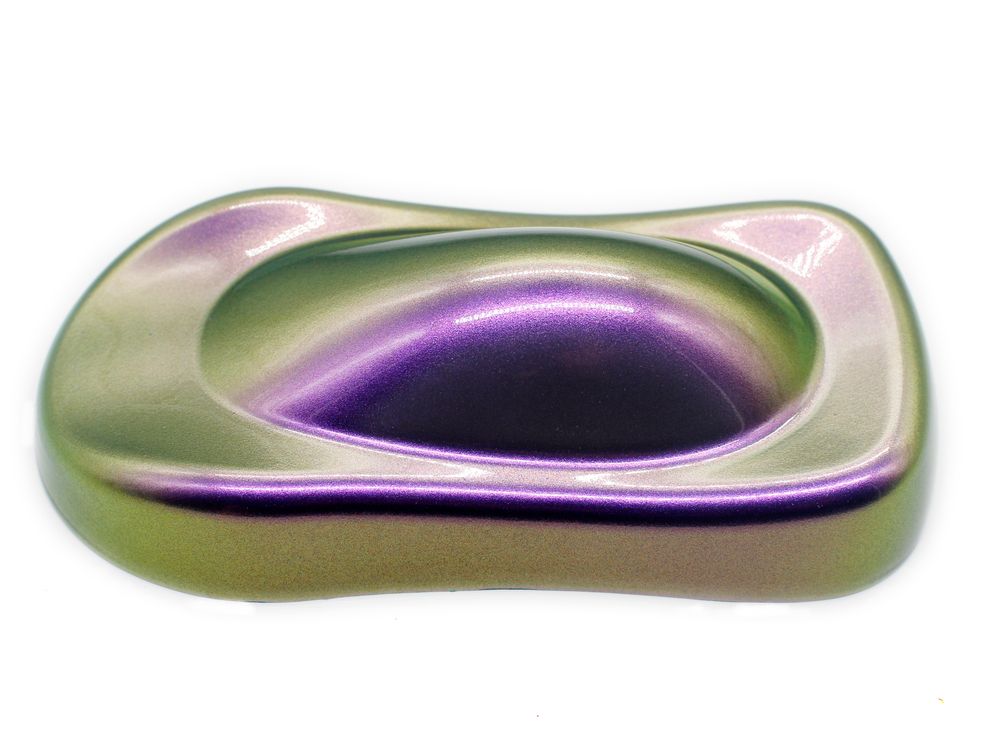
Chameleon car paint achieves its dramatic angle-dependent color travel by incorporating multilayer-coated mica platelets — like those in our KT-9000 Magic Chameleon Series — into a basecoat/clearcoat system over a dark substrate. As a specialized color shift pigment supplier, we formulate these inorganic pigments to pass QUV 1000+ hour weatherability requirements while delivering duochrome or multicolor goniochromatic effects. Particle size selection — from 10–60 μm standard grades up to 100–250 μm large flakes — directly determines whether the finish reads as a deep satin shift or an explosive multi-angle sparkle.
Read More
Kolortek's Chromashift series is an optically variable pigment engineered for dramatic, high-contrast color shift auto paint effects — shifting between two or more vivid colors as the viewing angle changes. Built on all-inorganic multi-layer interference technology, these pigments deliver the strongest color travel pigment auto paint performance in our portfolio, combining exceptional weatherability with compatibility across solvent-based, water-based, and UV-curable clearcoat systems.
Read More
 English
 Français
 Deutsch
 Русский
 Español
 Português