
Leave A Message
If you are interested in our products and want to know more details,please leave a message here,we will reply you as soon as we can.
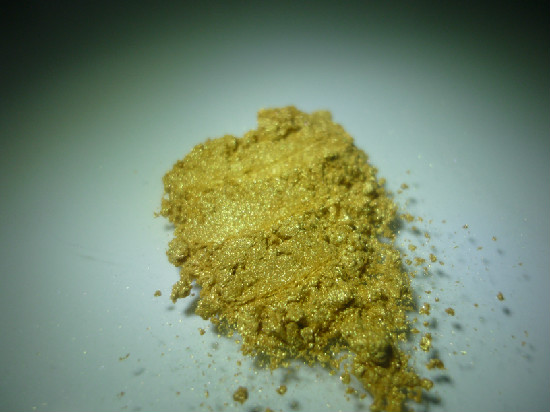
KT-300 is a gold pearl pigment built on natural mica coated with titanium dioxide, iron oxide, and tin oxide — producing a warm, semi-transparent metallic luster that closely matches the visual output of Merck's Iriodin 300 Gold Pearl. Designed as a cost-effective iriodin 300 equivalent, it performs consistently across coatings, printing inks, and cosmetic formulations where a rich, dimensional gold effect is required.
Item No. :
KT-300Color Effect :
Gold PearlParticle Size :
10-60μmComposition :
Mica, Titanium Dioxide, Iron Oxide, Tin OxideBrand :
Kolortek / OEMMOQ :
25 KGApplication :
Coatings, Plastics, Printing Inks, Cosmetics, Epoxy Floors, Crafts, etc.KT-300 is a natural mica-based effect pigment — mica flakes uniformly coated with TiO₂, Fe₂O₃, and SnO₂. The iron oxide content drives the warm golden tone; the tin oxide layer contributes to coating stability and luster depth. Particle size runs 10–60μm, which puts it in the general-purpose range: fine enough for most printing and cosmetic applications, coarse enough to register visible sparkle in coatings and plastics.
Compared to conventional copper gold powder, the mica base gives KT-300 a more transparent, layered visual quality — what formulators often describe as a "third-dimension" effect. The light interference mechanism allows the gold tone to shift slightly with viewing angle, which copper bronzes simply cannot replicate.
Merck's Iriodin 300 Gold Pearl is widely used across industrial and cosmetic applications as a benchmark gold pearl. KT-300 is formulated to the same specification: natural mica substrate, 10–60μm particle range, TiO₂ + Fe₂O₃ + SnO₂ coating system. In side-by-side dispersion tests across solvent-borne and water-borne systems, the color coordinates and luster profile align closely enough for direct substitution in most formulations.
Worth noting: "equivalent" here means matched composition and visual output — not identical sourcing. Any direct substitution should be validated against your specific system, particularly if working in cosmetic or regulated applications where raw material documentation matters.
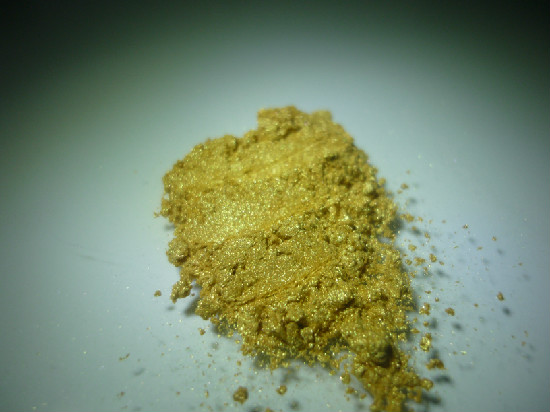
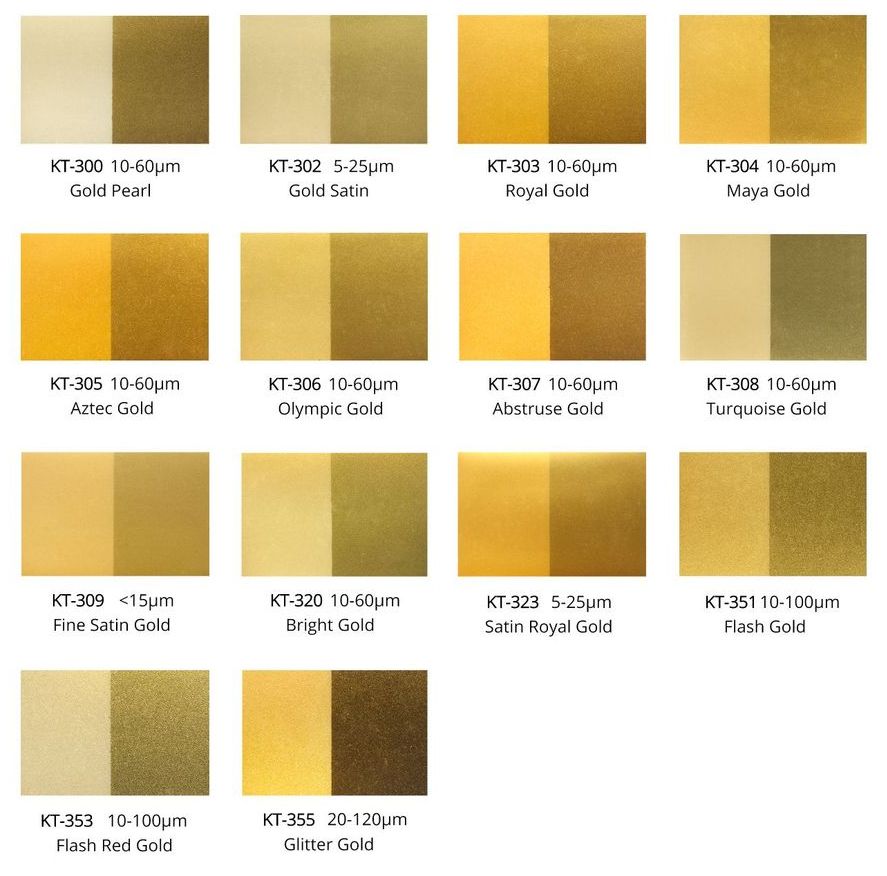
KT-300 is one reference point in a broader gold series spanning natural mica (KT-300 series) and synthetic fluorphlogopite (KT-7300 series). The table below covers both, organized by particle size range and substrate type.
| Model | Color / Effect | Particle Size (μm) | Substrate |
|---|---|---|---|
| KT-300 | Gold Pearl | 10–60 | Natural Mica |
| KT-303 | Royal Gold | 10–60 | Natural Mica |
| KT-304 | Maya Gold | 10–60 | Natural Mica |
| KT-305 | Aztec Gold | 10–60 | Natural Mica |
| KT-306 | Olympic Gold | 10–60 | Natural Mica |
| KT-307 | Abstruse Gold | 10–60 | Natural Mica |
| KT-309 | Fine Satin Gold | <15 | Natural Mica |
| KT-320 | Bright Gold | 10–60 | Natural Mica |
| KT-323 | Satin Royal Gold | 5–25 | Natural Mica |
| KT-351 | Flash Gold | 10–100 | Natural Mica |
| KT-353 | Flash Red Gold | 10–100 | Natural Mica |
| KT-355 | Glitter Gold | 20–120 | Natural Mica |
| KT-357 | Shimmer Gold | 20–200 | Natural Mica |
| KT-396 | Gold | 50–500 | Natural Mica |
| Model | Color / Effect | Particle Size (μm) | Substrate |
|---|---|---|---|
| KT-7301 | Satin Yellow Gold | 5–25 | Fluorphlogopite |
| KT-7311 | Light Gold | 10–60 | Fluorphlogopite |
| KT-7312 | Yellow Gold | 10–60 | Fluorphlogopite |
| KT-7313 | Red Gold | 10–60 | Fluorphlogopite |
| KT-7314 | Light Yellow Gold | 10–60 | Fluorphlogopite |
| KT-7315 | Yellow Gold | 10–60 | Fluorphlogopite |
| KT-7321 | Flash Light Gold | 20–100 | Fluorphlogopite |
| KT-7323 | Flash Red Gold | 20–100 | Fluorphlogopite |
| KT-7324 | Flash Yellow Gold | 20–100 | Fluorphlogopite |
| KT-7325 | Flash Deep Yellow Gold | 20–100 | Fluorphlogopite |
| KT-7331 | Shimmer Yellow Gold | 20–200 | Fluorphlogopite |
| KT-7341 | Shimmer Light Gold | 40–200 | Fluorphlogopite |
| KT-7344 | Shimmer Deep Gold | 40–200 | Fluorphlogopite |
| KT-7361 | Sparkle Light Gold | 60–300 | Fluorphlogopite |
| KT-7362 | Sparkle Red Gold | 60–300 | Fluorphlogopite |
| KT-7371 | Super Light Gold | 200–700 | Fluorphlogopite |
| KT-7391 | Pt Gold | 10–60 | Fluorphlogopite |
| KT-7392 | Flash Pt Gold | 10–100 | Fluorphlogopite |
| KT-7393 | Shimmer Pt Gold | 40–200 | Fluorphlogopite |
For most industrial coating, ink, and general plastic applications, the natural mica KT-300 series is the practical choice. It covers the full range of gold tones, processes cleanly in standard dispersion equipment, and the cost structure is straightforward.
The KT-7300 synthetic series becomes relevant when the application demands higher chemical purity — specifically cosmetics, skincare, and lip products where the lower heavy-metal trace content of fluorphlogopite is an advantage. Synthetic mica also tends to produce a slightly brighter, cleaner luster, which some formulators prefer in transparent cosmetic bases. In practice, if you're formulating a decorative coating or an industrial ink, the natural mica series will perform without issue. If you're building a lip gloss or foundation and your brand requires synthetic mica declaration on the INCI list, the KT-7300 series is the right path.
The 10–60μm particle range of KT-300 covers a wide application window. Fine-particle grades within this range (closer to the 10μm end) disperse well in gravure and flexographic inks, producing a smooth gold tone without visible grain. The coarser end of the range registers more sparkle — suitable for epoxy floor coatings, artificial marble, and countertop applications where visual impact at distance matters.
Cosmetic and soap applications are well established. For nail products specifically, the mid-range particle sizes provide the balance of visual coverage and smooth film formation that nail lacquer systems require. Craft and art resin applications can utilize the full range, including the larger-particle shimmer and glitter grades from the extended series.
The TiO₂ + Fe₂O₃ + SnO₂ coating system on natural mica produces a warm, semi-transparent gold luster — distinctly different from the flat, opaque tone of metallic copper powders. The transparency allows underlying substrates or base coat colors to interact with the pigment layer, enabling more complex visual effects in multilayer systems.
Blendability is a practical asset here. Because each grade in the series is built on a consistent substrate and coating chemistry, they mix predictably. Controlled blending of KT-300 with adjacent series grades — for example, introducing a redder tone from KT-353 — yields reproducible intermediate effects without unexpected compatibility issues.
Batch-to-batch consistency is worth confirming with any pigment supplier you qualify. Color coordinates and luster output should remain stable across production lots — this matters most in decorative coating lines and cosmetic manufacturing where visual consistency is a product requirement, not just a preference.
KT-300 is compatible with most solvent-borne, water-borne, and UV-curable systems. Standard handling precautions apply: avoid high-shear dispersion processes that can fracture the mica platelet and reduce luster. Low-shear mixing at the letdown stage, or post-addition to a pre-dispersed base, is the typical approach.
Loading levels vary by application. In coatings, 2–8% by weight is common. In cosmetic formulations, 1–5% depending on the base. Higher loadings in transparent systems can crowd the platelet alignment and reduce the interference luster — it's worth testing at your target film thickness rather than assuming a standard load rate will optimize appearance.
That said, the iron oxide coating makes these grades slightly more opaque than silver-white pearlescent grades. If you need maximum transparency with a gold tone, the KT-7300 series synthetic grades with thinner coating layers may give a cleaner result in high-transparency systems.
Q: Is KT-300 a direct drop-in replacement for Iriodin 300 in an existing formulation?
A: In most cases, yes. The composition — natural mica, TiO₂, Fe₂O₃, SnO₂, 10–60μm — matches Iriodin 300 Gold Pearl directly. That said, any supplier change should be validated in your specific system. Request a sample and run side-by-side color and luster evaluation before switching production lots.
Q: Can KT-300 be used in cosmetic formulations?
A: Yes. The composition is standard for cosmetic-grade iron oxide mica pigments. Documentation including MSDS, TDS, and COA is available. For applications requiring synthetic mica on the INCI declaration, the KT-7300 fluorphlogopite series is the appropriate alternative.
Q: What's the difference between KT-300 Gold Pearl and KT-320 Bright Gold?
A: Both are in the 10–60μm range on natural mica, but KT-320 is formulated for a higher-intensity, brighter gold tone — typically achieved through a modified coating weight or layer structure. KT-300 is the reference gold pearl; KT-320 is oriented toward higher visual saturation. Samples are the fastest way to confirm which fits your target appearance.
Q: What documentation is available for procurement qualification?
A: Standard documentation includes MSDS, TDS, and COA. REACH compliance documentation and SGS/TÜV SÜD test reports are available on request. Kosher certification is also available where required.
If you're evaluating KT-300 as an iriodin 300 equivalent or sourcing across the full gold series, samples and full technical documentation are available. Contact contact@kolortek.com with your application details and target particle size range — the right starting point depends on your substrate and intended visual output.
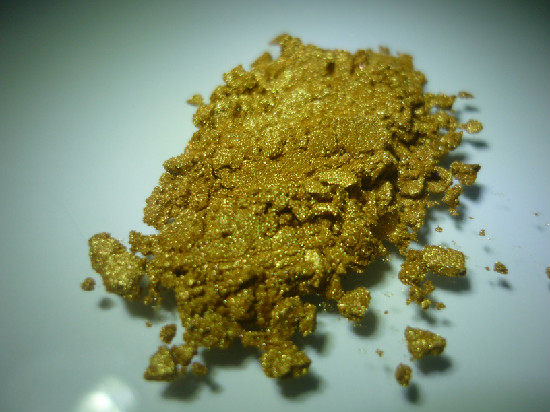
KT-303 is a Royal Gold natural mica pearlescent pigment in the 10–60μm particle size range — a deeper, more saturated gold tone than the standard KT-300 Gold Pearl grade, achieved through a higher iron oxide (Fe₂O₃) loading on the TiO₂-coated mica platelet. The warm, orange-toned gold body color is visible on any substrate without requiring a dark base — a key practical advantage over interference-only gold grades. At 10–60μm, KT-303 covers cosmetics, nail lacquer, decorative coatings, soap, and epoxy resin applications from a single grade specification.
Read More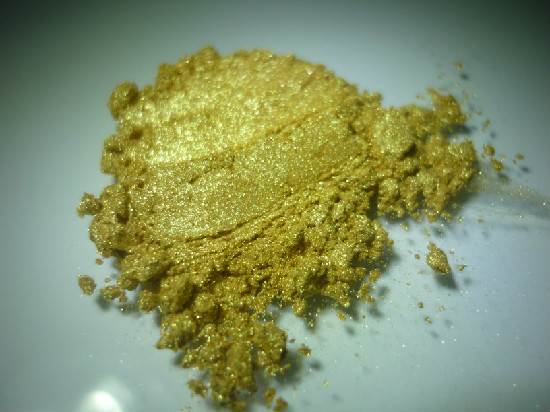
KT-351 is a Flash Gold natural mica pearlescent pigment in the 10–100μm particle size range — the coarser-format gold grade in the KT-300 series, designed for applications where visible individual-platelet gold sparkle is the target effect rather than smooth pearl coverage. The iron oxide and TiO₂ coating on each mica platelet produces a warm gold body color visible on any substrate, while the 10–100μm distribution delivers a flash-sparkle character that distinguishes it from the standard 10–60μm gold pearl grades. For epoxy flooring, decorative resin, craft applications, and nail lacquer where bold gold shimmer intensity matters, KT-351 is the appropriate specification within the KT-300 series.
Read More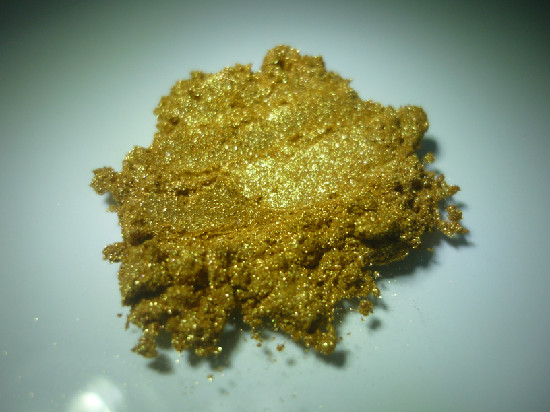
KT-355 is a Glitter Gold natural mica pearlescent pigment in the 20–120μm particle size range — the glitter-dominant gold grade in the KT-300 series, optimized for epoxy flooring, resin art, decorative coatings, craft applications, and nail lacquer where visible individual-platelet gold sparkle is the primary visual requirement. By starting at 20μm rather than 10μm, KT-355 removes the fine background pearl fraction present in KT-351 Flash Gold, concentrating the visual energy toward bold, individual gold flash reflections. The iron oxide and TiO₂ coating produces a warm gold body color visible on any substrate without requiring a dark base — practical for the broad range of base colors encountered in epoxy and decorative applications.
Read More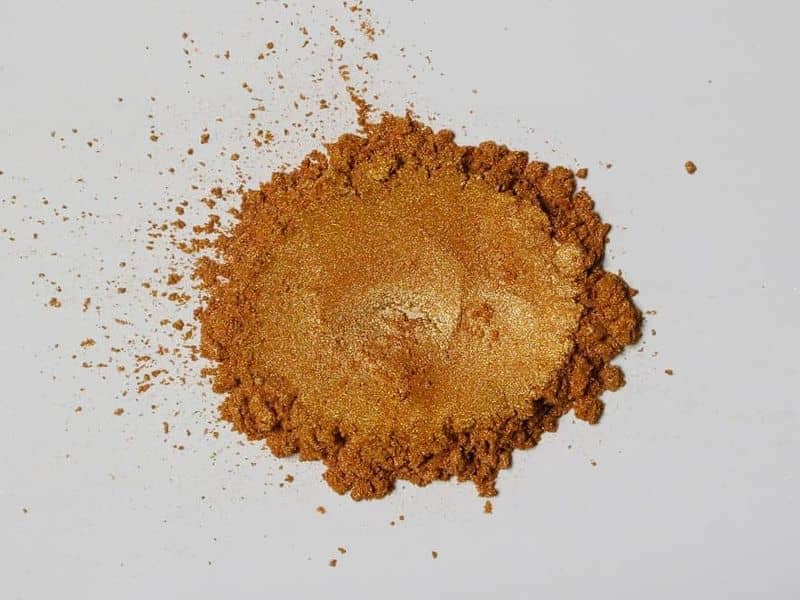
KT-303 is a royal gold pigment built on natural mica flakes, delivering a warm, metallic luster with genuine depth — the kind of three-dimensional gold effect that synthetic alternatives consistently fail to replicate. Coated with titanium dioxide and iron oxide, it offers strong opacity alongside a smooth, fine finish suited for cosmetics, epoxy flooring, and decorative printing. It disperses cleanly, stays stable across most formulation environments, and blends readily with other shades in the KT-300 Gold Series.
Read More
KT-7324 is a flash yellow gold mica powder built on a synthetic fluorphlogopite substrate, delivering a high-intensity flash with a clean, transparent gold tone — well-suited for decorative coatings, epoxy floors, and cosmetic formulations. As a fluorphlogopite pigment, it offers noticeably better color depth and weather resistance than natural mica-based alternatives, making it a reliable choice where long-term appearance retention matters. The coarser 20-100μm particle range pushes the flash effect to its visual maximum, and the pearlescent powder disperses readily across solvent-borne, water-borne, and UV-cure systems.
Read More
KT-300 is a gold pearl pigment built on natural mica coated with titanium dioxide, iron oxide, and tin oxide — producing a warm, semi-transparent metallic luster that closely matches the visual output of Merck's Iriodin 300 Gold Pearl. Designed as a cost-effective iriodin 300 equivalent, it performs consistently across coatings, printing inks, and cosmetic formulations where a rich, dimensional gold effect is required.
Read More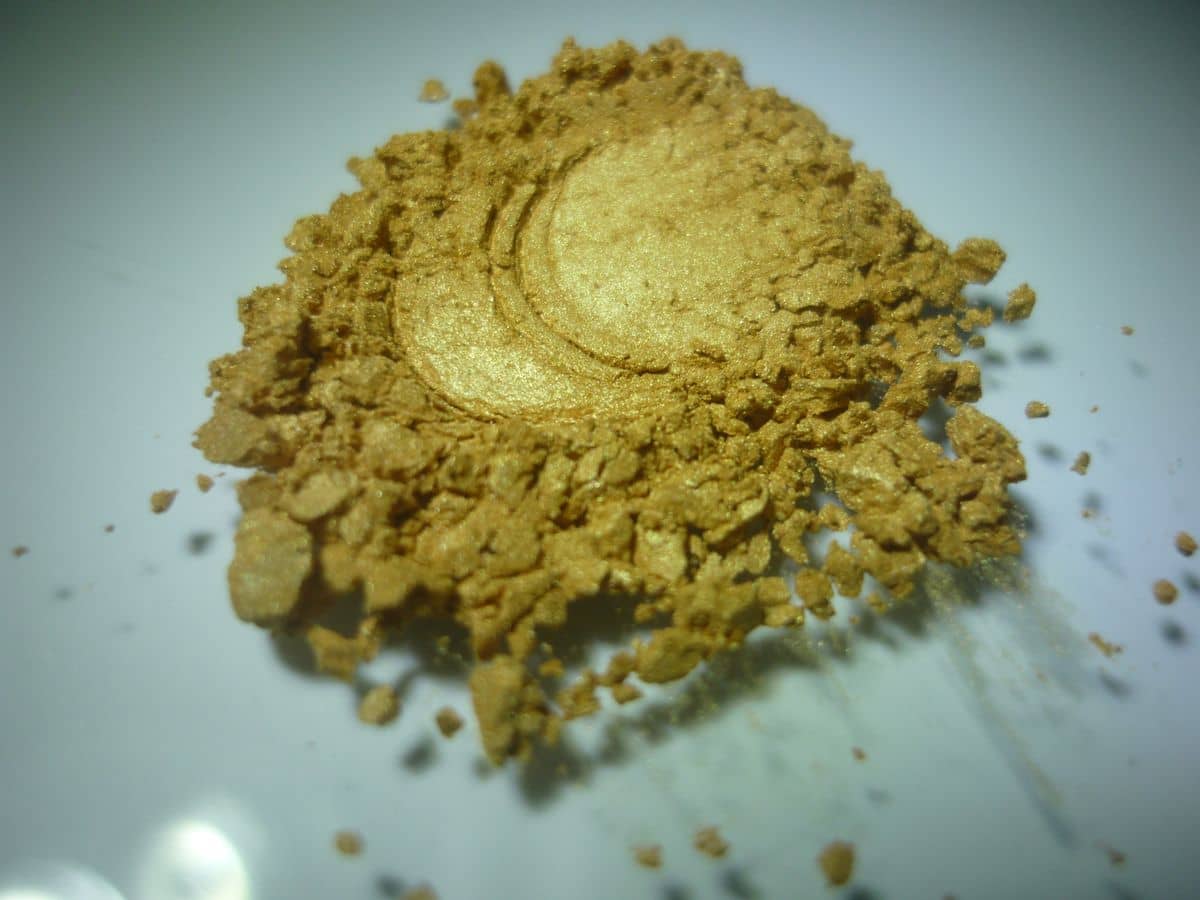
KT-309 is a fine satin gold pigment built on natural mica coated with rutile titanium dioxide, iron oxide, and tin oxide — delivering a warm, silky gold luster with genuine depth and transparency. The sub-15μm particle distribution makes it well-suited for fine printing applications and cosmetic formulations where smooth finish and consistent color response matter. For formulators sourcing an iriodin 309 equivalent, KT-309 is a direct performance match produced under ISO 9001-certified manufacturing conditions.
Read More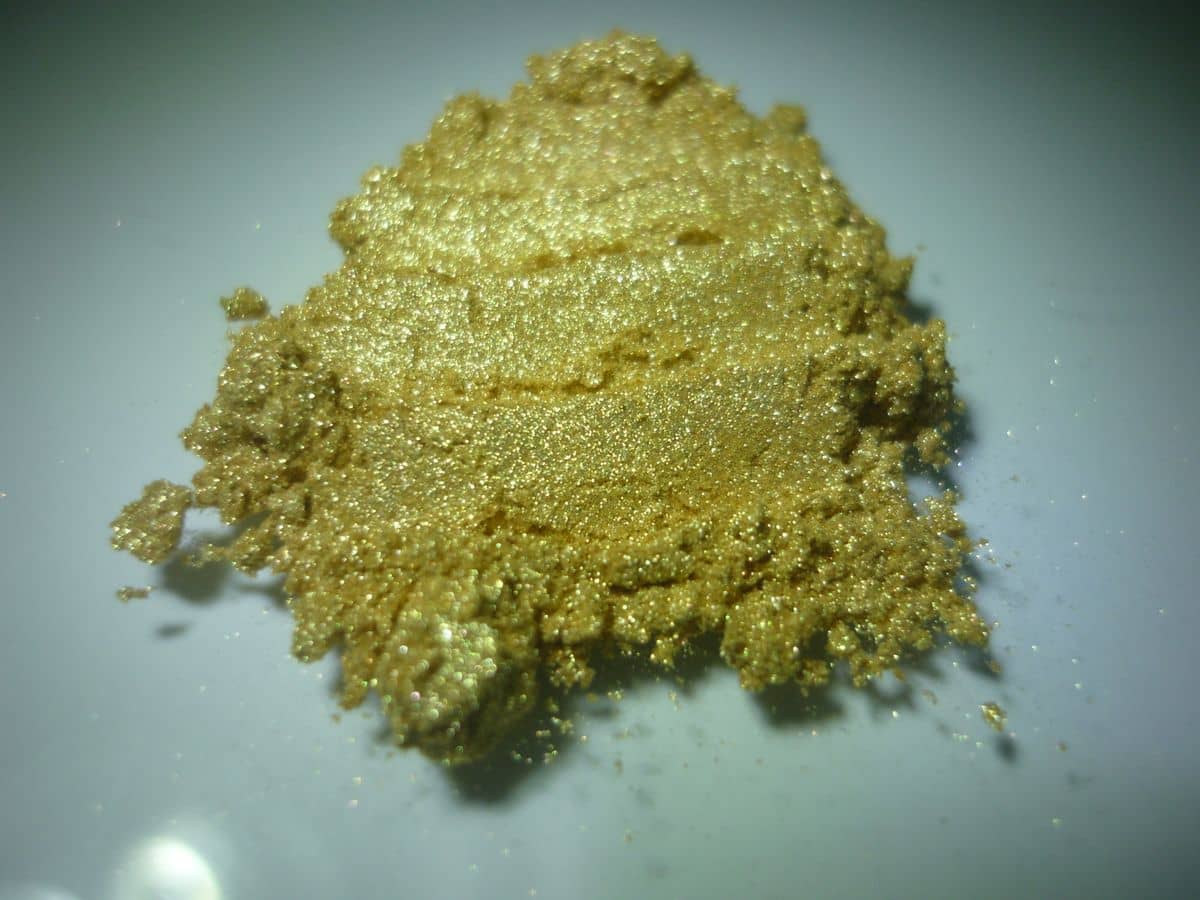
KT-353 is a natural mica-based flash red gold pigment delivering a warm, saturated gold tone with a high-brightness flash effect — a direct iriodin 353 alternative for formulators seeking consistent pearlescent performance without supplier dependency. Its transparent, multi-dimensional luster makes it well-suited for decorative coatings, cosmetic applications, and specialty printing where depth and brilliance matter.
Read More
 English
 Français
 Deutsch
 Русский
 Español
 Português