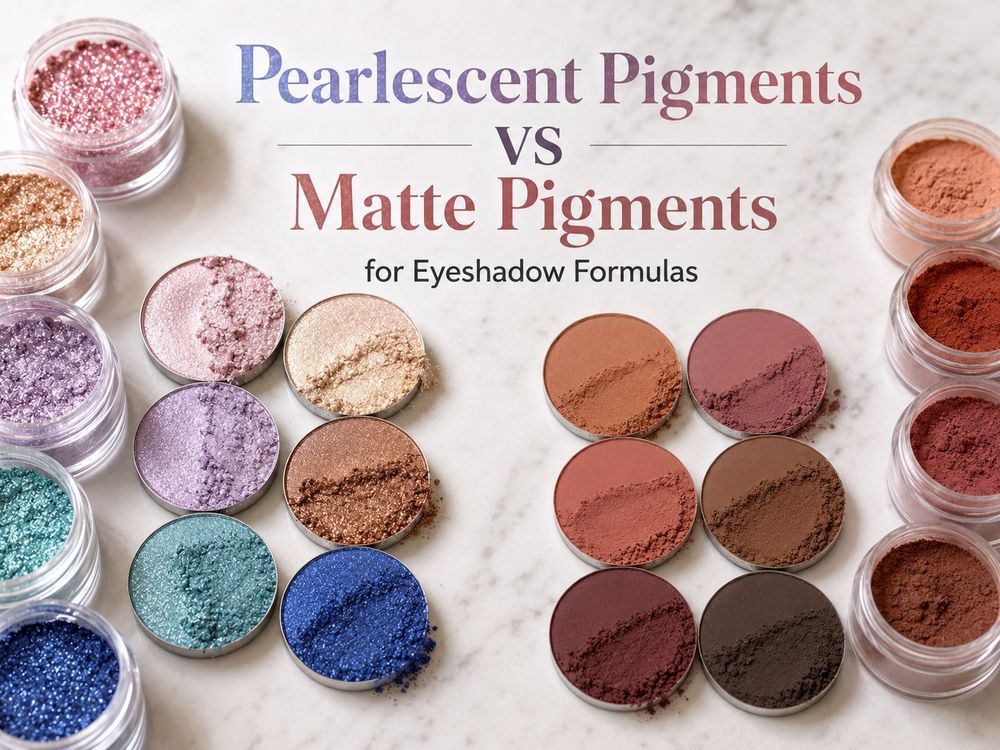
Choosing between pearlescent pigments cosmetics applications and matte cosmetic pigments comes down to more than aesthetics — it directly affects dispersion behavior, layering compatibility, and the tactile finish of your final eyeshadow pigment powder formula. Pearlescent types built on mica or borosilicate substrates deliver structured light reflection and shimmer depth, while matte oxides and treated fillers absorb light to create flat, saturated color. This article breaks down how each pigment class behaves in formulation, where they perform best, and how to use them together without compromising either effect.
How Pearlescent Pigments Actually Work in Eyeshadow
Pearlescent pigments are platelet-structured colorants — typically mica or calcium aluminum borosilicate flakes coated with titanium dioxide, iron oxide, or other metal oxides. The optical effect comes from interference and reflection at the coating layer. When light enters the coating, part reflects off the surface and part transmits through and reflects off the substrate. The path difference between those two beams determines what color you see at a given angle.
In an eyeshadow base, flake orientation matters more than most formulators acknowledge upfront. Pressed powders tend to align flakes parallel to the surface during compaction, which maximizes specular reflection — you get a cleaner, more intense shimmer. Loose powder formats scatter flake orientation more randomly, softening the effect. Neither is wrong, but they're not interchangeable in formulation targets.
The substrate choice also shifts the character of the effect significantly:
- Natural mica-based pearls — cost-effective, good coverage, slightly warm tactile feel. Particle shape variability is higher.
- Synthetic mica-based pearls — more uniform flake geometry, cleaner color, better transparency. Preferred for high-chroma interference effects.
- Calcium aluminum borosilicate (glass flake) — highest refractive index of the three, exceptional transparency and brilliance. Produces a wet, diamond-like sparkle that mica can't fully replicate. Larger smooth flake structure reflects more light per unit area.
Gold and bronze tones in pearlescent series (iron oxide + titanium dioxide coatings) carry stronger masking power than silver-white interference types. That affects how they layer over primers and base shades — worth factoring in early during formula development.
How Matte Pigments Behave — and Where Formulators Get Into Trouble
Matte eyeshadow pigments are primarily light absorbers. Iron oxides, ultramarines, chromium green oxide, carbon black — these don't reflect structured light. They scatter it diffusely, which is exactly what creates flat, defined color on the lid.
The formulation challenge with matte pigments isn't color — it's texture and skin adhesion. Untreated iron oxides have rough, irregular surface morphology and high oil absorption. That translates to drag during application, patchy payoff, and reduced blendability. Surface treatment changes this fundamentally.
Silicone-treated iron oxides (triethoxycaprylylsilane-treated yellow, red, black) significantly reduce oil absorption and improve substrate wetting. The treated surface accepts binders more consistently, and the pigment disperses more smoothly through the powder matrix. Matte sericite — and its dimethicone-treated variant — acts simultaneously as a filler and a slip agent, improving the sensory profile of pressed matte eyeshadow without diluting color intensity too aggressively.
In practice, a matte eyeshadow formula built on untreated pigments will almost always underperform in wear time and application feel compared to one using surface-treated equivalents — even at identical colorant loading.
Worth noting: D&C Lakes behave differently from inorganic oxides in matte formulas. They're organic dye-on-substrate systems — brighter and more saturated, particularly useful for hitting vivid blue, violet, or red tones that oxides can't reach. Their limitation is photostability and potential migration in some binder systems. For eye-area use, confirming regulatory compliance per your target market is non-negotiable.
Side-by-Side: Pearlescent vs Matte Eyeshadow Pigments
| Parameter |
Pearlescent Pigments |
Matte Pigments |
| Light Interaction |
Reflection + interference (specular) |
Diffuse absorption (non-reflective) |
| Visual Effect |
Shimmer, metallic, color-shift, holographic |
Flat, saturated, no sheen |
| Substrate Types |
Natural mica, synthetic mica, borosilicate |
Iron oxide, titanium dioxide, ultramarines, carbon black, D&C Lakes |
| Formulation Challenge |
Flake orientation, transparency management |
Oil absorption, surface texture, blendability |
| Surface Treatment Impact |
Improves dispersion, skin adhesion |
Critical — reduces drag, improves payoff |
| Best Format Fit |
Pressed, loose, cream-to-powder, topper |
Pressed, loose, transition/contour shades |
| Layering Role |
Topper, lid center, highlight |
Transition, crease, liner base, blending shade |
| Regulatory (Eye Area) |
Confirm colorant approvals by market |
Confirm colorant approvals by market |
Special Effect Pearlescents: Expanded Options for Eyeshadow
Standard silver-white and gold pearls are well-understood. The more interesting formulation territory is in special effect classes — particularly for editorial, prestige, and high-performance palettes.
Duochrome / chameleon pigments built on high-transparency flake crystals show angle-dependent color shifting — gold-to-green, red-to-blue, copper-to-purple. The effect is driven by thin-film interference at the titanium dioxide coating layer. In eyeshadow, these work best as standalone focal shades rather than mixed heavily into other pigments, which tends to dilute the shift. Keep the base palette clean and let the duochrome carry the statement.
Holographic pigments operate on diffraction rather than interference — they split white light into rainbow spectral bands via a physical grating structure. The visual result is distinct from chameleon effects: more prismatic, less color-dependent on viewing angle. They're typically lower in loading (3–8% in a pressed formula) because the effect saturates quickly.
Aurora powders — specifically series rated for eyeshadow use — bring a soft, multidimensional color flash. Some are solvent-sensitive, so compatibility with your binder system needs verification before scaling.
That said, all special effect pearls share one formulation constraint: their optical performance degrades when over-dispersed. Aggressive milling breaks down flake geometry, shortening the interference path and dulling the effect. Cold mixing or low-shear blending preserves the structure.
Combining Pearlescent and Matte Pigments in the Same Formula
Most commercial eyeshadow palettes combine both pigment types — sometimes within a single pan. The technical challenge is managing the interaction between reflective platelets and absorbing particles at the dispersion level.
When matte iron oxide is blended with pearlescent pigment, the oxide particles fill the voids between platelet flakes and reduce inter-flake light reflection. A small amount of oxide deepens and tones the pearl without eliminating the shimmer effect. Increasing oxide loading progressively dampens the pearlescence — this is actually the mechanism behind "duochrome with depth" formulas where a gold pearl is grounded by a trace of brown oxide.
The reverse — adding pearl to a matte formula to create a satin finish — requires careful binder balance. Platelet-shaped particles increase the surface area that needs to be wetted by the binder. If the binder system isn't adjusted, you'll see poor cohesion in pressed formats and increased fallout.
In practice, treating matte pigments with silicone before blending with pearls significantly improves the compatibility of the two systems. Treated surfaces reduce competitive oil absorption between the two pigment types, giving you more consistent payoff across the finished shade.
Selection Guidance: Which Type Fits Your Formula Target
The right choice depends on formula format, finish target, and application intent. A few practical reference points:
- Pressed shimmer topper or single-pigment foil shadow: Borosilicate-based pearls, high loading (40–70%), minimal filler. The transparency of borosilicate substrate delivers the wet, glass-like effect that mica can't match at equivalent loadings.
- Transition shade (crease, blend-out): Surface-treated iron oxide mixes with matte sericite. Smooth texture and diffuse color are the priority — no reflective content needed.
- Duochrome lid shade: Chameleon or chromashift pigment as the primary, minimal oxide addition to avoid killing the shift. Synthetic mica substrate preferred for cleaner color shift clarity.
- Pressed palette with varied finishes: Segregate matte and pearl pans. Shared binder formulas across finishes tend to compromise both — the matte shades pick up slip additives intended for pearl, and the pearl shades get under-lubricated. Two base systems, one palette.
- Editorial loose pigment: Holographic or aurora series, low binder content, no pressing aids. The formula is almost entirely pigment. Adhesion to skin relies on primer or base.
FAQ
Can pearlescent and matte pigments be mixed in the same eyeshadow pan?
Yes, but the ratio and surface treatment of the matte component matter significantly. Untreated matte oxides absorb binder aggressively and compete with pearl flakes for the available oil phase. Surface-treated pigments mitigate this. At low matte loadings (under 15%), the pearlescent character largely holds. Above 30–40% matte content, the finish transitions to a satin or soft-matte effect. This is useful and intentional in "dimensional matte" formulas — it's a controllable continuum, not a binary switch.
What's the difference between natural mica and synthetic mica as a pearl base for eyeshadow?
Natural mica has a more variable flake geometry — some irregularity in size and surface smoothness. This creates a slightly softer, warmer shimmer with more visual texture. Synthetic mica (fluorophlogopite) is more uniform in flake shape, whiter in its natural state, and produces cleaner, higher-chroma interference colors when coated. It also has a smoother feel on skin. For vivid color-shifting pearls or high-definition shimmer effects, synthetic mica is the preferred substrate. For traditional gold and bronze shimmers or cost-sensitive formulas, natural mica performs well.
Why do some matte eyeshadows feel dry or rough on the lid?
Almost always a texture issue tied to pigment surface morphology and insufficient slip additives. Untreated iron oxides have irregular, rough surfaces that create drag during application. The fix is two-part: use surface-treated pigments (silicone or silane coatings reduce roughness and oil absorption), and incorporate a sensory modifier like dimethicone-treated sericite or a synthetic slip powder into the base. Increasing binder content alone doesn't solve texture — it just adds oil, which changes the finish instead of improving the feel.
Are holographic pigments stable in pressed eyeshadow formulas?
Generally yes, with two caveats. Holographic pigments are physically structured via an embossed grating on a film substrate — aggressive mechanical processing can damage that grating structure and degrade the prismatic effect. Low-shear blending is required. Second, some holographic glitter types are not solvent-resistant, which limits their compatibility with certain binder systems. For pressed formats, verify solvent compatibility before committing to a base formula. Water-based pressing systems tend to be safer for holographic pigment integrity than high-aromatic-solvent systems.
For technical data sheets, formulation guidelines, or sample requests across pearlescent, matte, and special-effect pigment ranges, contact Kolortek directly at contact@kolortek.com. Batch-consistent supply with COA, MSDS, and TDS documentation is standard across all cosmetic-grade product lines.

 English
 Français
 Deutsch
 Русский
 Español
 Português