If you've been sourcing mica-based substrates for more than a few years, you already know the gap between spec sheet and reality. A supplier sends you "high-purity muscovite," you run it through your process, and the batch comes out with inconsistent luster and a color shift that wasn't there in the reference sample. Or you switch to synthetic fluorphlogopite to get cleaner optics, and your skin feel suddenly feels chalky. Neither outcome is catastrophic — but both cost time you don't have.
The natural vs. synthetic mica debate has become louder in the last five years, partly because of ethical sourcing pressure on natural mica, partly because synthetic grades have genuinely improved. But a lot of the conversation stays at surface level — "synthetic is purer," "natural has better feel" — without getting into what actually matters when you're formulating. This article is an attempt to fix that.
What You're Actually Working With: Mineral Structure and Chemistry
Natural mica is a phyllosilicate mineral mined primarily from India, Madagascar, and China. In cosmetic and coating applications, the dominant grades are muscovite (KAl₂(AlSi₃)O₁₀(OH)₂) and sericite — a fine-grained, silky muscovite with a D50 typically in the 5–15 µm range. Sericite mica is practically the default substrate for face powders, skin-feel-critical foundations, and blush formulations precisely because its small platelet size and natural surface texture translate to a soft, diffuse finish.
Synthetic mica — more precisely, synthetic fluorphlogopite (KMg₃(AlSi₃O₁₀)F₂) — is produced via a high-temperature melt crystallization process. The hydroxyl groups present in natural muscovite are replaced by fluorine. That substitution isn't cosmetic (no pun intended): it fundamentally changes the surface chemistry, thermal behavior, and optical properties of the platelet.
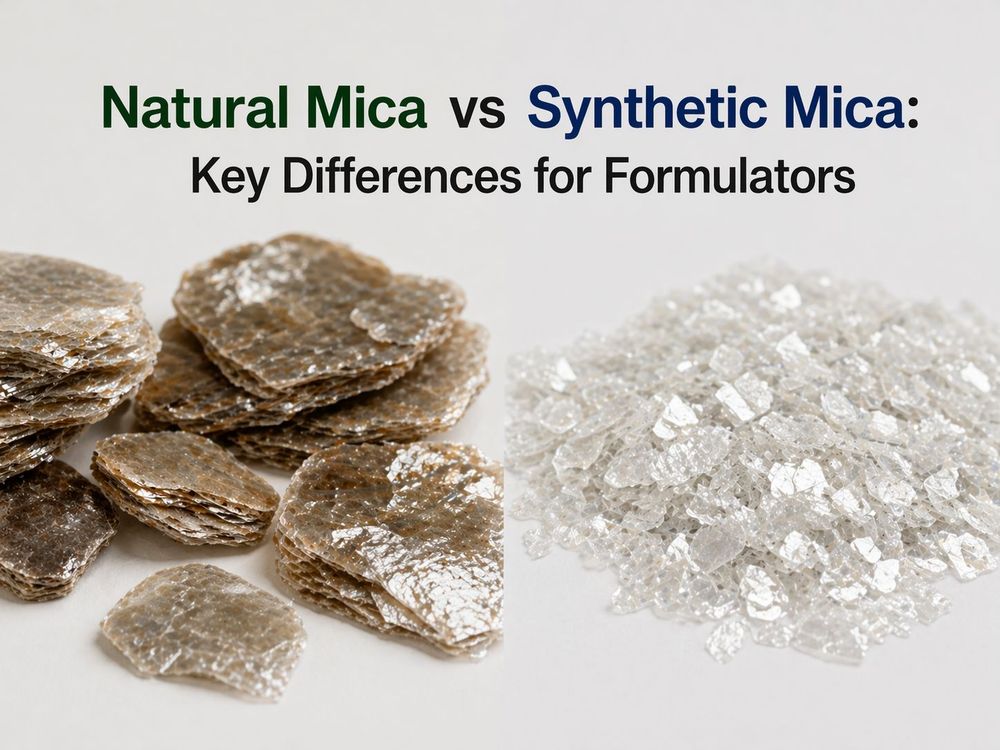
One structural consequence worth paying attention to: synthetic fluorphlogopite platelets tend to be smoother, more uniform in thickness, and more transparent than natural mica. That translates directly into better TiO₂ coating uniformity when producing a mica-based pearlescent pigment, and it's why synthetic mica interference pigments typically show cleaner, higher-purity color travel.
Purity and Variability: The Practical Gap
Natural mica is a mineral. It comes with everything that implies — batch-to-batch variation in iron content, trace heavy metals, inclusion of chlorite or feldspar contaminants, and variable aspect ratios depending on the deposit and processing facility. High-quality cosmetic-grade natural mica is rigorously processed and tested, but "high quality" is doing a lot of work in that sentence. The baseline iron content in muscovite can range from under 0.5% to over 2% Fe₂O₃ depending on the source, and iron directly affects both the inherent color of the substrate and the quality of any interference coating applied to it.
Synthetic mica powder, produced under controlled conditions, sidesteps most of this. Iron content is typically below 0.03%. The platelet morphology is highly consistent. This isn't a marginal difference — when you're building a silver-white or fine interference pigment where the base substrate needs to be essentially colorless, that level of purity matters significantly.
That said, "consistent" doesn't mean "identical across suppliers." Synthetic mica from different manufacturers can still vary in mean platelet diameter, thickness distribution, and surface defect density. Don't assume synthetic grade equals plug-and-play interchangeability.
Optical Performance: Where the Differences Show Up on Skin and Substrate
For pearlescent pigment applications — whether cosmetic or coating — the substrate's refractive index and surface smoothness govern how well you can deposit and control the optical coating layer. Natural mica has a refractive index around 1.56–1.60 (muscovite). Synthetic fluorphlogopite sits closer to 1.52–1.55. Lower RI means higher contrast with TiO₂ (RI ~2.5–2.7), which actually improves interference color saturation. This is one reason synthetic mica-based pearlescent pigments often show more vivid, higher-chroma interference effects.
In practice, you'll see this when comparing a fine interference red built on natural mica versus the same construction on synthetic mica powder. The synthetic-base version typically delivers sharper color purity, better specular reflectance in the peak interference angle, and a cleaner transition in color travel effects — which matters considerably for duochrome or flip pigment applications.
For straightforward silver-white pearlescents, the optical gap is smaller, though synthetic mica bases still tend to read as brighter with less background yellow — that residual warmth you sometimes get with muscovite from higher-iron sources.
In loose powders and pressed compacts, the optics shift slightly. Here, platelet orientation and packing density in the final formula matter as much as the substrate itself. Natural sericite's irregular surface creates more diffuse reflection — that's actually a feature, not a bug, when you want soft-focus or skin-blurring effects. Synthetic mica's smoother platelet surface gives you sharper specular response, which reads as higher gloss but less forgiveness on uneven skin texture.
Skin Feel and Sensory Performance
Sericite mica has built its reputation for a reason. The small platelet size, the slight surface roughness, and the natural lamellar structure combine to produce a skin feel that is nearly impossible to replicate synthetically. It's silky without being slippery, has good adhesion to skin, and reduces oil absorption efficiently without creating a tight or chalky after-feel.
Synthetic mica powder in fine grades can approach this, but the fluorine substitution and smoother surface often translate to a slightly different tactile experience — some formulators describe it as more "gliding" or "waxy" compared to sericite. Neither is objectively better; they're different sensory targets. A velvet-matte powder foundation may genuinely prefer sericite. A high-gloss illuminating serum might benefit from the slip of synthetic fluorphlogopite.
One area where synthetic mica has a clear advantage: surface treatment response. Because the platelet surface is more uniform and chemically consistent, surface treatments — dimethicone, triethoxycaprylylsilane, lauroyl lysine, and others — adhere more predictably and uniformly. For treated pigment applications where hydrophobicity, sebum resistance, or long-wear performance is a design requirement, synthetic mica often gives you more reliable results.
Thermal Stability: Why It Matters Beyond Cosmetics
Natural muscovite dehydroxylates (loses its structural OH groups) at around 700–900°C, which causes structural breakdown and color shift in the platelet. Synthetic fluorphlogopite, without those hydroxyl groups, is stable to above 1000°C. For cosmetic applications, this is rarely a limiting factor. But for high-temperature coatings, engineering plastics processed above 300°C, or powder coatings with oven cure cycles, the thermal stability gap becomes operationally significant.
If you're formulating a mica pigment for an automotive basecoat or a high-temperature industrial application, thermal stability is not a checkbox item — it's a pass/fail criterion. Synthetic mica is the right choice here without much debate.
Regulatory and Sourcing Considerations
The child labor issues in Indian mica mining have been well-documented, and major beauty brands have responded — some by switching to synthetic mica outright, others by requiring Responsible Mica Initiative (RMI) certification from their suppliers. If you're selling into retailers with public sustainability commitments, the origin of your natural mica is a legitimate procurement concern, not just an ethical one.
Synthetic mica sidesteps the sourcing provenance question entirely. It's produced industrially, traceability is straightforward, and it's compliant with EU Cosmetics Regulation, FDA requirements, and REACH without specific geographic sourcing caveats.
INCI labeling: natural mica is listed as Mica (CI 77019). Synthetic fluorphlogopite is listed as Synthetic Fluorphlogopite — they are different INCI entries, which matters if your claim is "natural" or "mineral-derived." Worth checking your specific label claims against your regulatory market before making a substrate switch.
Side-by-Side Comparison
The table below summarizes the key formulation-relevant parameters. These are practical generalizations — specific grades and treatments will shift individual parameters.
| Parameter |
Natural Mica (Muscovite / Sericite) |
Synthetic Mica (Fluorphlogopite) |
| Chemical formula |
KAl₂(AlSi₃)O₁₀(OH)₂ |
KMg₃(AlSi₃O₁₀)F₂ |
| Refractive index |
~1.56–1.60 |
~1.52–1.55 |
| Iron content (typical) |
0.5–2.0% Fe₂O₃ |
<0.03% Fe₂O₃ |
| Platelet uniformity |
Moderate — batch variation present |
High — controlled crystallization |
| Surface smoothness |
Rough, irregular edges |
Smooth, flat surface |
| Thermal stability |
Degrades ~700–900°C |
Stable above 1000°C |
| Interference color quality |
Good |
Higher chroma, purer hue |
| Skin feel (fine grades) |
Silky, soft-focus, diffuse |
Gliding, slightly more specular |
| Surface treatment response |
Good, variable with source |
More uniform, predictable |
| INCI name |
Mica (CI 77019) |
Synthetic Fluorphlogopite |
| Sourcing / ethics |
Requires supply chain audit / RMI cert |
Fully traceable, no mining concerns |
| Cost |
Lower baseline cost |
Higher — offset by performance in critical applications |
Pearlescent Pigment Construction: Where the Substrate Choice Compounds
When you're working with mica-based pearlescent pigments rather than raw mica powder, the substrate differences don't disappear — they get amplified through the coating process. A cleaner, smoother platelet gives the TiO₂ or iron oxide coating more uniform nucleation sites, which means more consistent optical thickness across the platelet surface, which means sharper interference colors and less haze in the final pigment.
This is why in Kolortek's cosmetic pearlescent lineup, the 699000 series — built on synthetic mica as the base material — is specifically positioned for applications where high color purity and vividness are the primary design targets. The 68800 series on natural mica remains the workhorse for a wide range of cosmetic applications where the combination of cost, skin feel, and proven performance matters more than maximum chroma.
For duochrome or color travel effects — where you're stacking light-absorbing layers over the TiO₂ interference coating — the synthetic substrate advantage compounds further. The 706000 series (synthetic mica + TiO₂ + tin dioxide) delivers noticeably more defined flip behavior compared to equivalent constructions on natural mica, particularly in the blue-to-green and red-to-gold ranges.
Which Substrate for Which Application: A Working Framework
Rather than declaring a winner, here's how to think through the choice:
Reach for natural sericite mica when: skin feel is the primary differentiator, you're in a cost-sensitive mass-market formulation, your brand platform uses "natural" or "mineral" positioning, or you need the proven soft-focus diffusion of a fine-platelet substrate in face powder or foundation.
Reach for synthetic mica powder when: optical purity is critical (premium interference pigments, vivid color play), thermal processing exceeds 300°C, surface treatment uniformity is a performance requirement, you need clean INCI labeling without sourcing provenance questions, or your regulatory market has explicit requirements around trace metal levels.
The "blended" answer — using a synthetic mica base for your key effect pigments while staying on natural sericite for filler/skin-feel components — is actually quite common in premium cosmetic formulations. It lets you get the optical pop from the pigment while keeping the tactile signature of sericite in the powder matrix.
A Note on Surface-Treated Grades
Whether you're working with natural or synthetic mica, surface treatment is where a lot of formulation performance is actually won or lost. Dimethicone-treated sericite, triethoxycaprylylsilane-treated grades, and lauroyl lysine-treated variants all change the oil absorption, water repellency, skin adhesion, and dispersibility in ways that can dwarf the underlying substrate difference.
In a silicone-heavy long-wear foundation, a dimethicone-treated sericite will likely outperform untreated synthetic mica on skin adhesion. In a water-based formulation where you need good dispersibility without agglomeration, a hydrophilic-treated synthetic mica may process more cleanly. The treatment layer and the base substrate need to be selected in tandem, not independently.
FAQ: Natural Mica vs Synthetic Mica
What is the main difference between natural mica and synthetic mica?
Natural mica (muscovite or sericite) is mined and processed from geological deposits; synthetic mica (fluorphlogopite) is manufactured via high-temperature melt crystallization. The key differences that matter to formulators are: synthetic mica has significantly lower iron content (<0.03% vs up to 2% Fe₂O₃), higher platelet uniformity, greater thermal stability (stable above 1000°C vs ~700–900°C for natural), and produces higher-chroma interference pigments due to its lower refractive index and smoother surface.
Is synthetic mica safer than natural mica for cosmetic use?
Both are well-established in cosmetic formulations and are compliant with EU Cosmetics Regulation and FDA requirements. Synthetic mica typically has lower trace heavy metal levels due to its controlled production process. The safety profiles are comparable for end-use; the distinction more often comes down to supply chain ethics (natural mica mining carries documented labor concerns in some sourcing regions) rather than toxicological differences.
Can I substitute synthetic mica for natural mica in my existing formula?
Not always without adjustment. The INCI name is different (Mica CI 77019 vs Synthetic Fluorphlogopite), so label changes are required. Tactile and sensory properties may differ — synthetic fluorphlogopite tends to feel more gliding, natural sericite tends to feel softer and more diffuse. Optical behavior in pearlescent pigments also changes. Test in-formula rather than assuming a drop-in swap.
Why do synthetic mica pearlescent pigments show more vivid colors?
The lower refractive index of synthetic fluorphlogopite (~1.52–1.55) compared to muscovite (~1.56–1.60) increases the optical contrast with the TiO₂ coating (RI ~2.5–2.7), which intensifies interference color saturation. Additionally, the smoother, more uniform platelet surface of synthetic mica enables more consistent coating thickness, reducing haze and producing sharper, purer interference hues.
What is sericite mica and how is it different from regular natural mica?
Sericite is a fine-grained variety of muscovite mica with a typical D50 in the 5–15 µm range. It's preferred in cosmetics — particularly face powders, foundations, and blush — for its exceptionally silky skin feel, soft-focus optical properties, and good adhesion to skin. Coarser natural mica grades are more commonly used in industrial pearlescent pigments and coatings applications where skin feel is not a design criterion.
Is synthetic mica more expensive than natural mica?
Yes, generally. The controlled manufacturing process for synthetic fluorphlogopite is more resource-intensive than mined and processed natural mica, and this is reflected in raw material cost. In applications where the performance advantages of synthetic mica translate directly into a better product — higher optical purity, thermal stability, or supply chain traceability — the cost premium is usually justified. For commodity-level filler applications, natural mica typically remains the cost-effective choice.
If you're working through a substrate selection decision — whether for a mica-based pearlescent pigment construction, a cosmetic filler system, or a treated powder application — Kolortek's technical team can walk through specific grades across both natural and synthetic mica platforms. Samples of raw mica powders and finished effect pigments are available on request.
Reach out directly: contact@kolortek.com

 English
 Français
 Deutsch
 Русский
 Español
 Português