Edible glitter for cakes delivers a pearlescent, shimmery finish that standard food colorings simply cannot replicate — making it a go-to choice for confectionery decorators working across everything from tiered wedding cakes to artisan chocolates. Whether applied as a dry-dusted luster dust or blended into a liquid medium for brush-on application, the technique and product type you choose directly affect the final visual output. This article breaks down the practical application methods, product selection criteria, and real trade-offs between different edible glitter formats.
What Edible Glitter Actually Is (And What It Isn't)
Edible glitter is a mica-based pearlescent powder formulated specifically for food contact applications. The base material — typically synthetic fluorphlogopite or natural mica — is coated with approved colorants and oxides to produce interference-based shimmer effects. The result is a powder that scatters and reflects light differently than dyes or pigment pastes.
It's not the same as non-toxic craft glitter. That distinction matters significantly from a compliance standpoint. Decorative-only glitters often contain polyethylene terephthalate (PET) particles — fine for centerpieces, unsuitable for anything ingested. Edible-grade products must meet food safety standards and carry certifications such as Kosher, and comply with relevant regional frameworks.
Worth noting: some products marketed as "non-toxic" or "food safe" still aren't approved for consumption. Always verify certification documentation before specifying any edible shimmer product for a formulation or production run.
Particle Size and Visual Output — The Trade-Off You Need to Understand
The shimmer intensity of edible glitter is directly tied to particle size. Finer grades (under 15µm) produce a smooth, satin-like sheen — elegant, subtle, almost metallic in finish. Coarser grades (40–200µm and above) produce visible sparkle — distinct light-catch points across the cake surface.
Neither is universally better. The decision depends on application context:
| Particle Range |
Visual Character |
Best For |
| <15µm (Fine Satin) |
Smooth, soft sheen, minimal sparkle |
Fondant, buttercream, smooth glazes |
| 10–60µm |
Balanced shimmer, good coverage |
Dusting on set surfaces, general cake decoration |
| 40–200µm |
Visible sparkle, higher light scatter |
Cake pops, cookies, textured surfaces |
| 50–500µm (Sparkle Pearl) |
Bold, chunky glitter effect |
Statement accents, direct surface application |
For R&D work: when you need fine satin coverage across a large surface (say, a fully coated mirror glaze), finer grades disperse more uniformly and reduce the risk of visible texture or uneven particle distribution. Coarser grades tend to settle and cluster on curved or textured substrates — which can be exactly what you want for accent work, but problematic for all-over coverage.
Application Methods for Edible Glitter Dust on Cakes
There are four primary methods used in practice. Each has distinct mechanical behavior and suits different substrates.
1. Dry Dusting
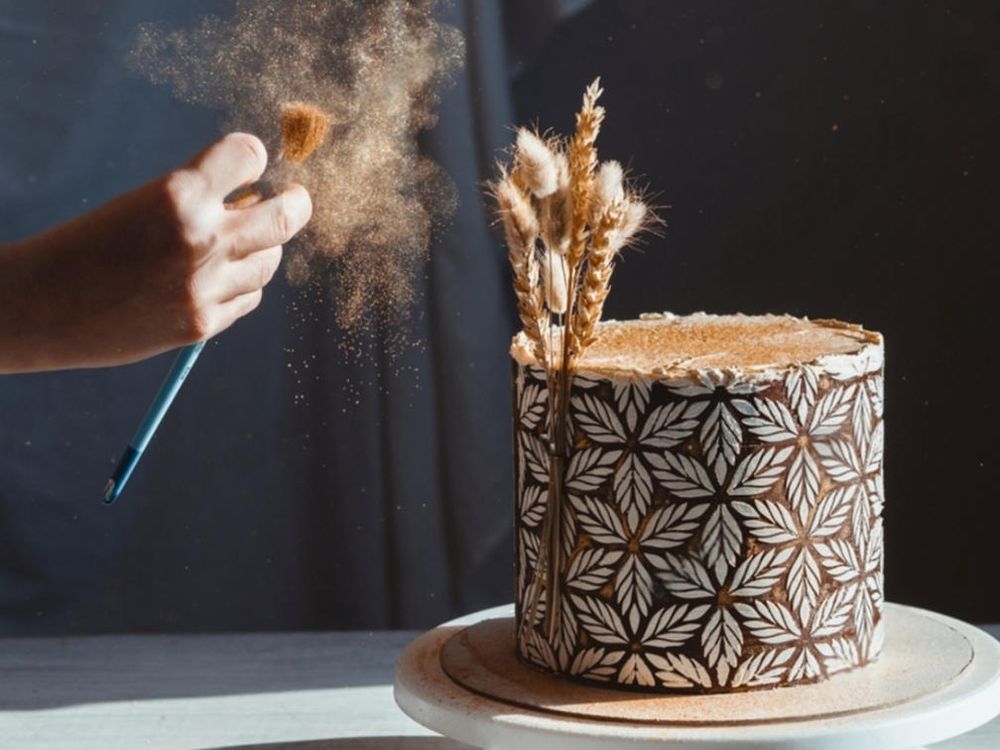
The most direct approach. Apply edible glitter dust using a soft brush (fluffy powder brush or fan brush) directly onto a set surface — fondant, dried royal icing, set ganache, or chilled buttercream. Dry dusting works because the powder adheres through electrostatic attraction and surface texture. On very smooth surfaces, adhesion can be inconsistent. A light pre-mist of clear alcohol helps anchor the particles without dissolving the substrate.
2. Alcohol Activation (Paint Method)
Mix the luster dust with a small volume of food-grade high-proof alcohol (ethanol, isopropanol, or vodka) to form a fluid paint. This enables precise brushwork — fine detail, lettering, accent strokes. The alcohol evaporates quickly, leaving behind the metallic or pearlescent pigment layer. The ratio matters: too much liquid and the suspension becomes too thin for good coverage; too little and it clumps. A starting point of 1:3 to 1:5 (powder to alcohol by volume) is typical, adjusted based on particle size and desired opacity.
3. Mixed Into Gel or Glaze
Edible glitter blends compatibly with gel colorings, mirror glazes, and edible lacquers. This approach gives a uniform all-over effect — particularly effective for mirror glaze cakes where the shimmer needs to be embedded in the coating itself rather than applied on top. Key consideration: particle size matters here more than in dry application. Finer grades integrate more smoothly; coarse grades can settle in the glaze before it sets.
4. Spray Application
Suspending edible glitter in an appropriate carrier and using an airbrush or pump spray gives broad, even coverage — ideal for large surface areas. Particle size ceiling matters here: coarser grades will clog standard airbrush nozzles. For spray application, grades under 60µm are generally workable. The suspension vehicle needs sufficient viscosity to keep particles in dispersion during application, without being thick enough to clog or produce uneven droplets.
Selecting the Right Color and Format
Gold and silver are the dominant colors in professional cake decoration — they read as luxury finishes across all styles. That said, the category has expanded significantly. Rose gold, violet, blue, green, and deep red edible glitters are now standard specification requests, particularly for themed and seasonal work.
A practical split worth knowing: standard edible glitters use titanium dioxide as an opacity base, which produces brighter, more opaque shimmer. Titanium dioxide-free formulations — increasingly requested in markets where TiO₂ in food applications is under regulatory scrutiny (notably the EU, where TiO₂ as a food additive has been banned since 2022) — produce a more translucent shimmer with slightly different interference characteristics. Neither is inherently superior; the right choice depends on target market, regulatory requirements, and the visual effect required.
For procurement: always specify TiO₂ status, particle range, and certifications required (Kosher, Halal, organic compliance if relevant) upfront. This prevents reformulation downstream and keeps regulatory documentation clean.
Substrate Compatibility and Common Failure Points
Edible glitter doesn't behave identically across all cake surfaces. Understanding the interaction between the powder and the substrate prevents the most common application failures.
Buttercream: Chilled, firm buttercream accepts dry dusting well. Warm or soft buttercream will cause the powder to partially absorb into the surface, dulling the effect and reducing shimmer. Apply after the cake has been refrigerated and given a few minutes at room temperature to lose condensation.
Fondant: Ideal substrate for dry dusting. Set fondant has enough surface texture to grip particles and enough rigidity to avoid smearing during application. Heavily kneaded or still-warm fondant can drag and streak when brushed.
Ganache and chocolate coatings: Work well when the surface is fully set. On tempered chocolate, the low-energy surface can limit adhesion; a light moisture contact (from brief refrigeration causing condensation) or a thin alcohol base coat helps. In liquid ganache or glaze, integrate finer-grade edible glitter dust directly before pouring.
Royal icing: Fully dried royal icing is one of the better surfaces — hard, stable, and accepts both dry and alcohol-paint methods reliably.
In practice, the most common failure is applying edible glitter to a surface that's too wet, too warm, or too smooth without preparation. The powder either absorbs into the surface, fails to adhere evenly, or smears during brush application. Substrate preparation is as important as product selection.
Storage and Batch Stability
Mica-based edible glitters are inherently stable — the base material doesn't degrade, oxidize, or change color under normal storage conditions. That said, moisture is the primary risk. Clumping and caking occur when powder absorbs ambient humidity, which compromises flowability and makes even application difficult.
Store in sealed, airtight containers in a cool, dry environment. Avoid repeated opening in humid conditions — if you're working in a warm kitchen, decant working quantities into a small secondary container and keep the bulk stock sealed. Batch-to-batch color consistency is generally high with well-manufactured mica-based products, but verify COA documentation when color matching is critical across production runs.
FAQ
Can edible glitter be mixed directly into cake batter or dough?
Technically yes, but the visual payoff is minimal. Heat-stable mica-based pigments survive baking temperatures, but the shimmer effect relies on light reflection from oriented flakes at or near a surface. Buried in batter, the particles are surrounded by opaque matrix material and the effect is lost. Application to the finished surface is always more effective.
What's the difference between luster dust and edible glitter?
Luster dust is typically a finer-grade pearlescent powder (often under 60µm), producing a smooth metallic or satin finish. Edible glitter generally refers to coarser-grade products that create visible sparkle and distinct light-catch points. Both are mica-based and food-grade; the distinction is primarily particle size and the visual character that results. Some manufacturers use the terms interchangeably, so always check particle specification rather than relying on labeling alone.
Is titanium dioxide-free edible glitter visually different?
Yes, noticeably. Standard formulations with TiO₂ produce brighter, more opaque shimmer with higher covering power. TiO₂-free grades tend toward a more translucent, interference-based effect — the color shifts slightly with viewing angle, and the overall brightness is lower on dark substrates. For decorators working in EU markets or responding to clean-label briefs, TiO₂-free is increasingly the default. Visually, it's a trade-off: regulatory compliance in exchange for some brightness reduction.
How much edible glitter is needed to cover a standard cake tier?
Consumption rates vary considerably by application method and coverage goal. For dry dusting with a brush, a light sheen effect on a 6-inch round tier typically requires 1–3 grams. Full, dense coverage or alcohol-paint application will consume more — 5–10 grams per tier is a reasonable planning estimate for heavy coverage. For formulators incorporating edible glitter into mirror glazes, typical inclusion rates are 0.5–2% by weight of the glaze, adjusted to the desired shimmer intensity.
If you're sourcing edible glitter for commercial production or developing a new confectionery product line and need samples, technical data sheets, or formulation guidance, reach out directly: contact@kolortek.com

 English
 Français
 Deutsch
 Русский
 Español
 Português