
Leave A Message
If you are interested in our products and want to know more details,please leave a message here,we will reply you as soon as we can.
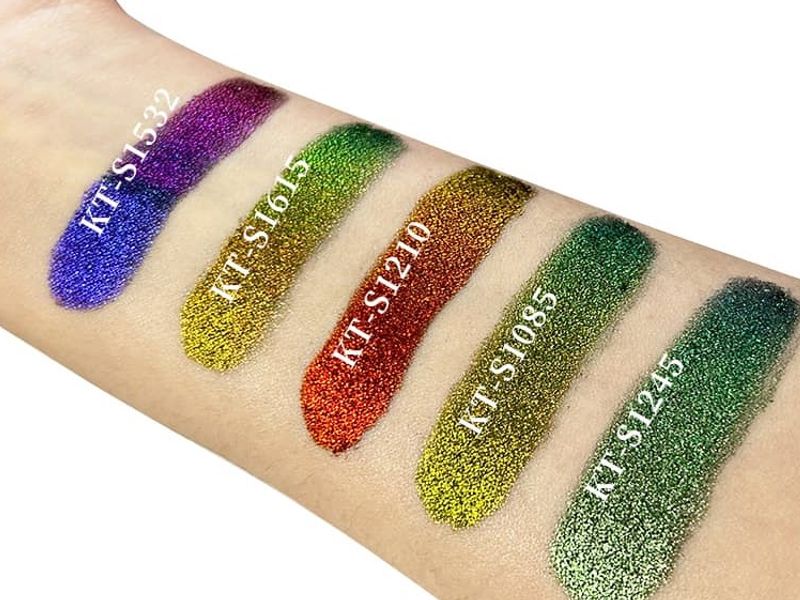
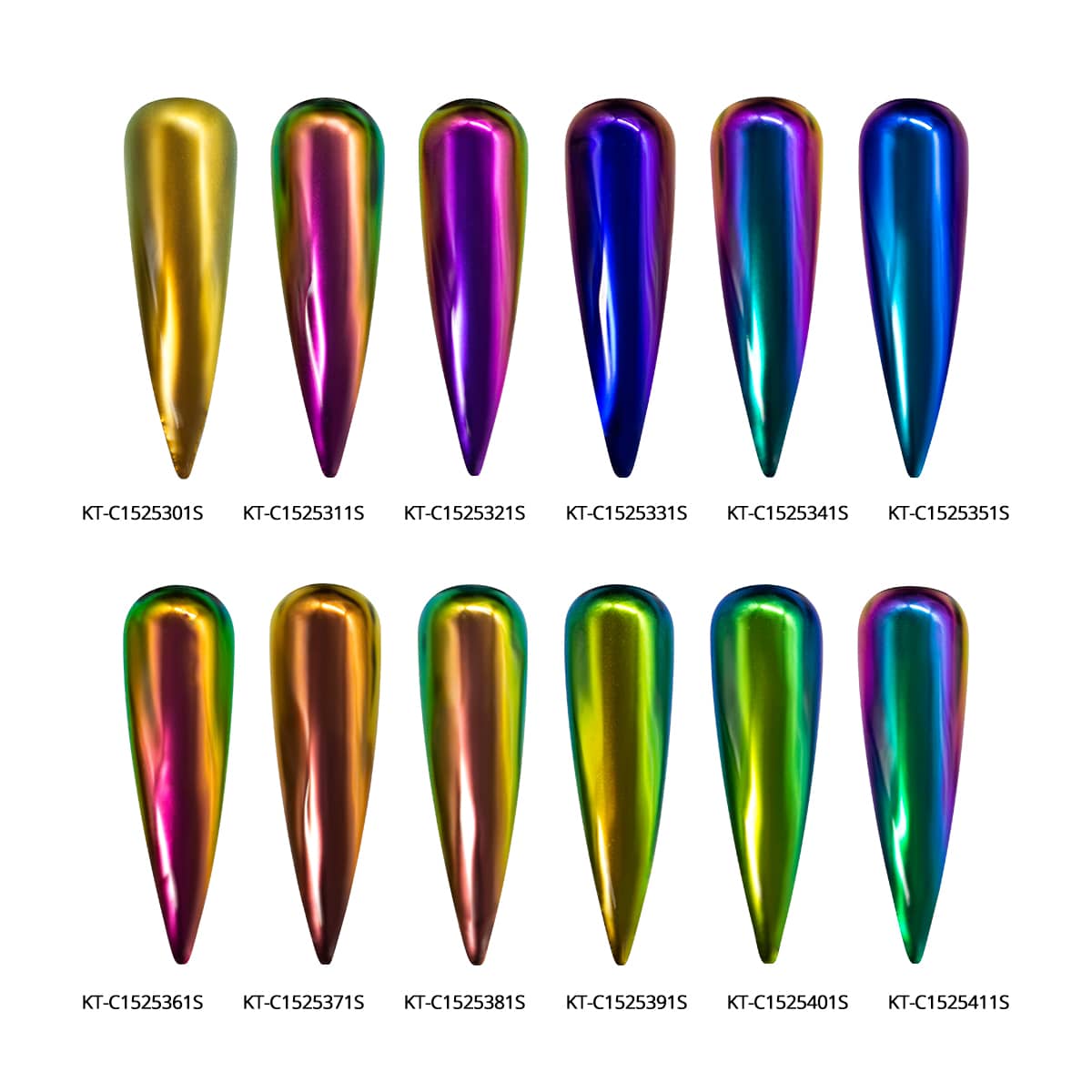
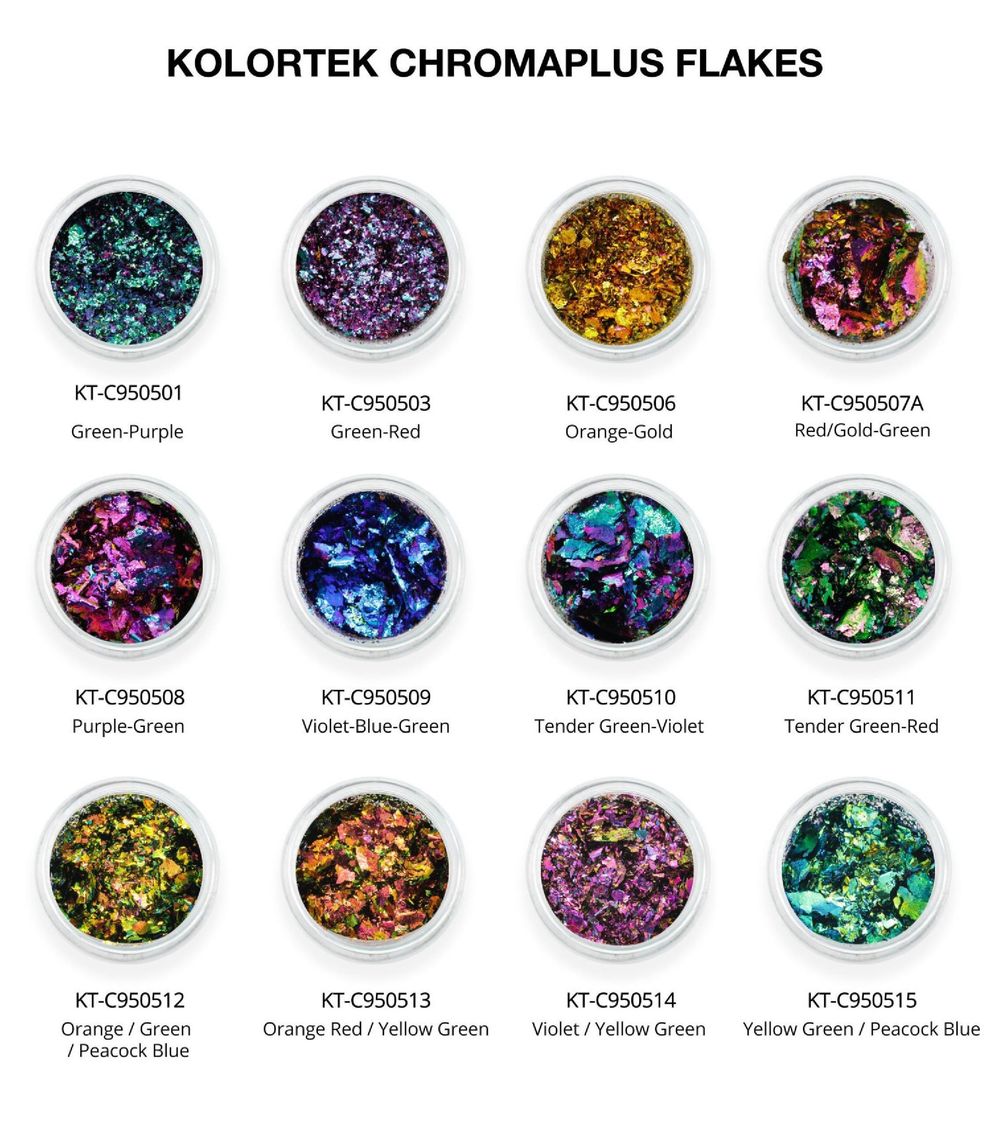
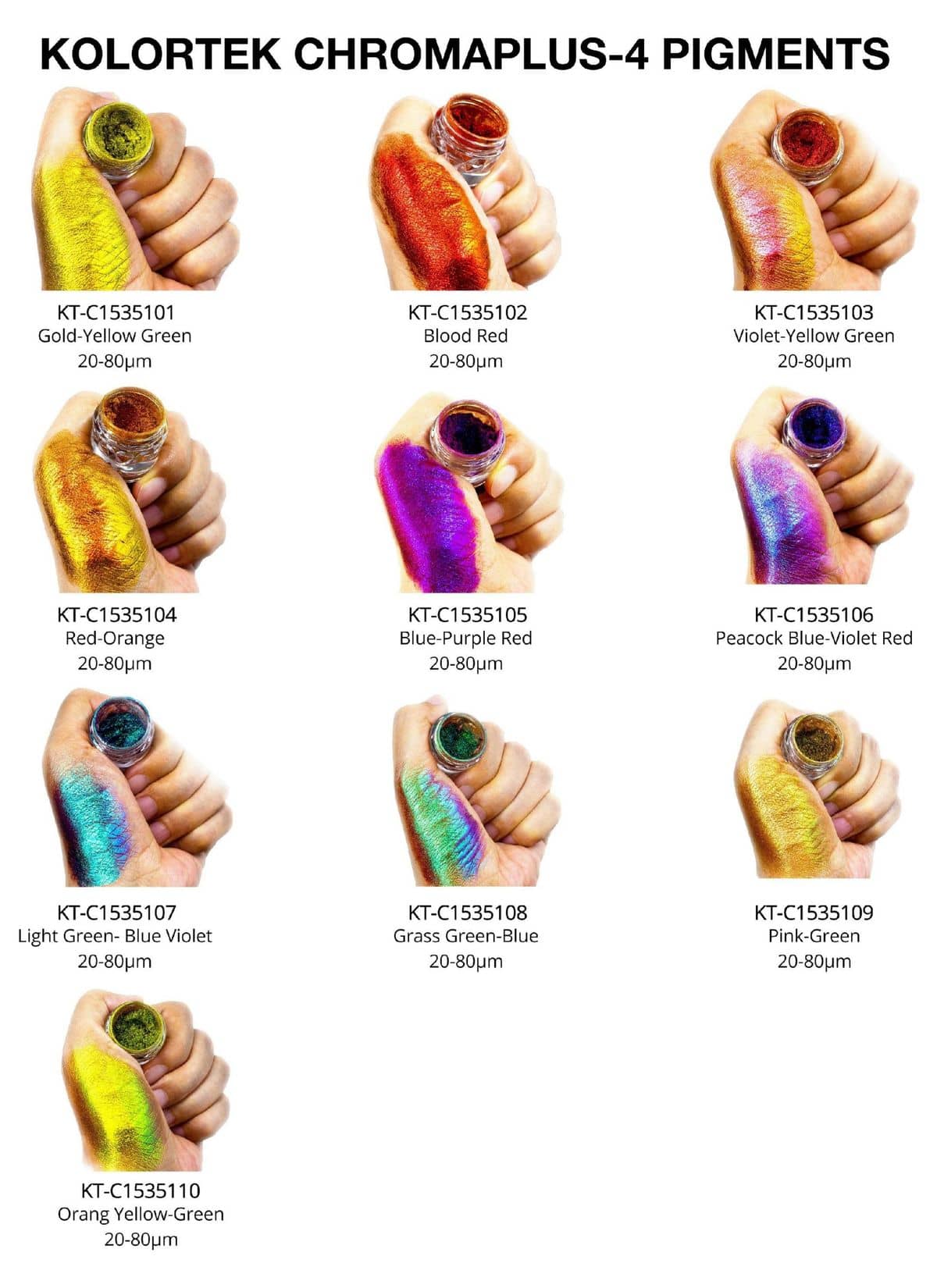
Chromashift pigment is a high-performance colour shifting pigment that produces a vivid, fluid color transition across the visible spectrum when the viewing angle changes — delivering effects far beyond what conventional interference or metallic pigments can achieve. The chromashift pigment lineup spans duochrome to multicolor shift options, with particle sizes suited to everything from fine gravure inks to large-flake decorative coatings. Formulators working in automotive coatings, security printing, and cosmetic finishes will find consistent, angle-dependent color travel across all standard substrates.
Item No. :
Chromashift SeriesColor Effect :
multiple color shiftingBrand :
Kolortek / OEMMOQ :
1KGApplication :
Automotive Coatings, Security Printing, Luxury Packaging, Cosmetics, Plastics, Leather, etc.The defining characteristic here is the color flowing effect — not just a hue shift between two discrete colors, but a dynamic, continuous transition that moves through the color space as the angle changes. On a dark base (black being optimal), this effect becomes particularly pronounced, with colors appearing to travel across the surface rather than simply switch.
This behavior is driven by thin-film optical interference. The flake substrate is coated with precisely controlled layers of titanium dioxide — and in some series, tin dioxide — creating phase interference that selects different reflected wavelengths at different angles. The result is genuinely angle-dependent, not a shift caused by flop alone.
Worth noting: the effect is significantly substrate-dependent. On light or white bases, the shift contrast drops noticeably. For maximum visual travel, dark backgrounds are strongly recommended, and pigment loading should be adjusted accordingly if you're working on lighter substrates.
The Chromashift range is organized into multiple series based on color pairs, particle size, and end-use requirements. Here is a working summary:
| Series | Particle Size | Typical Color Pairs | Notes |
|---|---|---|---|
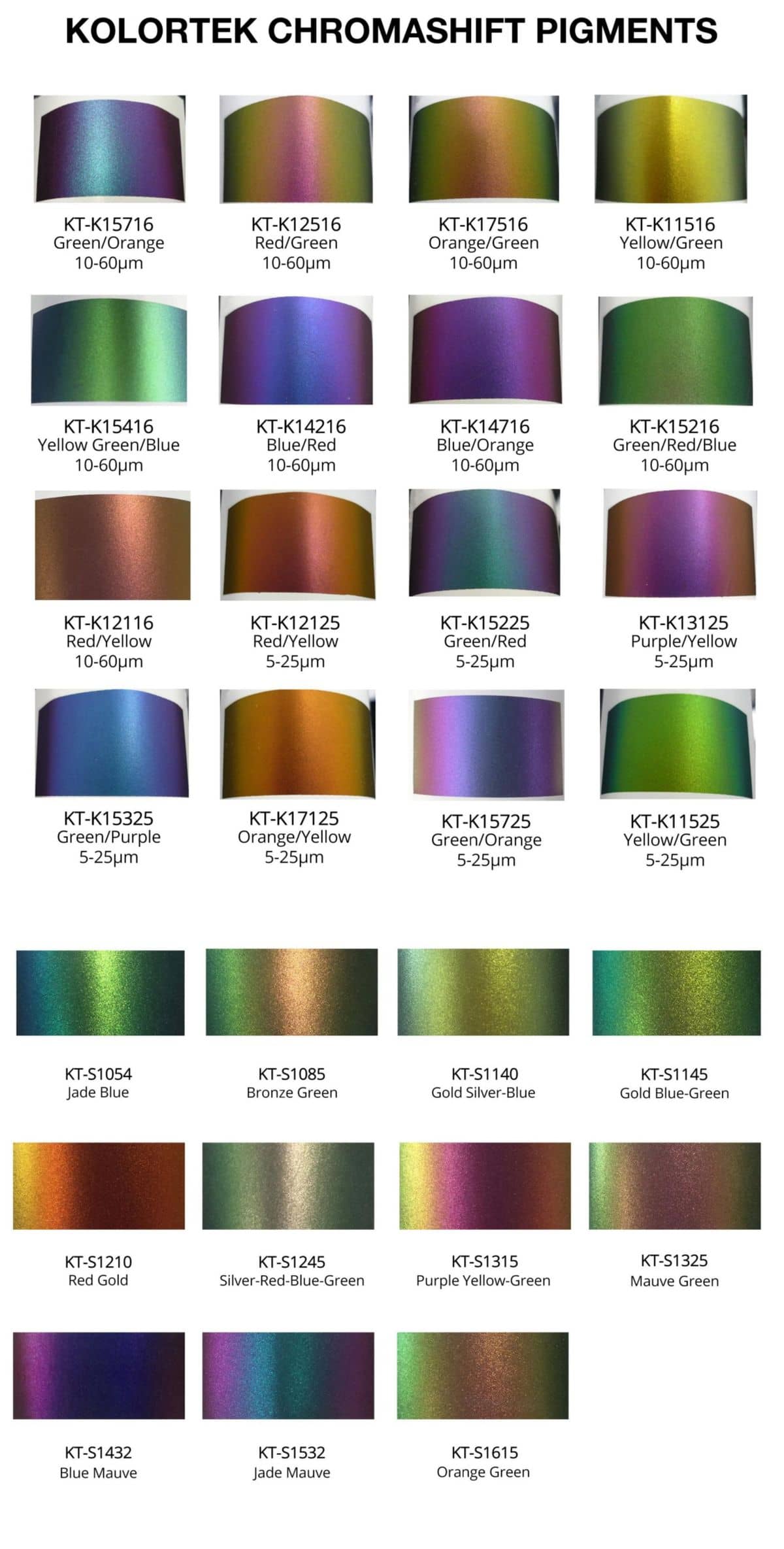
| K1**** (e.g., KT-K15716) | 10–60μm | Green/Orange, Red/Green, Blue/Red, Green/Red/Blue | Standard industrial grade; broad application range |
| K1****25 (e.g., KT-K12125) | 5–25μm | Red/Yellow, Purple/Yellow, Green/Purple, Orange/Yellow | Fine grade; suitable for gravure inks, security printing |
| S1*** (e.g., KT-S1325) | 15–25μm | Mauve green, Purple yellow-green, Bronze green, Jade blue | Refined, muted color travel; suitable for cosmetics and coatings |
| ChromaPlus C150*** / C1525*** | 5–75μm (varies) | Green-Blue-Violet, Pink-Green, Yellow-tender green | Cosmetic grade; face, eyes, lips, nail polish |
| ChromaPlus-4 C1535*** | 20–80μm | Gold-Yellow Green | TiO₂-free; for formulations requiring clean ingredient declarations |
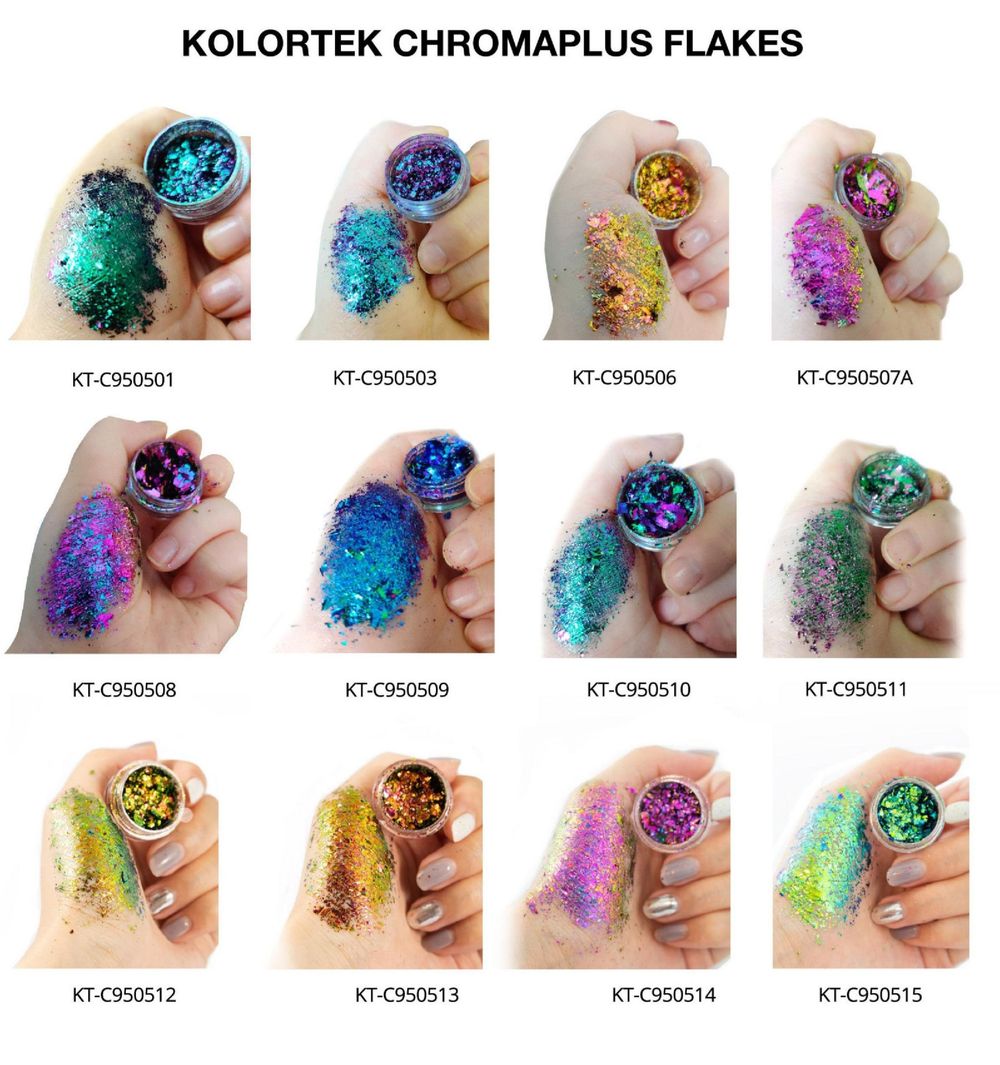
| ChromaFlakes F95** / S9*** | Irregular large flakes | Red Yellow, Blue Red, Purple Green, Mauve green, Jade Blue | Large flake format; nail art, decorative coatings |
| Devil's Kiss DK** / DKC1** | 10–40μm | Red-Black-Purple-Green, Black Red Green | Black-change chromashift; high-contrast dramatic shifts |
| Holographic Multichrome HMC6** | 20–80μm | Holo Yellow-tender green | Combines holographic diffraction with color shift; cosmetic grade |
The color shift mica powder format works across a wide range of substrates and processing environments. Below are the primary application areas along with the relevant product considerations for each.
| Application | Recommended Series | Key Consideration |
|---|---|---|
| Automotive coatings / color-changing film | K1****, S1***, XiallicSparks | Dark base required; solvent compatibility check needed |
| Gravure printing (security, packaging) | K1****25 (5–25μm fine series) | Plate depth 45–70μm; viscosity 40–60s (Zahn2#); nylon substrate |
| High-security / anti-counterfeiting | Fine Chromashift (OVP grade) | Used as OVP on banknotes and negotiable securities |
| Cosmetics (face, eyes, lips) | ChromaPlus C150***, Color up, DKC1**, Holographic Multichrome | Cosmetic-grade series; compliant with US, EU, JP regulatory requirements |
| Nail polish / nail art | ChromaFlakes, ChromaPlus, Moonlight Mirror | Large flakes for decorative effects; fine grades for smooth gel systems |
| Plastics / injection molding | K1****, S1*** | Verify thermal stability at processing temperatures |
| Synthetic leather | K1****, ChromaFlakes | Confirm compatibility with PU/PVC binder systems |
| Paints, lacquers, craft art | K1****, S1***, ChromaFlakes | Best on dark-tinted bases; loading rate adjustments for light bases |
The color flowing effect produced by these pigments originates from controlled optical interference rather than dye-based absorption. This is a practical distinction: the effect is durable, does not fade through photodegradation in the same way organic colorants do, and maintains angle-dependency throughout the product's service life.
Composition varies by series. Standard Chameleon and Chromashift series are built on high-transparency flake crystals coated with titanium dioxide. Some interference-based series additionally incorporate tin dioxide as a modulating layer. The ChromaPlus-4 (C1535***) series is formulated without titanium dioxide entirely — a relevant detail for formulators managing EU cosmetic ingredient declarations or specific application restrictions.
In practice, particle size selection directly affects both the visual quality and the processing method. Fine grades (5–25μm) are preferred for gravure printing and smooth cosmetic formulations. Coarser grades (20–80μm and above) produce more visible individual flake sparkle and are better suited for decorative coatings, nail gels, or craft applications where macro effect is the goal.
For gravure Chromashift inks specifically: pigment loading runs at approximately 20% by weight. The ink system uses synthetic resin and organic solvent carriers with special additives. Print speed range is 60–150 m/min, drying temperature 60–100°C. For anti-counterfeiting pattern designs, line width should exceed 0.15mm, spacing above 0.2mm, and intersection angles above 30° to maintain visual integrity of the shift effect.
This distinction matters in formulation. Ordinary interference pigments show a single reflected color against a dark base — the interference color — while appearing essentially colorless or white on light bases. Chromashift and chameleon pigments go further: they exhibit genuine angle-dependent color travel, shifting through two or more distinct hues as the observation or illumination angle changes.
That said, not every "color shift" product in the market behaves identically. The multicolor shift series (e.g., KT-95107 cycling through blue-green/blue/violet/red) provides broader angular color travel than a standard duochrome pair. The Devil's Kiss black-change series adds another dimension — the shift passes through or from a deep black, producing high-contrast dramatic transitions not achievable with conventional chromashift. Selecting the right series depends on the specific visual target, not just the listed color pair.
Q: What base color gives the strongest color flowing effect?
Black is the most effective base. Other deep colors — deep red, dark blue, dark green, and brown — also work well. On white or pale bases, the interference contrast is reduced, and pigment loading needs to increase to compensate. For printing applications, black ink underlayers are the standard approach.
Q: Are any Chromashift pigments suitable for direct cosmetic use on skin, eyes, and lips?
Yes. The ChromaPlus series (C150***, C1525***, C1535***), Color up series, Holographic Multichrome, Devil's Kiss DKC1** series, and several 3D Cat Eye Magnetic series are produced as cosmetic-grade products, verified for face, eye, lip, and nail use. Regulatory documentation (MSDS, TDS, COA) is available for these grades, with compliance data for US, EU, and Japanese market requirements.
Q: Which particle size range is appropriate for gravure printing in security applications?
The 5–25μm fine series (e.g., KT-K12125, KT-K15225) are the working grades for gravure printing. Coarser particles will block fine plate cells and produce uneven ink transfer. Plate etching depth should be set between 45μm and 70μm to accommodate the flake geometry and achieve consistent film build.
Q: Can Chromashift pigments be used in solvent-based coating systems?
Most standard Chromashift series (K1****, S1***) are compatible with solvent-based systems. That said, the Aurora series has specific solvent-resistance distinctions — the Candy Aurora (ARS6***) and CandyPlus Aurora lines are explicitly solvent-resistant, while some Aurora Multicolor powder series are not. Always confirm solvent compatibility with the specific series before committing to a formulation. Technical data sheets and formulation guideline support are available on request.
If you are evaluating Chromashift pigment for a specific system — whether it is an automotive base coat, a security ink formulation, a cosmetic product, or a decorative coating — the most direct path is to request targeted samples for your substrate and base color. Kolortek provides MSDS, TDS, COA, and formulation guidelines as part of standard technical support. Custom color matching and OEM/private label options are also available for qualified buyers.
Contact the technical team with your target application, substrate type, base color, and particle size preference to receive the most relevant sample set.
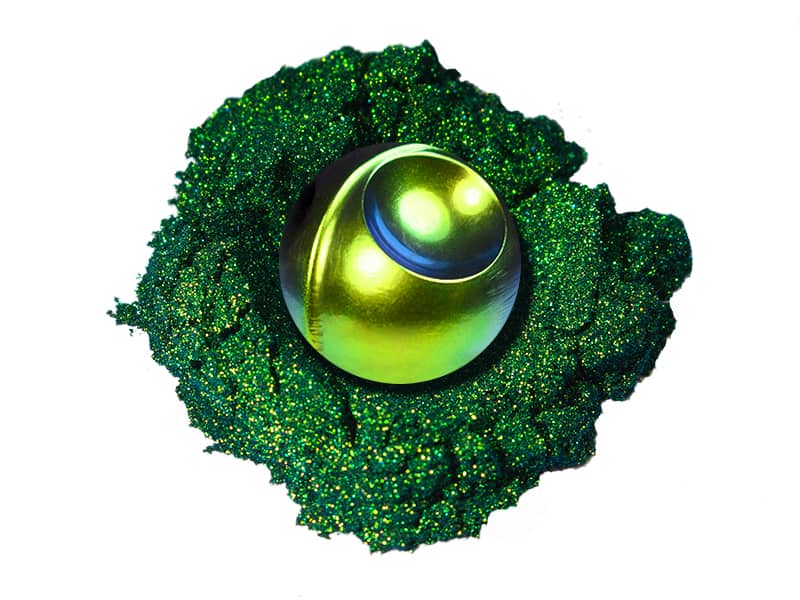
Kolortek Chromashift Optical Variable Pigments represent a sophisticated class of multi-layer interference materials. Utilizing a high-purity silica substrate combined with aluminum and iron layers, these pigments produce a sharp, definitive color shift and intense color travel. Unlike standard pearls, Chromashift offers a powerful flowing effect, providing premium visual depth for high-end industrial, automotive, and anti-counterfeiting applications.
Read More
Chromashift pigment is a high-performance colour shifting pigment that produces a vivid, fluid color transition across the visible spectrum when the viewing angle changes — delivering effects far beyond what conventional interference or metallic pigments can achieve. The chromashift pigment lineup spans duochrome to multicolor shift options, with particle sizes suited to everything from fine gravure inks to large-flake decorative coatings. Formulators working in automotive coatings, security printing, and cosmetic finishes will find consistent, angle-dependent color travel across all standard substrates.
Read More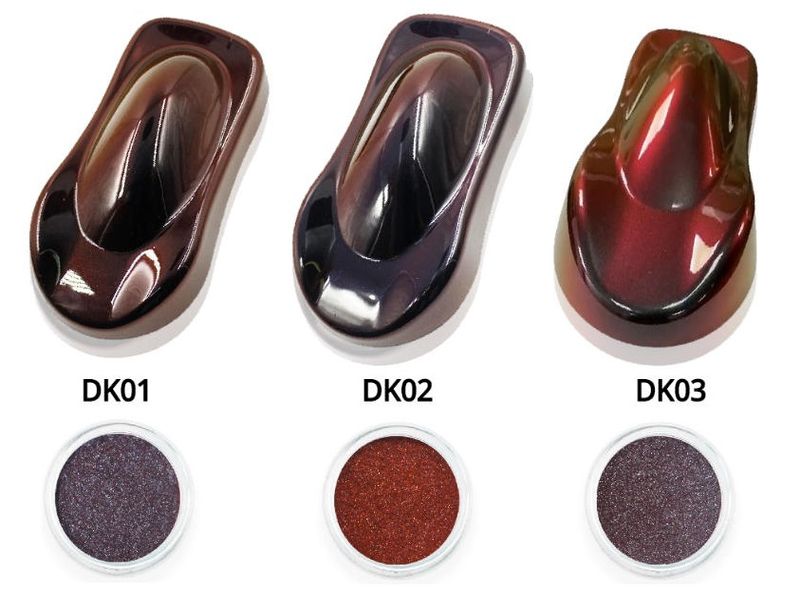
Devil Kiss pigment delivers a deep black base that flips through red, purple, green, and gold as the viewing angle changes — a true "black change" travel rarely seen in standard pearl effects. This chameleon color shift pigment works across nail polish, automotive coatings, inks, and plastics, with both industrial and cosmetic grades available. As a color shift pigment supplier, we stock multiple shift directions so formulators can match the exact flop they need.
Read More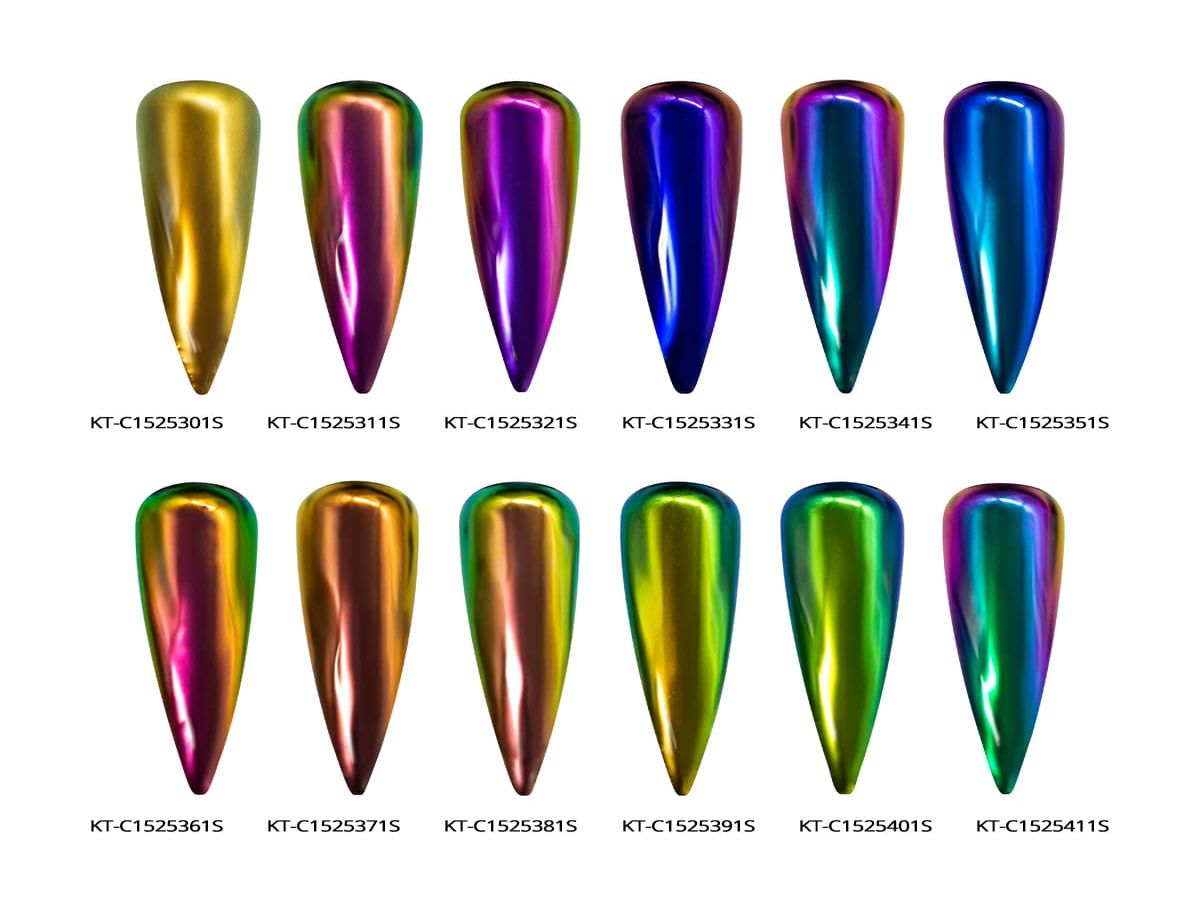
Kolortek's chameleon pigment series covers a wide range of angle-dependent color shifting powders — from interference-based pearlescents to magnetic cat eye flakes — engineered for automotive coatings, cosmetics, and high-security printing. Each grade delivers a strong color flowing effect as viewing angle shifts, with collections spanning duochrome transitions, multicolor sequences, and holographic multichrome responses. Whether you're formulating a color shift pigment into nail gel, gravure ink, or a thermoplastic masterbatch, there's a specific product line built for that substrate.
Read More
 English
 Français
 Deutsch
 Русский
 Español
 Português